What Her Cloth Said When She Could Not Speak
Across East Africa, women have been buying, wearing, and gifting printed cloths that carry messages most people cannot read. A kanga is never just a kanga. It is a letter you wear on your body.
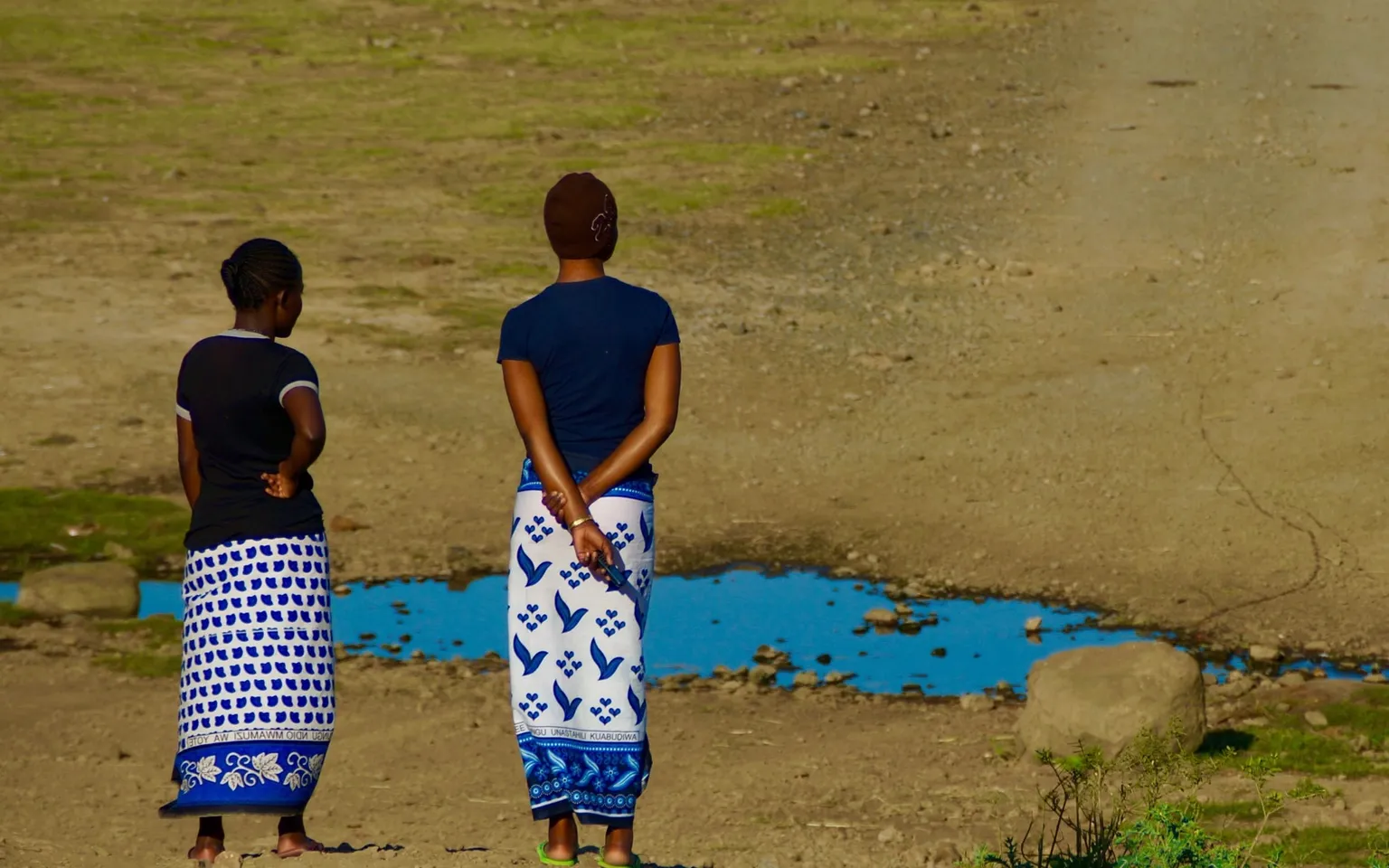
Two women wearing kangas with Swahili sayings, Moshi, Tanzania / Sophiestolle / CC BY-SA 4.0
A woman walks into a market in Dar es Salaam. She is not looking for just any cloth. She passes stall after stall, running her fingers over folded rectangles of cotton, each one a burst of colour and geometry. She is not looking at the patterns. She is reading the words.
Every kanga has a message printed along its border, a Swahili proverb or phrase called the jina. The woman finds the one she wants. She pays. She takes it home. She wraps it around her waist and walks past her neighbour's house, making sure she is seen.
The kanga she has chosen reads: Hasira ya mkizi ni kuchana mwenyewe. A catfish's anger only tears itself apart.
Her neighbour will understand exactly what that means. Everyone on the street will understand. The woman has said something devastating without opening her mouth. She has accused her neighbour of self-destructive jealousy, and she has done it in broad daylight, wrapped in beauty and plausible deniability.
This is the kanga. It is a piece of cloth. It is also one of the most sophisticated systems of female communication that has ever existed.
How it started
The kanga emerged in the mid-19th century along the Swahili coast. Women in Zanzibar and Mombasa began buying imported printed cotton, cutting it into pairs, and wrapping it around their bodies. Local traders saw the demand and started commissioning bolder designs with elaborate borders. At some point, someone — possibly the women themselves, possibly merchants who knew what would sell — added text. A Swahili proverb or phrase called the jina, printed along the cloth's border.
That changed everything. Without the words, it was fabric. With them, it was a weapon, a love letter, a warning, a prayer, and a political statement, depending on who was wearing it and why. Swahili culture already valued the art of saying things without quite saying them. The kanga gave women a way to communicate publicly while maintaining the appearance of simply getting dressed in the morning.
What women actually said
The messages on kangas cover everything. Love, anger, jealousy, grief, pride, ambition, religion, and spite. Some are gentle. Some are brutal. All of them are deliberate.
A woman giving a kanga as a wedding gift might choose one that reads: Nipe nikupe, penzi letu lidumu. Give to me and I will give to you; may our love endure. That is warm and hopeful.
A woman who suspects her husband has taken a second lover might wear one that says: Siku za mwizi ni arobaini. A thief's days are numbered forty. That is a threat wrapped in a proverb.
A mother-in-law unhappy with her son's wife might present her with a kanga reading: Ukipenda mwana, penda tabia yake. If you love a child, love their character too. That is advice that is not really advice.
And then there are the kangas that are pure defiance. Wajipendeze kwa yako, yangu yananipa raha. Enjoy what is yours, because mine gives me pleasure. A woman wearing that kanga is telling everyone who looks at her that she is satisfied with her life, and she does not care what you think of yours.
These are not slogans on novelty items. These are carefully chosen statements women used to navigate polygamous marriages, co-wife rivalries, in-law conflicts, and the constant negotiation of status in communities where women's direct speech was often constrained.
The rules of the game
If a woman wraps a kanga with the jina facing outward, she wants you to read it. Words hidden against her body mean the message is private. If she buys a pair with a pointed message and gives one to the woman she is in conflict with, she has escalated things — accepting the gift means acknowledging the message, rejecting it means open confrontation. Giving a kanga with the wrong jina at a funeral is a serious social error. Giving one with a deliberately cutting message at someone else's celebration is an act of war conducted through gift wrapping.
Girls learned to read these dynamics from childhood, watching their mothers choose kangas with the same care a diplomat would choose words in a treaty negotiation.
When cloth became political
During Tanzania's independence movement, kangas bearing the slogans of Julius Nyerere became popular. Women wore their political allegiance on their bodies. In Kenya, candidates distributed kangas during elections — wearing one was a public endorsement, refusing one was a quiet rejection. The kanga let women cast a visible vote every morning when they got dressed.
But the political kanga was never fully controlled by those in power. Women kept choosing what to wear. A woman might put on a government-issue kanga for a rally and a subversive one to the market the next day.
The kanga is the most documented example, but the practice stretches across the continent. In West Africa, choosing whose aso-ebi to wear at a contested event is a political decision disguised as fashion. In South Africa during apartheid, the green and black of the ANC Women's League became inseparable from the struggle. In Algeria, women hid weapons beneath the haik. Fabric is one of the oldest communication technologies women have ever used. And it has the advantage that no one can take it away without undressing you.
What to take away
- The kanga carries Swahili proverbs and messages on printed cloth, creating one of the most sophisticated systems of female communication in history.
- Women used kangas to navigate marriages, rivalries, politics, and protest without speaking a word out loud.
- The kanga was social media before electricity — every woman in the market was a walking editorial page, and manufacturers who printed unpopular messages went unsold.
- The tradition is alive today, with new designs and messages printed every year across East Africa.
She could not always speak. So she wore what she wanted to say. She wrapped it around her waist, walked out the door, and let the whole street read her mind. They could tell her to be quiet. They could not tell her to get undressed.
Cite this page
HerStory Africa. (2026). What Her Cloth Said When She Could Not Speak. HerStory Africa. Retrieved October 1, 2026, from https://herstoryafrica.com.ng/articles/what-her-cloth-said-when-she-could-not-speak
"What Her Cloth Said When She Could Not Speak." HerStory Africa, 2026, https://herstoryafrica.com.ng/articles/what-her-cloth-said-when-she-could-not-speak. Accessed 1 Oct 2026.
HerStory Africa. "What Her Cloth Said When She Could Not Speak." Accessed October 1, 2026. https://herstoryafrica.com.ng/articles/what-her-cloth-said-when-she-could-not-speak.