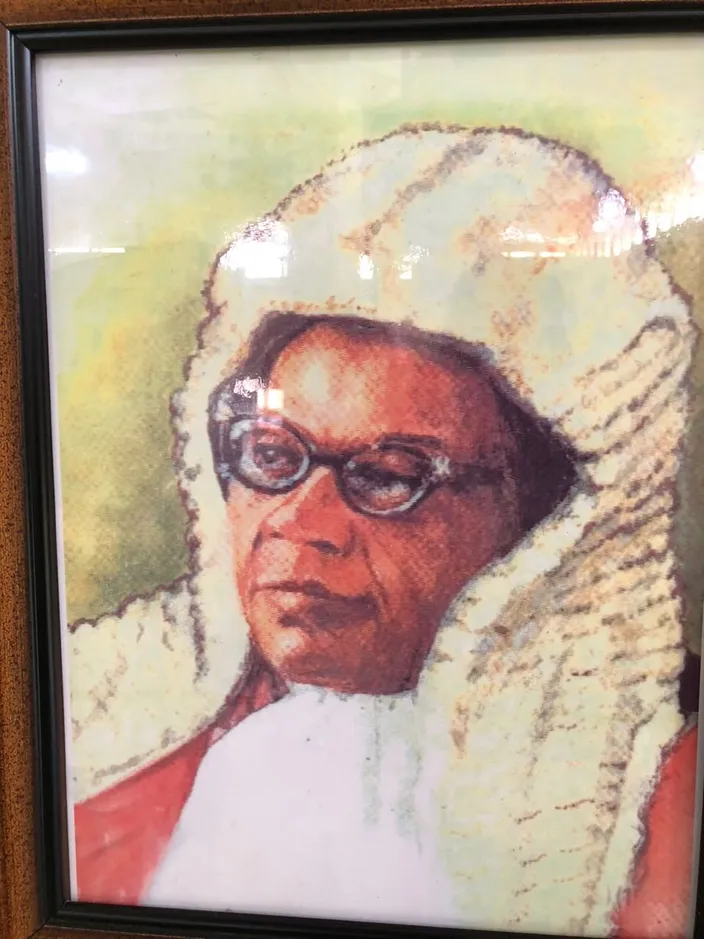
DwAseye / CC0 1.0 via Wikimedia Commons
Annie Jiagge
The 1967 UN declaration she drafted overnight became CEDAW.
Ghanaian jurist who became the first woman judge in the Commonwealth of Nations and the principal drafter of the 1967 UN declaration that grew into CEDAW, the world's bill of rights for women.
Biography
Annie Ruth Jiagge was born Annie Baëta on 7 October 1918 in Lomé, in what was then French Togoland, to an Ewe family. Her father, Robert Domingo Baëta, was a Presbyterian minister and her mother, Henrietta, a schoolteacher. She earned a teacher's certificate at Achimota College in 1937 and served as headmistress of the Evangelical Presbyterian Girls' School in Keta before making a decision that was almost unheard of for a West African woman of her generation: she left teaching to study law. She took her LLB at the London School of Economics in 1949 and was called to the Bar at Lincoln's Inn in 1950, despite male colleagues suggesting she would be better suited to dress design.
Returning to the Gold Coast, she practised privately before becoming a magistrate in 1953, the same year she married Fred Jiagge. She rose steadily through the judiciary: Circuit Court judge in 1959, then High Court judge in 1961, making her the first woman judge in Ghana and in the entire Commonwealth of Nations. She was elevated to the Court of Appeal in 1969 and served as its President from 1980 to 1983, when it was Ghana's highest court. On the world stage she represented Ghana on the UN Commission on the Status of Women from 1962 to 1972, chairing it in 1968, and was the principal drafter of the 1967 UN Declaration on the Elimination of Discrimination Against Women, the direct forerunner of the CEDAW convention adopted in 1979.
Her public service ran far beyond the bench. She was a President of the World Council of Churches (1975–1983) and moderator of its Programme to Combat Racism, a sustained ecumenical assault on apartheid. At home she was founding chair of Ghana's National Council on Women and Development in 1975, helped instigate what became Women's World Banking to put credit in the hands of market women, sat in the 1979 constituent assembly, served on the 1991 Committee of Experts that drafted Ghana's Fourth Republic constitution, and was a member of the Council of State from 1993 until her death in Accra on 12 June 1996.
Historical Context
Jiagge's life spanned the Gold Coast colonial era, Kwame Nkrumah's independence movement that made Ghana sub-Saharan Africa's first independent state in 1957, successive military coups, and the 1992 return to constitutional democracy. She helped draft the constitutions that bookended that turbulence. She built her judicial career in a profession that was almost entirely male across the Commonwealth, and carried Ghanaian women's realities, especially those of traders and farmers, into rooms in Geneva and New York where global standards were being written.
What She Fought For
Legal equality for women, nationally and globally. She believed discrimination against women was an injustice the law itself had a duty to dismantle, and she turned that conviction into binding international language. She fought for market women's access to credit, for an end to racial discrimination and apartheid through the World Council of Churches, and for constitutional governance in Ghana. Her own words capture the engine of her career: "Injustice eats me internally. I get very restless when I come in touch with it."
Major Achievements
- First woman appointed a High Court judge in Ghana and the Commonwealth of Nations (1961).
- Principal drafter of the 1967 UN Declaration on the Elimination of Discrimination Against Women, the precursor to CEDAW; chaired the UN Commission on the Status of Women in 1968.
- Awarded the Grand Medal of Ghana in 1969.
- Founding chair of Ghana's National Council on Women and Development (1975) and a driving force behind the creation of Women's World Banking.
- President of Ghana's Court of Appeal, then the nation's highest court (1980–1983).
- Member of the Committee of Experts that drafted Ghana's Fourth Republic Constitution (1991–1992).
Her Impact Today
CEDAW, ratified by more than 180 states and often called the international bill of rights for women, traces directly to the declaration Jiagge drafted in 1967. Ghana's Ministry of Women and Children established the Justice Annie Jiagge Memorial Lectures in 2009, a house at Achimota School bears her name, and Geneva has named a public way after her through the 100Elles project. Every woman who invokes CEDAW in a courtroom anywhere in the world is, knowingly or not, standing on her overnight draft.
Wikipedia (Annie Jiagge), Wikimedia Commons, UN Commission on the Status of Women records, World Council of Churches history, 100Elles project (Geneva).
Cite this page
HerStory Africa. (1996). Annie Jiagge. HerStory Africa. Retrieved October 15, 2026, from https://herstoryafrica.com.ng/women/annie-jiagge
"Annie Jiagge." HerStory Africa, 1996, https://herstoryafrica.com.ng/women/annie-jiagge. Accessed 15 Oct 2026.
HerStory Africa. "Annie Jiagge." Accessed October 15, 2026. https://herstoryafrica.com.ng/women/annie-jiagge.