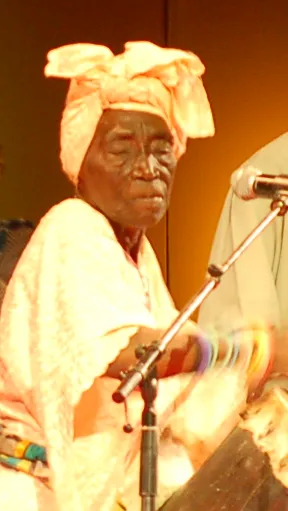
Erik (HASH) Hersman / CC BY 2.0 via Wikimedia Commons
Bi Kidude
Barefoot and unveiled, she sang taarab for a century and won WOMEX in her nineties.
Zanzibar's legendary taarab singer, who ran away from a forced marriage as a teenager, sang barefoot and unveiled when both were scandalous, kept the island's musical traditions alive across a century, and became a world music star in her nineties.
Biography
Fatuma binti Baraka was born in the village of Mfagimaringo, Zanzibar, around 1910. Nobody wrote the date down; she was the daughter of a coconut seller, and colonial Zanzibar did not keep careful records of such girls. The nickname the island gave her, Bi Kidude, means something like "little granny", and it stuck for a hundred years.
As a child she would sneak away to listen to Siti binti Saad, the first great star of taarab, the sung poetry of the Swahili coast, and the first East African woman to record commercially. The music took hold of her and never let go. In her early teens, Bi Kidude was forced into marriage. She ran. She fled the marriage and, for a time, the island itself, walking barefoot, singing where she could, travelling with taarab groups as far as Egypt in the 1930s. Barefoot became permanent. So did her refusal of the veil while performing, which scandalised respectable Zanzibar and delighted everyone else.
For decades she was a fixture of the island's music without being famous beyond it. She sang taarab in a rasping, smoke-cured voice that grew more astonishing as it aged, and she became a master of unyago, the initiation drumming tradition in which older women prepare girls for adulthood, teaching them, alongside the rhythms, frank lessons about their bodies, marriage and how to stand up for themselves. She also worked as a healer, mixing traditional remedies and henna.
Then, in her eighties, the world discovered her. Recordings and festival invitations arrived; she toured Europe, Japan and beyond with taarab ensembles and as a solo artist, a tiny barefoot woman commanding huge stages. In 2005 she received the WOMEX Award, one of world music's highest honours, and Tanzania decorated her for her contribution to the arts. The 2006 documentary As Old As My Tongue carried her story around the world. She died in Zanzibar on 17 April 2013, aged roughly one hundred and three. Her funeral filled the streets.
Historical Context
Taarab grew up in the sultan's Zanzibar as courtly entertainment, and it was Siti binti Saad who dragged it out of the palace and into Swahili, the people's language, in the 1920s. Bi Kidude was the living bridge from that founding generation across the entire twentieth century: through British colonial rule, the 1964 revolution, union with Tanganyika, and into the tourist economy of modern Zanzibar. In a conservative Muslim society where women's public performance was tightly policed, her whole existence, unveiled, barefoot, unmarried by choice for most of her life, singing pointed lyrics in public, was a negotiation conducted entirely on her own terms.
What She Fought For
She would have laughed at the word "cause". But look at the life: she refused a forced marriage when refusal was barely thinkable. She kept unyago alive, one of the few channels through which Zanzibari girls received honest education about their own bodies. She preserved and transmitted a century of taarab repertoire that would otherwise have died with its composers. And she demonstrated, every time she walked on stage, that a poor, unlettered African woman owed the world's expectations exactly nothing.
Major Achievements
- Carried the taarab tradition of Siti binti Saad's generation across an entire century, becoming its most celebrated custodian.
- Mastered and sustained the unyago initiation tradition, educating generations of Zanzibari girls.
- Became an international star in her eighties and nineties, touring worldwide as the "queen of taarab".
- Received the WOMEX Award in 2005 and Tanzania's Medal for Arts and Sports.
- Subject of the acclaimed documentary As Old As My Tongue (2006).
Her Impact Today
Zanzibar's annual Sauti za Busara festival, where she was for years the inevitable headliner, still invokes her as its presiding spirit, and taarab singers across East Africa cite her the way guitarists cite their founding legends. Beyond music, she has become a Swahili shorthand for a certain kind of freedom: the grandmother who did as she pleased for a hundred years and was loved for it. Musicians she mentored and the recordings of her final decades keep the voice itself in circulation, sand and gravel and joy.
Wikipedia (Bi Kidude), As Old As My Tongue: the Myth and Life of Bi Kidude (2006), WOMEX award records, BBC and Guardian obituaries (2013).
Cite this page
HerStory Africa. (2013). Bi Kidude. HerStory Africa. Retrieved October 1, 2026, from https://herstoryafrica.com.ng/women/bi-kidude
"Bi Kidude." HerStory Africa, 2013, https://herstoryafrica.com.ng/women/bi-kidude. Accessed 1 Oct 2026.
HerStory Africa. "Bi Kidude." Accessed October 1, 2026. https://herstoryafrica.com.ng/women/bi-kidude.