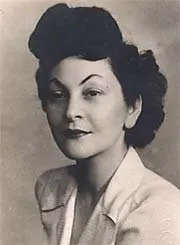
Portrait of Doria Shafik, Al-Ahram Weekly / Wikimedia Commons / Public Domain
Doria Shafik
Fifteen hundred women, four hours, and an all-male parliament brought to a halt.
The Egyptian philosopher and publisher who stormed parliament with 1,500 women and starved herself until Egypt promised women the vote, then was erased from history for defying Nasser.
Biography
On February 19, 1951, the guards at Egypt's parliament thought they were watching women arrive for a "feminist congress" nearby. Then Doria Shafik gave the signal. Fifteen hundred women broke away, pushed through the gates, and flooded into the all-male chamber. "Our meeting today is not a congress but a parliament. A true one! That of women," Shafik declared. "We are here by the force of our right." The legislature was paralyzed for more than four hours, and Egypt's rulers were forced to hear, for the first time in the building's history, women demanding the vote.
Shafik had been defying expectations since her birth in Tanta on December 14, 1908. At sixteen she became one of the first Egyptian girls to earn the French baccalaureate, then won a scholarship to the Sorbonne in Paris, where she completed a PhD in philosophy with distinction. One of her theses argued that women's equal rights had deep roots in Egypt itself. Back home in 1935 she even entered the Miss Egypt pageant, a scandal for a Muslim woman, and finished first runner-up. "In Paris I had asserted myself intellectually," she said. "Now I wanted to assert myself in the feminine sphere."
Snubbed by Cairo's aristocratic feminist circles because of her middle-class background, she built her own movement. In November 1945 she launched the magazine Bint Al-Nil, "Daughter of the Nile," and its first issue sold out at once. In 1948 it grew into the Bint Al-Nil Union, which ran literacy centers, employment services, and cafeterias for working women. "No one will deliver freedom to the woman except the woman herself," she wrote. After the parliament raid came hunger strikes, a promise of "full political rights," and, in the 1956 constitution, the prize itself: Egyptian women won the right to vote.
Then the state turned on her. In 1957 she went on hunger strike again, this time against President Gamal Abdel Nasser's dictatorship. He put her under house arrest, banned her name from the press, and shut down her publications. She spent eighteen years erased, reading and writing in isolation. On September 20, 1975, she died after falling from her sixth-floor balcony, a death ruled suicide. "I have demanded women's rights," she had written. "My fight was enlarged to human freedom. And what was the result? I have no more friends."
Historical Context
Shafik came of age in an Egypt under British occupation, where nationalism and feminism grew up together. Women had marched in the 1919 revolution, and pioneers like Huda Shaarawi had founded the Egyptian Feminist Union, but by mid-century Egyptian women still could not vote, and parliament remained entirely male. The feminist establishment was aristocratic; Shafik, a scholarship girl from Tanta, aimed her movement at teachers, clerks, and working women instead.
The early 1950s were electric and unstable. Riots against the British, the burning of Cairo, and finally the Free Officers' coup of 1952 swept away the monarchy. For a moment, everything seemed possible, and Shafik pressed the new republic to write women into its constitution, even forming a paramilitary unit of women during the 1951 anti-British unrest.
But the revolution that granted women the vote in 1956 also strangled Egyptian politics. Nasser's government dissolved parties, jailed opponents, and brought feminism under state control. A woman who had defied a king could not be tolerated when she defied the president. Shafik's fate showed the bargain of state feminism: rights granted from above could be paired with silence enforced from above.
What She Fought For
Shafik's target was simple and enormous: the total exclusion of Egyptian women from political life. Half the nation could be taxed and governed but never heard. Her genius was to make that exclusion visible through spectacle. The 1951 storming of parliament was not a riot; it was a demonstration of a parliament of women confronting a parliament without them. When she was put on trial for it, so many women packed the courtroom in support that the case was adjourned, never to resume.
Her most dangerous weapon was her own body. In March 1954, when a committee of men was appointed to write the new constitution without a single woman on it, Shafik stopped eating. From the journalists' syndicate in Cairo, joined by fellow strikers, and with news photographers watching, she fasted for eight days until President Muhammad Naguib's government gave written assurance that the constitution would respect women's rights. Two years later, the constitution of 1956 made Egyptian women voters, though with a literacy condition never applied to men.
The turning point of her life was realizing that the fight did not end there. In 1957 she declared a new hunger strike, at the Indian embassy, against what she called Nasser's drift toward dictatorship, becoming one of the first Egyptians to publicly stand against him. The regime's newspapers branded her a traitor; even some former allies denounced her. The vote had been won, but the freedom to use it had not, and she refused to pretend otherwise.
She paid with everything: her organization, her magazines, her public existence, and finally, after eighteen years of enforced solitude, her life. As one observer later put it, "There was a day when Doria Shafik was the only man in Egypt."
Major Achievements
- Founded the magazine Bint Al-Nil in 1945 and the Bint Al-Nil Union in 1948, building literacy centers and services for working-class Egyptian women
- Led 1,500 women in storming Egypt's parliament on February 19, 1951, halting the legislature for over four hours with demands for the vote
- Won a written government pledge on women's constitutional rights through an eight-day hunger strike in March 1954
- Helped secure the vote for Egyptian women in the 1956 constitution, the first time in Egypt's history women could elect and be elected
- Publicly challenged Nasser's authoritarian rule with a 1957 hunger strike, at the cost of house arrest and total erasure from Egyptian media
- Earned a doctorate in philosophy from the Sorbonne and published poetry and essays in both Arabic and French
Her Impact Today
Every Egyptian woman who votes, runs for office, or sits in parliament exercises a right that Doria Shafik starved and marched for. That is her monument, even though for decades her name was missing from Egyptian textbooks and newspapers, exactly as Nasser intended.
The erasure is finally failing. Cynthia Nelson's biography recovered her story, Google honored her with a Doodle seen across the Middle East, and in 2018 The New York Times published her obituary in its "Overlooked" series, admitting that her death in 1975 had passed without notice. In Egypt and beyond, young feminists have reclaimed her as a symbol of protest that refuses permission.
Her legacy carries a double lesson. Rights can be won by ordinary women acting together, in magazines, classrooms, courtrooms, and the streets. And rights alone are not enough: the woman who won the vote for millions spent her last eighteen years forbidden to speak. Shafik insisted that women's freedom and everyone's freedom are the same cause. "My fight," she wrote, "was enlarged to human freedom."
Wikipedia ("Doria Shafik"); The New York Times, "Overlooked No More: Doria Shafik, Who Led Egypt's Women's Liberation Movement" (2018); contemporary 1954 press reports on the Bint Al-Nil hunger strike; Cynthia Nelson, "Doria Shafik, Egyptian Feminist: A Woman Apart".
Cite this page
HerStory Africa. (1975). Doria Shafik. HerStory Africa. Retrieved September 15, 2026, from https://herstoryafrica.com.ng/women/doria-shafik
"Doria Shafik." HerStory Africa, 1975, https://herstoryafrica.com.ng/women/doria-shafik. Accessed 15 Sept 2026.
HerStory Africa. "Doria Shafik." Accessed September 15, 2026. https://herstoryafrica.com.ng/women/doria-shafik.