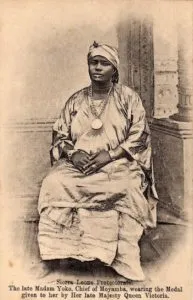
Photographer unknown, before 1906 / Public domain
Madam Yoko
Her Sande bush at Senehun married its graduates to chiefs and built her a confederacy.
Mende leader who rose from celebrated Sande dancer to Paramount Chief of the Kpaa Mende Confederacy of fourteen chiefdoms, wielding the greatest political authority ever held by a woman in Sierra Leone up to her time.
Biography
Madam Yoko was born Soma around 1849 at Gbograma in the Gbo Chiefdom of present-day Sierra Leone. At puberty she was initiated into the Sande society, the powerful Mende women's institution that taught singing, dancing, medicine and domestic arts, emerging with the name Yoko. She became a celebrated Sande dancer and, in time, a senior leader of the society. She married three times: first the warrior Gongoima, whom she left over his jealousy; then Gbenjei, chief of Taiama, who raised her to senior wife; and finally the powerful war chief Gbanya Lango of Senehun. Around 1875 she personally appealed to the British governor to secure Gbanya's release from detention, a diplomatic success that established her standing with the colonial administration.
When Gbanya died in 1878, Yoko succeeded him at Senehun. Governor Havelock placed her formally in charge in 1882, and by 1884 the British recognised her as "Queen of Senehun." Over the following two decades she consolidated fourteen chiefdoms into the Kpaa Mende Confederacy, ruling as Paramount Chief until her death, the greatest political authority ever held by a woman in Sierra Leone to that point. At Senehun she ran a famous Sande bush, training young women and marrying them strategically to influential men, building a political network unavailable to any male chief. During the 1898 Hut Tax War she sided with the British and enforced the tax, for which Queen Victoria awarded her a silver medal, though it earned her lasting resentment among some of her own people. She died in August 1906, reportedly by her own hand, leaving no children; her brother Lamboi succeeded her.
Historical Context
Yoko's rule spanned Sierra Leone's transition from independent Mende polities to the British Protectorate declared in 1896. The 1898 Hut Tax War split the chiefs into resisters, like Bai Bureh, and collaborators; Yoko's British alignment secured her confederacy's expansion but left a contested legacy, heroine to some, collaborator to others. What is not contested is the scale of what she built: a woman ruling fourteen chiefdoms in a chieftaincy system designed by and for men.
What She Fought For
Female access to supreme political office in a male-dominated chieftaincy system; the unification of the fragmented Kpaa Mende chiefdoms; and the institutional power of the Sande society as a vehicle for women's advancement. Her statecraft was pragmatic to the core: she chose diplomacy over war to secure her people's survival, and used marriage, education and alliance as instruments of power.
Major Achievements
- Successfully petitioned the British governor for her husband's release (c. 1875), launching her diplomatic career.
- Became chief of Senehun in 1878, a woman succeeding a war chief.
- Officially recognised as "Queen of Senehun" (1884).
- Built the Kpaa Mende Confederacy of fourteen chiefdoms through the 1880s–1890s, ruling as Paramount Chief.
- Survived the 1898 Hut Tax War as a British ally; awarded a silver medal by Queen Victoria.
- Established a renowned Sande bush at Senehun that became a hub of female political networking.
Her Impact Today
Madam Yoko legitimised female paramount chieftaincy in Sierra Leone, one of the few places in Africa where women regularly hold paramount chieftaincies to this day, a lineage traced directly to her precedent. Freetown's Mammy Yoko Hotel carries her name, she is a staple of Sierra Leonean history curricula, and scholars continue to debate and document her path from mediator to ruler. Her life remains the sharpest African case study in how a woman could turn the institutions available to her (marriage, sisterhood, diplomacy) into sovereign power.
Wikipedia (Madam Yoko), Encyclopaedia Africana, African American Registry, BlackPast.org, Project MUSE scholarship on Mende chieftaincy.
Cite this page
HerStory Africa. (1906). Madam Yoko. HerStory Africa. Retrieved October 1, 2026, from https://herstoryafrica.com.ng/women/madam-yoko
"Madam Yoko." HerStory Africa, 1906, https://herstoryafrica.com.ng/women/madam-yoko. Accessed 1 Oct 2026.
HerStory Africa. "Madam Yoko." Accessed October 1, 2026. https://herstoryafrica.com.ng/women/madam-yoko.