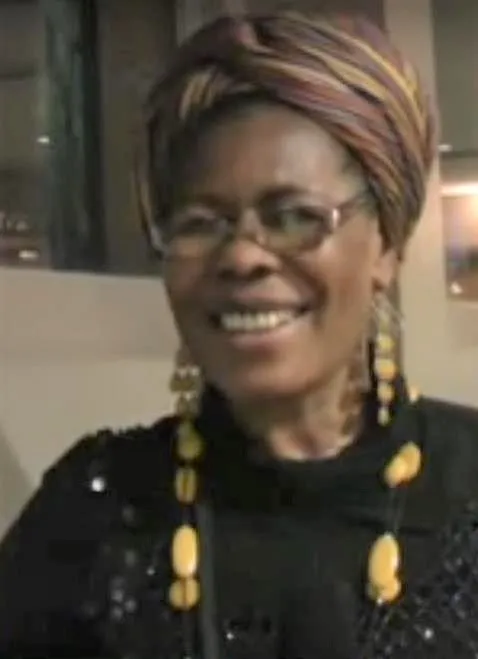
ATV News / CC BY 3.0 via Wikimedia Commons
Stella Chiweshe
Teacher after teacher refused her the mbira, so her great-uncle taught her instead.
Zimbabwe's 'Queen of Mbira', who defied a sacred male-only taboo and colonial bans to master the mbira dzavadzimu, scored a gold record with her debut single, and carried Shona spiritual music onto the world's stages.
Biography
Stella Rambisai Chiweshe was born on 8 July 1946 in Mujumi Village, Mhondoro, in what was then Southern Rhodesia. Between 1966 and 1969 she set out to learn the mbira dzavadzimu, the sacred "mbira of the ancestral spirits," at a time when strong social taboos barred women from the instrument and Rhodesian colonial authorities suppressed traditional Shona ceremonies. Teacher after teacher refused her before her great-uncle finally agreed. She went on to play at forbidden spiritual ceremonies throughout the colonial era, holding a musical tradition together in defiance of both custom and colony.
In 1974 she released her debut single "Kasahwa" on Teal Records; it achieved gold status, a landmark for a female mbira player. After independence she joined Zimbabwe's National Dance Company in 1981 and toured internationally, then formed her own band, The Earthquake, in 1985, amplifying the mbira and adding electric instruments to carry ancestral music into modern halls. In 1988 she recorded the politicised tracks "Chimurenga" and "NeHondo," and she played the lead role in the film about the anti-colonial spirit medium Mbuya Nehanda. Living partly in Germany, she performed at WOMAD festivals in the United States, Australia and Spain, helped establish the Zimbabwe Musicians Union, and trained her daughter, Virginia Mukwesha, as an mbira player. Honoured in later life as "Mbuya" (grandmother), she died in Harare on 20 January 2023, and Zimbabwe granted her a state-assisted funeral.
Historical Context
Colonial Rhodesia actively suppressed Shona religious ceremonies, and within Shona tradition itself the mbira dzavadzimu was a male preserve; Chiweshe was transgressing two systems of authority at once. Her career bridged the Chimurenga liberation struggle and the cultural renaissance of independent Zimbabwe after 1980, when mbira music became a symbol of national identity and she became its most famous female custodian.
What She Fought For
A woman's right to play sacred ancestral music, and the survival of the mbira tradition under colonial suppression. Her politicised recordings served the liberation cause, and her international touring won global recognition for Shona spiritual music, not as folklore, but as living ceremony. Every stage she stood on was an argument that tradition belongs to whoever keeps it alive.
Major Achievements
- Debut single "Kasahwa" (1974) achieved gold status, a first for a female mbira player.
- Joined the National Dance Company of Zimbabwe (1981), touring worldwide.
- Formed The Earthquake (1985), pioneering electrified mbira music.
- Billboard Music Award (1993).
- Zimbabwe Music Awards for Most Outstanding Female Contribution and Best Mbira Artiste (2005).
- National Arts Merit Awards Lifetime Achievement (2020) and Legends Award (2021).
Her Impact Today
Known across the world as the Queen of Mbira, Chiweshe opened the sacred instrument to generations of women players and made mbira a global concert-stage genre. Her music was sampled in Zimbabwean land-reform campaigns, writer Panashe Chigumadzi centred her in "These Bones Will Rise Again" (2018), and her daughter carries the lineage forward. The taboo she broke has stayed broken: today a Zimbabwean girl who picks up the mbira walks through a door Stella Chiweshe forced open.
Wikipedia (Stella Chiweshe), Wikimedia Commons, Zimbabwe National Arts Merit Awards records, WOMAD festival archives, contemporary obituaries (2023).
Cite this page
HerStory Africa. (2023). Stella Chiweshe. HerStory Africa. Retrieved October 1, 2026, from https://herstoryafrica.com.ng/women/stella-chiweshe
"Stella Chiweshe." HerStory Africa, 2023, https://herstoryafrica.com.ng/women/stella-chiweshe. Accessed 1 Oct 2026.
HerStory Africa. "Stella Chiweshe." Accessed October 1, 2026. https://herstoryafrica.com.ng/women/stella-chiweshe.