Raising Children at the Crossroads: How Gender, Culture, and Power Meet in African Homes
The lessons that shape girls into future wives and boys into men who expect service do not come from one place. They are built at the intersection of gender, culture, class, religion, and history. Understanding that crossroads is how we raise people instead of roles.
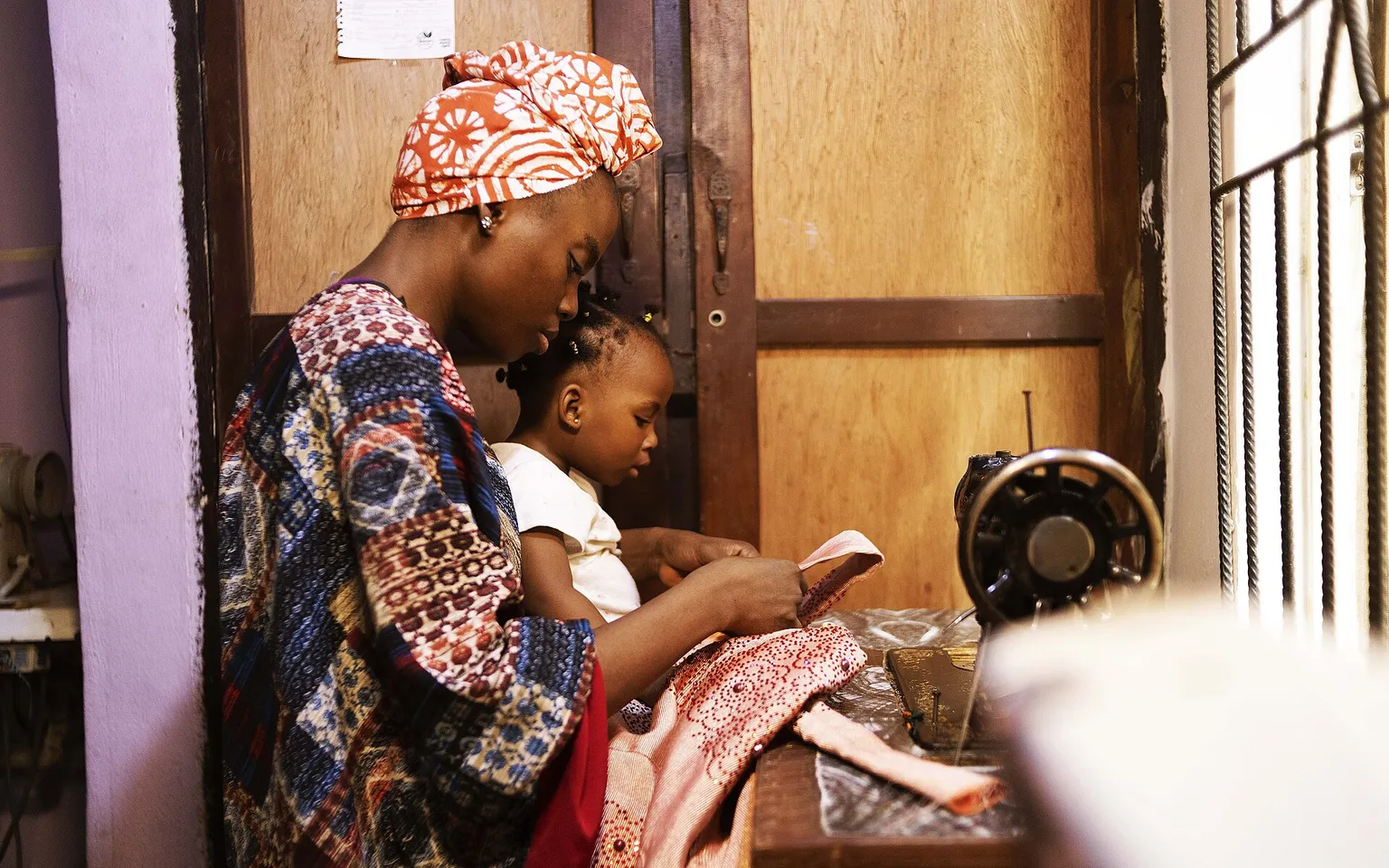
Teaching Them Young by Ayorinde Ogundele / Wikimedia Commons / CC BY-SA 4.0
A girl comes home from school and says a boy has been hitting her. Someone she trusts smiles and answers, “It is because he likes you.”
Later that evening, her mother tells her younger sister to run inside and change those shorts before the uncle arrives. The boys her age stay outside in whatever they are wearing.
At dinner the men remain seated in the living room while the women and girls cook, serve, clear the plates, and wash the dishes. Nobody explains why. It simply happens, the way the sun sets.
Years later the same girl will be asked, every time she makes a mistake, “Is this what you will do in your husband’s house?”
None of these moments feels like a lesson in ideology. Each one feels like love, or protection, or ordinary home training. Stack eighteen years of them, however, and you have written a complete script inside a child’s head — what women are for, and what men are owed. That script is not written by gender alone. It is written at a crossroads where gender meets culture, class, religion, history, and fear.
That meeting point has a name: intersectionality.
What intersectionality actually means
Intersectionality is a framework developed by the legal scholar Kimberlé Crenshaw. It shows that our identities do not operate in isolation. Being a girl is one experience. Being a poor girl is another. Being a poor girl in a devout household in a society still shaped by colonial ideas about gender is something else again. The combination creates realities that cannot be understood by looking at any single factor.
Bring that lens into the African home and the everyday scenes above stop looking like simple “tradition” or simple “sexism.” They become visible as the product of several forces acting at once.
How the script is written in different inks
The same core lesson (girls prepare for marriage, boys prepare to be served) appears across the continent, but it is never written in identical ink.
In many middle-class urban African households a daughter may be pushed hard toward a university degree and still told, quietly and constantly, that a good husband remains the real prize. In poorer rural homes the same lesson arrives more bluntly: school may end early because her labour or her bride price feels more urgent than her future. In many Christian and Muslim homes the script arrives wrapped in scripture, which makes questioning it feel like questioning God. And for families in the diaspora the monitoring of daughters often tightens further, because parents are trying to guard against two threats at once: racism outside the door and the fear of cultural loss inside it.
History writes in its own ink too. Many of the rigid expectations defended today as pure culture were introduced or intensified under colonial rule, which stripped women of public power and hardened male authority in the home. Parents who enforce them as ancestral truth are often passing on a colonial afterlife without knowing it.
Even the harshness of discipline has layers. Parents who spend years “beating the audacity” out of a child are frequently not acting from pure cruelty. They are preparing that child for a world in which, in their experience, audacity is punished by the police, by poverty, or by the state. The obedience that can feel suffocating in one generation was survival strategy in another. Intersectionality lets us see both truths at the same time: the cage is real, and the materials used to build it are not always the ones we first assume. But the cost of that obedience compounds, because hierarchy inside the home and silence toward power outside it are the same lesson taught once and applied everywhere. A generation raised never to challenge a father will struggle to challenge a government.
What the script produces
Watch what these layered lessons create in adulthood.
Boys who grew up watching women and girls carry the entire domestic load often become men who see no problem when a pregnant wife still cooks, cleans, and serves alone. They are not inventing a new rule. They are following the only rule the living room ever taught them.
Girls who were told that a boy’s aggression equals affection grow into women who stay in relationships where their partners speak to them in ways no friend would be allowed to speak. The decoder that turns danger into desire was installed early.
Both children who were taught that daddy leads because men are logical and women are emotional carry that belief into adulthood, where the evidence keeps contradicting it. In the United Kingdom, researchers found that reports of domestic abuse rise sharply on days the national football team loses. Rage that endangers a partner is not logic. It is emotion, unregulated and armed. We simply decided long ago that men’s emotions do not count as emotions.
And girls whose entire childhood was framed as preparation for a man they had not yet met often organise their ambitions around the future “Mrs.” attached to their name. Achievements become decorations on the road to marriage. Ambitions that might threaten a husband become negotiable. This is not weakness. It is successful training. The assignment was never to become a full person. The assignment was to become a wife.
Across Africa the most extreme version of this script is not metaphorical. Millions of girls are still married as children, the preparation phase collapsed into the thing itself. When Theresa Kachindamoto, a senior chief in Malawi, used her authority to annul hundreds of child marriages and send the girls back to school, she was fighting exactly this layered system: gender expectation meeting poverty meeting custom.
The women who prove the script is a lie
History keeps offering evidence that the script is not destiny.
Funmilayo Ransome-Kuti was not raised to stay quiet. She organised 20,000 women, confronted a king, and helped force political change in colonial Nigeria. Gambo Sawaba went to prison again and again insisting that northern Nigerian girls belonged in classrooms, not only in kitchens. Wangari Maathai became the first woman in East and Central Africa to earn a doctorate and later won a Nobel Prize for a movement that planted tens of millions of trees. Ngozi Okonjo-Iweala walked into rooms full of men who expected deference and ended up directing the World Trade Organization.
None of these women lacked the “natural” domestic destiny the script claims all girls possess. At some point they were allowed, or forced, to imagine themselves as more. The capacity was always there. The script was what sat on top of it.
Raising people instead of roles
Understanding the crossroads does not require us to reject every cultural practice or pretend families do not matter. It requires us to distinguish between practices that protect children and practices that shrink them.
The practical work looks like this:
- Notice the small sentences. “He hits you because he likes you.” “Go and help your mother, you’re a girl.” “Is this what you will do in your husband’s house?” These are not neutral. They are curriculum. Replace them.
- Give both children the same chores and the same scale of dreams. If the boy eats, the boy can wash plates. If the girl is brilliant, tell her the boardroom and the laboratory are possible rooms for her, not only the kitchen. As Chimamanda Ngozi Adichie put it in her manifesto on raising a feminist daughter, the idea of gender roles is “absolute nonsense.”
- Stop measuring girls primarily by marriageability. Marriage can be one chapter. It should not be the entire plot.
- Remember that African women have always been more than the roles assigned to them. Queens, traders, warriors, organisers and thinkers built and defended communities long before anyone decided their highest purpose was to prepare for a husband.
What to take away
- The everyday lessons that turn girls into future wives and boys into men who expect service are not produced by gender alone. They are written at the intersection of gender, culture, class, religion, and history.
- Intersectionality, Kimberlé Crenshaw’s framework, helps us see why the same script appears differently in a wealthy urban home, a poor rural one, a devout household, or a diaspora family.
- These layered lessons produce real adult outcomes: men who do not question unequal domestic labour, women who misread abuse as love, and girls who shrink their ambitions before anyone asks them to.
- The historical record of African women who led, fought, traded, and governed proves the script is not natural or inevitable.
- The solution begins in the same place the problem begins: raise children as full people first. Self-respect first, respect for others as human beings next, and rigid gender roles nowhere.
The home is the first place society is made. When we understand the crossroads at which we stand while raising children, we gain the power to choose a different direction, one that produces free adults rather than well-trained roles.
Cite this page
HerStory Africa. (2026). Raising Children at the Crossroads: How Gender, Culture, and Power Meet in African Homes. HerStory Africa. Retrieved October 1, 2026, from https://herstoryafrica.com.ng/articles/raising-children-at-the-crossroads
"Raising Children at the Crossroads: How Gender, Culture, and Power Meet in African Homes." HerStory Africa, 2026, https://herstoryafrica.com.ng/articles/raising-children-at-the-crossroads. Accessed 1 Oct 2026.
HerStory Africa. "Raising Children at the Crossroads: How Gender, Culture, and Power Meet in African Homes." Accessed October 1, 2026. https://herstoryafrica.com.ng/articles/raising-children-at-the-crossroads.