What Are Gender Roles and Who Decides Them?
Where the unwritten rules about men and women come from, why they feel like nature, and how to tell a tradition from a cage.
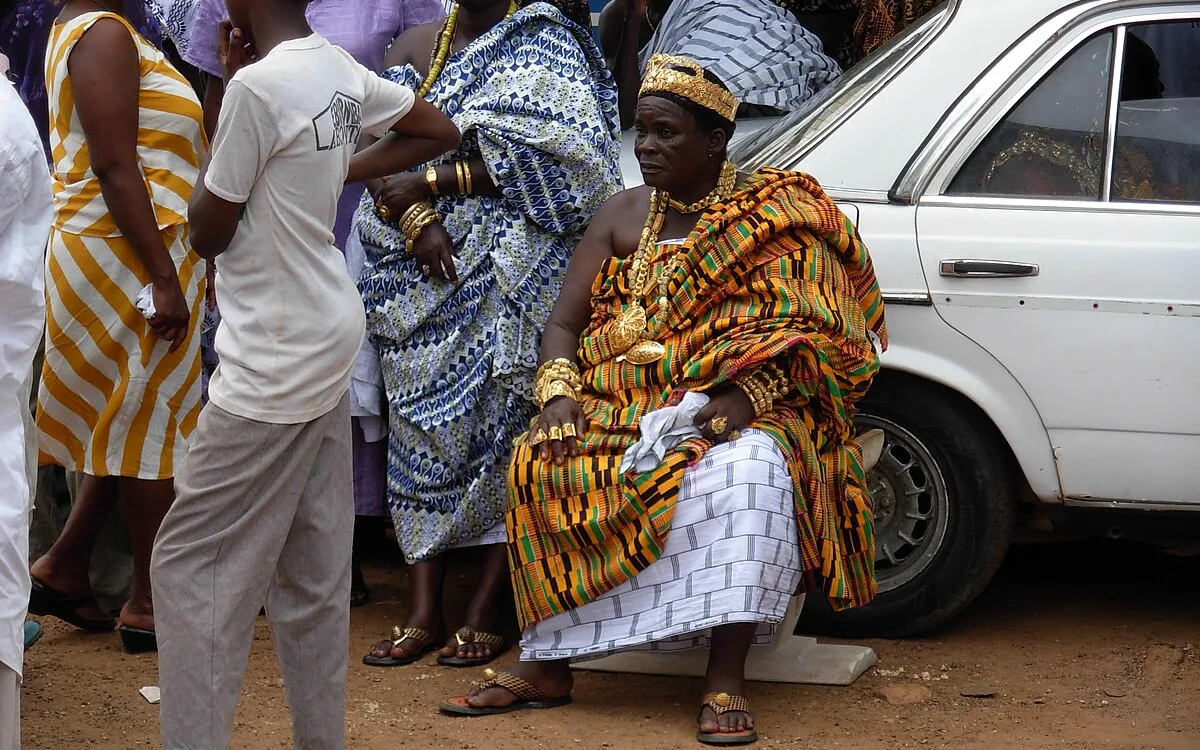
Queen Mother of Ghana / Wikimedia Commons / CC BY 2.0
When the food is ready, the girls stand up. Nobody announces this. Plates appear in front of the men first. The boys stay seated unless someone shouts for water. A visitor compliments the mother on how well her daughters have been trained. The daughters have been in school all day. Training, here, means they already know which chair is not theirs.
In the same compound, a boy falls and starts to cry. An adult laughs. "Are you a woman?" The boy swallows it. His sister is told not to laugh too loud, not to answer back, not to sit with her legs apart. Nobody writes these instructions down. They arrive with the rice.
These instructions have a name. Gender roles. They are the behaviours a society treats as normal for girls and boys, women and men: what you are supposed to like, what work is yours, which feelings you may show, and who you are supposed to become. They start before a child can argue back. If patriarchy is the larger system that ranks men above women, gender roles are the daily script that makes the ranking feel like common sense.
They are not laws of nature
People talk about gender roles as if they were weather. As if girls arrived already knowing how to serve, and boys already knowing how to decide. Bodies differ. Average strength differs. Pregnancy is not a social invention. The leap from those facts to "therefore she cooks and he leads" is the invention.
Watch a house for a week and you can see the teaching. A girl who is "too sharp-mouthed" is told to be nicer. A boy who reaches for a knife in the kitchen is waved away, sometimes kindly, as if the work would shrink him. A girl is praised for being pretty. A boy is praised for being brave. After enough years of this, the lessons stop feeling like lessons. They feel like personality.
That is why the same role looks so different from one place to another. In one family, a woman who trades in the market is ordinary. In another, a woman who wants her own stall is called stubborn. What counts as "manly" in Lagos may be women's work in Accra, or was women's work a century ago in the same town. If the rules were wired into the body, they would not travel this badly.
In many precolonial African societies they did not look the way people now call traditional. Igbo women had their own political assemblies. Ashanti lineage ran through the mother, and a Queen Mother could name a king. Market women across West Africa ran the trade that fed cities. Colonial rule later handed land titles, schools, and public office to men, and many of those new arrangements got remembered as culture. The script is old. It is not as old, or as African, as it pretends.
Who writes it
No single person sits down and invents gender roles. The script is copied, a little at a time, by people who often believe they are only doing what is proper.
Family is usually first. Parents buy the gifts, assign the chores, and decide whose education can wait. They do not need a lecture to do it. "Go and help your mother" is a sentence. So is "leave your brother, he is reading." One child learns that labour is hers. The other learns that his time is more expensive.
Culture and tradition give those sentences a longer history. Some of the expectations are old and local. Some arrived with colonial courts, missionary schools, and new property laws, then stayed long enough to feel ancestral. When someone says "that is how we do it," it is worth asking since when, and for whose benefit.
Religion carries particular weight because it is taught as moral truth, not as preference. A teaching about husbands and wives can close a conversation before it starts. Faith can hold a family together. Using it to freeze a seating plan, as if God assigned the chairs, is how a social habit becomes untouchable.
School continues the sorting. Which subjects are treated as if they belong to boys. Who is named class captain. Which girl is called "too much" for speaking as often as the boys. Teachers do not have to mean harm for the sorting to work.
Media keeps showing you the finished product. Nollywood knows the suffering mother, the proud career woman who must be humbled, the man whose tears would spoil the scene. Music, adverts, and timelines repeat the casting until you recognise the types before you recognise yourself.
Friends enforce what adults started. A boy who cries is mocked. A girl who competes is called proud. The punishment is social, which is why it works. Most people would rather fit than become the story told about them.
When a role becomes a rule
Some people like the work that matches the script. A woman who loves cooking is not confused. A man who wants to provide for his family is not a villain. The trouble starts when liking something is no longer the point. When the role stops being a choice and becomes a test you can fail.
For girls and women, the test is often smallness. Ambition looks unseemly if it shows. Value gets attached to beauty, to obedience, or to how well a girl cares for everyone else. A girl who wants to lead, to build, or simply to sit down after cooking is told she is forgetting herself.
For boys and men, the test is hardness. Crying becomes a problem, then asking for help, then any tenderness other people can see. A boy who wants to cook, to dance, to study art, or to talk about fear is told to be a man, as if manhood were the opposite of being human. That training follows men into adulthood. It is one reason so many of them suffer in silence, and why the people who love them sometimes cannot reach them.
Houses pay for this. So do countries. When half the people in a community are trained to stay small, the community does not get their ideas, their public labour, or their leadership. The loss gets called culture. It is waste.
What the rule looks like when it is enforced
It does not always arrive as a speech about gender. It arrives as a girl taken out of school to help at home, or to marry, while her brother keeps his uniform. Gambo Sawaba spent her life naming that arrangement in northern Nigeria. She was arrested more than 17 times. Authorities banned her from Zaria. She went back anyway, insisting that girls belonged in classrooms, not only in kitchens, and that women should vote.

It arrives as widowhood rites a man never faces. A woman loses her husband and, in some places, loses her home, her property, and her standing in the same week. The community calls it custom. The custom has a gender.
It arrives as a woman in a job men have held for years being treated as if the job itself had changed. Ngozi Okonjo-Iweala has spoken about the scrutiny and hostility she met as Nigeria's Finance Minister, attention her male predecessors did not attract in the same way. The qualifications were not the problem. The picture of who is allowed to hold the file was.
The dining table, the school gate, and the ministry are different rooms. The script is the same.
You can keep a tradition without obeying a cage
Understanding gender roles is not a demand that every family throw out its cooking pots, or that men and women pretend to be identical. It is a demand that we tell the difference between a choice and a rule.
If a woman wants to take care of her home, that is hers. If a man wants to be the one who earns, that is his. What is not a choice is the engineer sent back to the kitchen because of her body, or the man in pain who is told to be a man. What is not a choice is the child who is never asked, because the house already decided.
The goal is not a new script written by someone else. It is enough room to live without being punished for stepping off a line you did not draw.
What to take away
- Gender roles are taught expectations about how men and women should behave. They feel natural because they start early, not because they are hardwired.
- Family, culture, religion, school, media, and friends all copy the script. No single source is in charge.
- The harm is not that some people enjoy traditional work. The harm is when a role becomes a rule you can be mocked, excluded, or punished for leaving.
- Many arrangements defended as African tradition were hardened or introduced under colonial rule. Age is not the same thing as origin.
- Questioning the script is not the same as rejecting your people. It is how you tell a choice from an order.
You did not write the rules. You still get to decide whether they get the last word.
Cite this page
HerStory Africa. (2026). What Are Gender Roles and Who Decides Them?. HerStory Africa. Retrieved October 1, 2026, from https://herstoryafrica.com.ng/articles/what-are-gender-roles
"What Are Gender Roles and Who Decides Them?." HerStory Africa, 2026, https://herstoryafrica.com.ng/articles/what-are-gender-roles. Accessed 1 Oct 2026.
HerStory Africa. "What Are Gender Roles and Who Decides Them?." Accessed October 1, 2026. https://herstoryafrica.com.ng/articles/what-are-gender-roles.