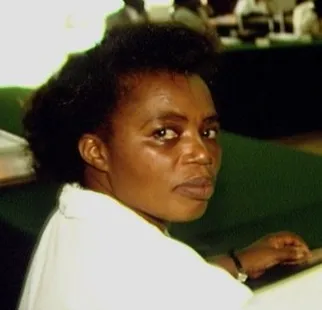
Author unknown, via BBC Gahuza / fair use (no free image known)
Agathe Uwilingiyimana
Abolished Rwanda's school ethnic quotas, then died in the genocide's opening hours.
Rwanda's first and only female Prime Minister, a chemistry teacher who abolished ethnic quotas in schools, stood against Hutu Power extremism, and was assassinated with her UN guards in the opening hours of the 1994 genocide.
Biography
Agathe Uwilingiyimana was born on 23 May 1953 in Nyaruhengeri village, Butare Province, in southern Rwanda. She earned a humanities certificate from Notre Dame des Cîteaux Secondary School in 1973, married Ignace Barahira in 1976 (they raised five children), and began teaching in Butare that same year while studying part-time. She completed a BSc in mathematics and chemistry at the National University of Rwanda in 1985, taught chemistry at the university, and in 1989 became a director in the Ministry of Commerce. A schoolteacher's daughter of modest rural origins, she was living proof of what merit could achieve, and merit became her political creed.
She joined the opposition Republican Democratic Movement in 1992 and was appointed Minister of Primary and Secondary Education that April. In office she did something quietly revolutionary: she abolished the ethnic-quota system for school places and scholarships, awarding them on merit alone. The decision enraged Hutu Power extremists and marked her for life. On 18 July 1993 she became Rwanda's first, and to this day only, female Prime Minister, one of the first female heads of government in Africa. Under the Arusha Accords signed weeks later, her government was to hand over to a broad-based transitional government that was never installed, leaving her as caretaker Prime Minister for eight months under constant threat and vilification by extremist media, including the hate station Radio Mille Collines.
After President Habyarimana's plane was shot down on the night of 6 April 1994, she became the constitutional acting head of government. The next morning, the Presidential Guard disarmed the ten Belgian and five Ghanaian UN peacekeepers protecting her; she and her husband were captured and shot at point-blank range. The ten Belgian peacekeepers were then tortured and murdered, precipitating Belgium's withdrawal from the UN mission. Her murder was among the very first acts of the genocide against the Tutsi that killed more than 800,000 people in a hundred days. She is buried in Rwanda's National Heroes Cemetery.
Historical Context
Rwanda between 1990 and 1994 was a country at war with itself: civil war between the Hutu-led government and the Tutsi-led Rwandan Patriotic Front, a forced experiment in multiparty coalition politics, and the rise of Hutu Power extremism amplified by hate radio. The Arusha peace process offered a way out; its enemies chose annihilation instead. Uwilingiyimana stood at the exact point where those forces collided, a moderate woman holding a caretaker government together while extremists broadcast her death warrant.
What She Fought For
Merit over ethnicity in education; girls' access to school and to science; moderate multiparty democracy; implementation of the Arusha peace accords. In November 1993 she publicly warned against retaliatory violence toward Tutsis. She knew what her positions cost and held them anyway, protected, in the end, by fifteen peacekeepers whom the killers had to remove before they could reach her.
Major Achievements
- Earned a BSc in mathematics and chemistry (1985) while teaching and raising five children.
- As Minister of Education (1992), abolished Rwanda's ethnic quotas in schools and scholarships.
- Co-founded the Forum for African Women Educationalists, FAWE (1992).
- Became Rwanda's first female Prime Minister on 18 July 1993.
- Held the caretaker government together through eight months of extremist threats (1993–1994).
- Her assassination was central to the ICTR's 2008 conviction and life sentence of Colonel Théoneste Bagosora, an architect of the genocide.
Her Impact Today
Agathe Uwilingiyimana is a national heroine buried in the Heroes Cemetery, and across Africa she stands as the symbol of moderate courage against genocidal ideology: the leader who would not trade principle for safety. FAWE, which she co-founded, honours her with the Agathe Innovative Award funding education projects for African girls. She remains Rwanda's only female Prime Minister; her life is taught as both an inspiration and a warning about what extremism destroys first.
Wikipedia (Agathe Uwilingiyimana), ICTR Bagosora judgment records, FAWE, BBC Gahuza, histories of the 1994 genocide against the Tutsi.
Cite this page
HerStory Africa. (1994). Agathe Uwilingiyimana. HerStory Africa. Retrieved October 1, 2026, from https://herstoryafrica.com.ng/women/agathe-uwilingiyimana
"Agathe Uwilingiyimana." HerStory Africa, 1994, https://herstoryafrica.com.ng/women/agathe-uwilingiyimana. Accessed 1 Oct 2026.
HerStory Africa. "Agathe Uwilingiyimana." Accessed October 1, 2026. https://herstoryafrica.com.ng/women/agathe-uwilingiyimana.