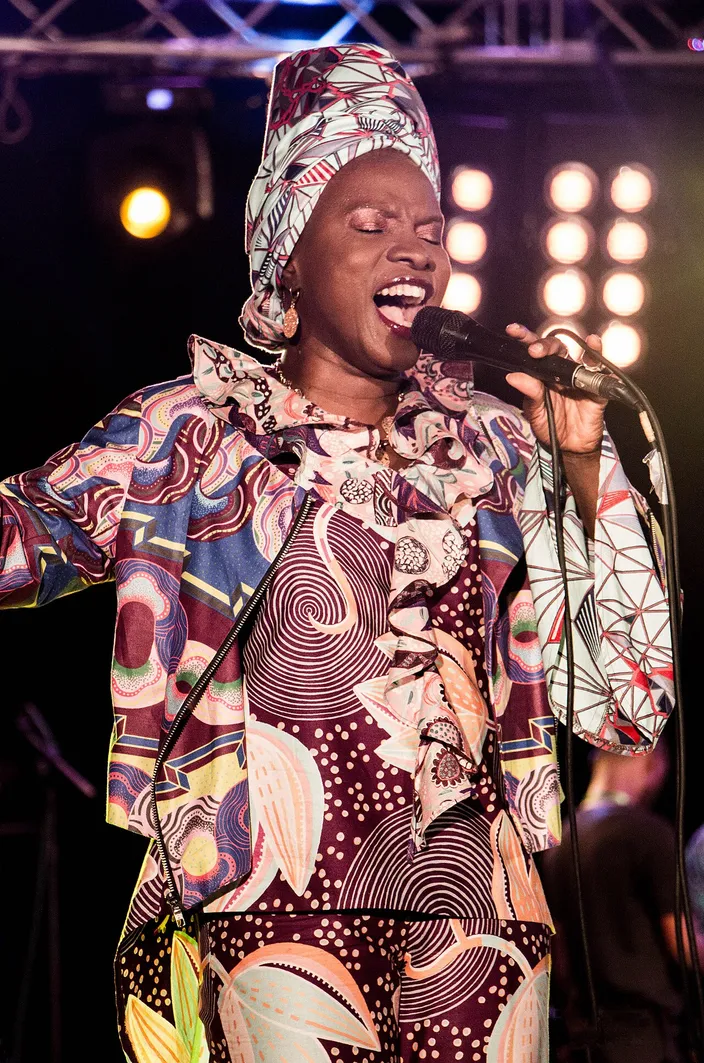
Photo: HankBate123 / CC BY-SA 4.0 via Wikimedia Commons
Angélique Kidjo
Walked out on Benin's regime in 1983 rather than sing for it, and won five Grammys.
Beninese singer who refused to perform propaganda for a dictatorship, fled to Paris in 1983, and became a five-time Grammy winner, UNICEF ambassador, and the first Black African artist honored with a star on the Hollywood Walk of Fame.
Biography
In 1983, one of the most promising young singers in Benin walked away from her own fame. The country's Marxist regime expected musicians to sing for the government. Angélique Kidjo would not. Musicians, she later recalled, were forced to "praise the government and the ideology of power," and, in her words, "which I refused to do." So she left for Paris, a national radio star starting over with almost nothing.
Music had raised her. Born on 14 July 1960 in the coastal town of Ouidah, to a Fon father who loved music and a Yoruba mother who ran a theatre troupe, she was on stage by the age of six. As a teenager her cover of a Miriam Makeba song played on national radio, and Benin learned her name.
Paris was hard and electric. She briefly considered studying law, then chose music, training at a jazz school where she met the French composer Jean Hébrail, whom she married in 1987. She sang backup, then fronted the European Afro-jazz band Pili Pili. In 1991, Island Records founder Chris Blackwell, the man who had signed Bob Marley, signed her. Her album Logozo turned her into an international star, singing in Fon, Yoruba, French and English, fusing Beninese rhythms with funk, jazz and pop.
Four decades later she has released more than a dozen albums, reimagined Talking Heads and Celia Cruz, sung at the Tokyo Olympics opening ceremony, and won five Grammy Awards. She has been called Africa's premier diva. She prefers to talk about girls' education.
Historical Context
Kidjo grew up in Dahomey, renamed Benin under Mathieu Kérékou, who seized power in 1972 and declared a Marxist-Leninist state. In that Benin, art was expected to serve the party. For a young woman whose whole life was music, the choice was stark: sing what you are told, or stop singing, or leave. Her flight in 1983 placed her among a generation of African artists in Paris, exiles and migrants who were quietly building the sound the world would call world music.
She entered a global industry that liked to put African artists in a box marked traditional. Kidjo spent her career smashing that box, insisting that African music was not a genre but a universe, and that funk, salsa, samba and rock and roll were all its children. Her album Celia honored the Cuban legend Celia Cruz; her version of Talking Heads' Remain in Light reclaimed an album that had itself borrowed from West African rhythms.
She also came of age as Africa's daughters were still being kept out of classrooms. That, more than any stage, became her battlefield.
What She Fought For
The turning point of Kidjo's life was a refusal. In 1983 she gave up home, family and a ready-made career rather than lend her voice to power. Everything after flows from that: a career built on the idea that a voice is only worth something if it is free. She has said that when she arrived in Paris she decided she "would try to touch poor people with my music."
Freedom, for Kidjo, quickly became something to give away. In 2002 she became a UNICEF Goodwill Ambassador, traveling across Africa for children's rights. In 2006 she founded the Batonga Foundation, named for the word she invented as a schoolgirl to fend off bullies, to get girls in Africa into school and keep them there. The foundation supports adolescent girls and young women in Benin and across sub-Saharan Africa with education, skills and financial literacy.
The world eventually caught up with her. Five Grammy Awards: for Djin Djin (2008), Eve (2015), Sings (2016), Celia (2020) and Mother Nature (2022), making her the most awarded African solo artist in Grammy history. Time magazine named her one of the 100 most influential people in the world in 2021. France gave her the Legion of Honor. Sweden gave her the Polar Music Prize in 2023. And in July 2025 came a poetic full circle: the girl who fled with nothing was announced as the first Black African artist to receive a star on the Hollywood Walk of Fame.
Major Achievements
- Won five Grammy Awards (2008, 2015, 2016, 2020, 2022), the most of any African solo artist
- Became the first Black African artist selected for a star on the Hollywood Walk of Fame, announced in July 2025
- Named one of Time magazine's 100 most influential people in the world in 2021, and awarded the Polar Music Prize in 2023
- Has served as a UNICEF Goodwill Ambassador since 2002, advocating for children across Africa
- Founded the Batonga Foundation in 2006 to champion education and opportunity for girls and young women in Africa
- Performed at the Tokyo Olympic Games opening ceremony in 2021 and recorded landmark albums honoring African and diaspora music, from Celia Cruz to Talking Heads
Her Impact Today
Kidjo redrew the map of what an African artist could be. Burna Boy, Yemi Alade and a generation of Afrobeats stars name her as an ancestor figure, and she has collaborated with many of them, as well as with Philip Glass, Yo-Yo Ma and symphony orchestras on three continents. When the Grammys renamed the world music category global music, it was in no small part her world that had gone global.
Her deepest legacy may be in classrooms rather than concert halls. Through Batonga, thousands of girls in Benin and beyond have received schooling, mentoring and leadership training, girls she calls the future presidents and engineers of Africa. She built the foundation on a childhood act of defiance, one invented word flung at bullies, which is fitting for a life defined by refusing to be silenced.
More than forty years after she left Benin with almost nothing, her voice is one of the most recognizable on earth. The dictatorship that wanted to script her songs is gone. The songs are still here.
Wikipedia (Angélique Kidjo), Encyclopedia.com (Angelique Kidjo biography, quoting Interview and the Boston Globe), Forbes and Forbes Africa (July 2025, Hollywood Walk of Fame), kidjo.com, Polar Music Prize, UAB Institute for Human Rights blog (Batonga), Grammy.com.
Cite this page
HerStory Africa. (1960). Angélique Kidjo. HerStory Africa. Retrieved September 15, 2026, from https://herstoryafrica.com.ng/women/angelique-kidjo
"Angélique Kidjo." HerStory Africa, 1960, https://herstoryafrica.com.ng/women/angelique-kidjo. Accessed 15 Sept 2026.
HerStory Africa. "Angélique Kidjo." Accessed September 15, 2026. https://herstoryafrica.com.ng/women/angelique-kidjo.