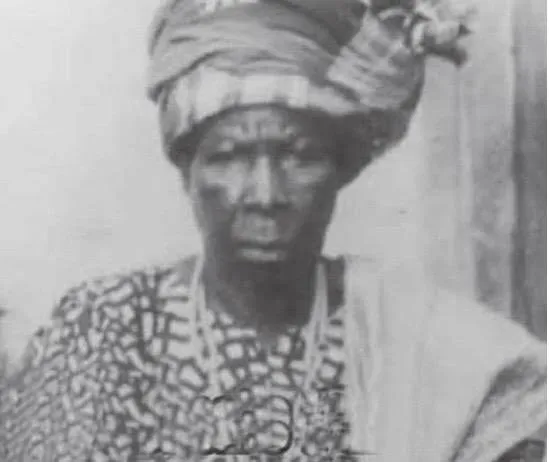
Archival photograph; rights holder unidentified
Ahebi Ugbabe
Promised to a goddess as a girl, she ran, and came home a king.
A girl from Enugu-Ezike in northern Igboland who ran away rather than be given to a goddess, spent about twenty years in Igala land, and came home at the head of a British force. She became headman, the only woman warrant chief in colonial Nigeria, and then eze: a king, not a queen. Her own masquerade was the one step her town's elders would not accept.
Biography
The trouble started with a bad season. When Ahebi was thirteen or fourteen, her family in Umuida, a village of Enugu-Ezike in northern Igboland, ran into one misfortune after another: poor harvests, sickness, trade that would not move. Her father, Ugbabe Ayibi, was a farmer and palm-wine tapper. Her mother, Anekwu Ameh, farmed and traded. A diviner told the family that the father had offended Ohe, a goddess of creation, fertility and protection, and that the debt would be paid with his daughter. Ahebi was to be married to the goddess, a fate that would have reduced her to the status of a slave of the shrine.
She did not wait for it. She ran west into Igala land, across what is now the border between Enugu and Kogi states, and stayed away for about twenty years. Her biographer, the historian Nwando Achebe, describes her living there as a trader and an autonomous sex worker. She learned Igala, Nupe and Pidgin English, and she came to know the men who ran the region: the Attah, as the Igala king is called, and British colonial officers.
When the British pushed into her home district in the 1910s, Ahebi walked in at the front of their force. The runaway came home as their guide, and the British rewarded her. First she was made headman of her village, replacing an aging man named Ugwu Okegwu. Then, in October 1918, she was appointed a warrant chief on the Native Court of Enugu-Ezike. No other woman in colonial Nigeria held that office. A British district officer described her as "a lady of influence and power."
She used it. She collected labour, a census and a tax for the colonial government, which won her few friends at home. In the 1920s, with the Attah's support, she was crowned eze in Igala land and came back a king, not a queen. Her palace became the showpiece of the town, with its own market, court and prison, guest houses, stables and barns of yams. She sat in judgment on everything from land disputes to adultery. She married wives for herself and for her brothers, and many of the women who came to her were running from marriages of their own.
Then, in the 1930s, she brought out her own masquerade, Ekpe Ahebi. In Igboland, masquerades are the business of initiated men. The elders seized her mask. Ahebi took them to the colonial court, and the case went up to the British Resident at Onitsha. For once the British did not back her. They found for the elders, and her masked spirit was not seen again.
Ahebi did not trust her town to bury her as she deserved. So while she was still alive, she gave herself a funeral, with music, sacrifices and gunfire. She died in 1948 and was buried by the customs used for men.
Historical Context
Most of Igboland had no kings. Communities like Enugu-Ezike were run by councils of elders and titled men, and the town is still led by its oldest man. British indirect rule wanted a single ruler to deal with, so the colonial government made one: the warrant chief, appointed on a paper warrant and answerable to the district officer. Across southeastern Nigeria these men grew hated, and in 1929 tens of thousands of women went to war against them in Ogu Umunwaanyi. Ahebi held the same office, the only woman who ever did.
Northern Igboland had long been a borderland with the Igala kingdom, whose Attah ruled from Idah. Her years in exile gave Ahebi patrons on both sides of that frontier, the Igala king and the British officers, and she used both to rise above her own town's elders.
What She Fought For
Herself, first. Ahebi refused the life her community chose for her, survived alone in a foreign kingdom, and came home on terms she set. Her rise came through the colonial state, and she enforced its labour and taxes on her own people, which is part of her story too. What she would not accept was the rule that a woman could hold power only in a woman's shape. She took the title of king, married wives, judged men, and claimed the masquerade, the one institution her town held back. The fight over that mask decided how far she could go.
Major Achievements
- Escaped being given to a shrine as a teenager and survived about twenty years in exile in Igala land.
- Appointed headman of her village after the British conquest of Enugu-Ezike.
- Appointed a warrant chief on the Native Court of Enugu-Ezike in October 1918, the only woman to hold the office in colonial Nigeria.
- Crowned eze, a king, in the 1920s with the support of the Attah of Igala.
- Built a palace with its own court, market and prison, and judged cases for her district.
- Brought out her own masquerade, Ekpe Ahebi, and fought the elders over it in the colonial courts.
Her Impact Today
For decades the colonial record barely noticed her. In the 1930s the government anthropologist C. K. Meek wrote that Ogurte, her part of Enugu-Ezike, was "distinguished by having a female Eze", and he did not write down her name. Nwando Achebe found her in that line and rebuilt her life from oral histories and the colonial court files of Nsukka Division. Her biography, The Female King of Colonial Nigeria (2011), won the Aidoo-Snyder Prize. Enugu-Ezike still remembers her in songs and parables, and in her mother's hometown the girl they tried to give to a goddess is worshipped as one.
Nwando Achebe, The Female King of Colonial Nigeria: Ahebi Ugbabe (Indiana University Press, 2011); Nwando Achebe, "And She Became a Man: King Ahebi Ugbabe in the History of Enugu-Ezike, Northern Igboland, 1880–1948", in Men and Masculinities in Modern Africa (Heinemann, 2003); Nwando Achebe, "Writing King Ahebi's Life" (American Historical Association, 2010); Ogechukwu Ezekwem, review, Reviews in History no. 1393; Anne Jebet Waliaula, review, African Studies Quarterly 13 (2012); Dig: A History Podcast, "King Ahebi Ugbabe" (2018); Wikipedia (Ahebi Ugbabe).
Cite this page
HerStory Africa. (1948). Ahebi Ugbabe. HerStory Africa. Retrieved November 1, 2026, from https://herstoryafrica.com.ng/women/ahebi-ugbabe
"Ahebi Ugbabe." HerStory Africa, 1948, https://herstoryafrica.com.ng/women/ahebi-ugbabe. Accessed 1 Nov 2026.
HerStory Africa. "Ahebi Ugbabe." Accessed November 1, 2026. https://herstoryafrica.com.ng/women/ahebi-ugbabe.