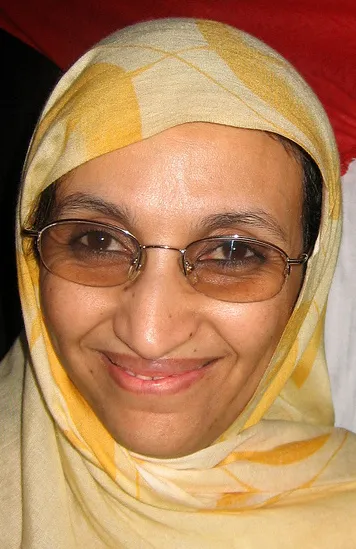
Saharauiak (Flickr) / CC BY-SA 2.0 via Wikimedia Commons
Aminatou Haidar
A 32-day hunger strike on a Lanzarote airport floor that made Morocco back down.
The 'Sahrawi Gandhi', a nonviolent resistance leader who survived four years of secret detention and torture, and whose 32-day airport hunger strike in 2009 forced Morocco into a rare public climb-down before the eyes of the world.
Biography
Aminatou Ali Ahmed Haidar was born on 24 July 1966 in Akka and raised in Tan-Tan, a southern Moroccan town with a large Sahrawi population. She came of age just after Morocco annexed Western Sahara following Spain's 1975 withdrawal. In 1987, aged twenty-one, she took part in a nonviolent demonstration in El Aaiún against Moroccan rule and was "forcibly disappeared" without charge or trial for nearly four years, held blindfolded in secret detention, where she was beaten, starved, sleep-deprived and given electric shocks. Released in 1991, she did not retreat; she became one of the leading documenters of Sahrawi disappearances.
During the "Independence Intifada" of 2005 she was beaten by police on her way to a demonstration in El Aaiún, then jailed in the notorious "Black Prison," where she led a 51-day hunger strike before being released in January 2006. She became president of the Collective of Sahrawi Human Rights Defenders, CODESA, an organisation Morocco refuses to legalise. Her most famous act came in November 2009: returning from abroad, she refused to write "Moroccan" as her nationality on the landing card. Morocco confiscated her passport and expelled her to Lanzarote in the Canary Islands, where she staged a 32-day hunger strike at the airport. Near death, and after diplomatic intervention involving Spain, France and the United States, with public support from Nobel laureates José Saramago, Günter Grass and Dario Fo, Morocco relented and let her return home, a rare public reversal.
Divorced with two children, both of whom have been threatened and assaulted because of her work, she continues to live in El Aaiún under surveillance rather than in exile. She is not a member of the Polisario Front, though she regards it as the Sahrawi people's representative; her weapon has only ever been her own body and her refusal.
Historical Context
Western Sahara is Africa's last major decolonisation dispute. Spain withdrew in 1975; Morocco annexed the territory in the Green March, and war with the Polisario Front lasted until a 1991 UN-brokered ceasefire that promised a self-determination referendum which has never been held. Sahrawis in the Moroccan-controlled zone face protest bans, surveillance and imprisonment, while some 170,000 refugees live in camps near Tindouf, Algeria. Haidar's entire adult life has unfolded inside this frozen conflict, and has repeatedly forced the world to look at it.
What She Fights For
A free and fair self-determination referendum for Western Sahara; an end to torture, disappearance and arbitrary detention of Sahrawis; and strictly nonviolent methods, which have earned her the names "Sahrawi Gandhi" and "Sahrawi Pasionaria." Her documentation work through CODESA underpins UN and NGO reporting on the territory.
Major Achievements
- Survived and exposed a four-year secret detention (1987–1991), becoming a key witness on Moroccan forced disappearances.
- Led a 51-day hunger strike in the "Black Prison" during the 2005 Independence Intifada.
- Robert F. Kennedy Human Rights Award (2008).
- Her 32-day Lanzarote airport hunger strike (2009) forced Morocco to readmit her; awarded the Civil Courage Prize the same year.
- Right Livelihood Award, the "Alternative Nobel," in 2019, for steadfast nonviolent action in pursuit of justice and self-determination.
- Founding president of CODESA, the main Sahrawi human rights coalition.
Her Impact Today
Haidar is the internationally recognisable face of Sahrawi nonviolent resistance. Her 2009 hunger strike put Western Sahara back on front pages worldwide and remains a case study in the power of disciplined, bodily protest against a state. That she still lives in El Aaiún, surveilled, harassed, unbowed, is itself her argument: that a people's claim to decide their own future cannot be deported.
Right Livelihood Foundation, Wikipedia (Aminatou Haidar), Robert F. Kennedy Human Rights, Democracy Now!, CODESA documentation.
Cite this page
HerStory Africa. (1966). Aminatou Haidar. HerStory Africa. Retrieved October 15, 2026, from https://herstoryafrica.com.ng/women/aminatou-haidar
"Aminatou Haidar." HerStory Africa, 1966, https://herstoryafrica.com.ng/women/aminatou-haidar. Accessed 15 Oct 2026.
HerStory Africa. "Aminatou Haidar." Accessed October 15, 2026. https://herstoryafrica.com.ng/women/aminatou-haidar.