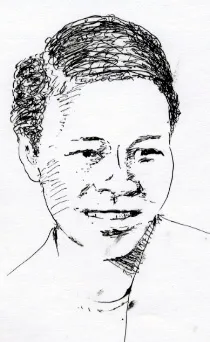
Lolatta / CC BY-SA 4.0 via Wikimedia Commons
Deolinda Rodrigues
Walked out on a US degree in 1962 because the struggle needed her more than a diploma.
Angolan revolutionary, poet and translator who corresponded with Martin Luther King Jr., co-founded the MPLA's women's organisation, marched with the guerrilla Camy Squadron, and was captured and executed at 29. Angola marks Women's Day on the date of her capture.
Biography
Deolinda Rodrigues Francisco de Almeida was born on 10 February 1939 in Catete, east of Luanda, into a Methodist family that prized books in a colony determined to keep Africans from them. She was a relative of Agostinho Neto, the poet-doctor who would lead Angola's liberation movement, and she grew up inside the small, watched world of educated Angolans under Portuguese rule. She wrote from childhood: poems, essays, and later a diary that would outlive her.
A Methodist scholarship carried her to Brazil in 1959 to study sociology in São Paulo. There, improbably, the Angolan teenager began a correspondence with Martin Luther King Jr., trading letters about segregation, colonialism and faith. When her work for the banned MPLA, the People's Movement for the Liberation of Angola, made her a target for extradition to Portugal, she fled Brazil and continued her studies at Drew University in New Jersey. She could have stayed. An American degree, a safe career, a life. In 1962 she walked away from all of it and travelled to Léopoldville in the Congo, where the MPLA operated in exile, because, as she wrote, the struggle needed her more than she needed a diploma.
She became the only woman on the MPLA's central committee in those years and did every job the movement had: translator across her several languages, teacher, nurse-trainer, presenter on the rebel radio programme Angola Combatente. In 1962 she co-founded the Organização da Mulher Angolana, the Organisation of Angolan Women, built on her conviction that a liberation that left women behind would be no liberation at all. She also trained as a fighter, one of five women in the Esquadrão Kamy, a guerrilla unit formed to reinforce MPLA forces inside Angola.
In March 1967, while attempting to cross into Angola with the squadron, Deolinda and four comrades, Engrácia dos Santos, Irene Cohen, Lucrécia Paim and Teresa Afonso, were captured by fighters of the rival FNLA. They were held at the Kinkuzu prison camp, tortured, and executed in 1968. She was twenty-nine. Her diary, smuggled through the decades, was finally published in 2003 as Diário de um exílio sem regresso, the diary of an exile without return.
Historical Context
Portugal was the last and most obstinate of Europe's colonial powers, insisting into the 1970s that Angola was not a colony but a province of Portugal itself. The independence war that began in 1961 was fought not by one movement but by three, and the rivalry between the MPLA and the FNLA was lethal long before it exploded into the post-independence civil war. That is what killed Deolinda: not the Portuguese army but a rival liberation movement. Her death is a window into the tragedy folded inside Angola's independence struggle, in which the fighters' cruelest enemies were sometimes each other.
What She Fought For
An Angola free of Portuguese rule, and inside that fight, a second one: the full participation of women, as thinkers, organisers and combatants rather than auxiliaries. Her diary records her frustration with comrades who wanted women's hands but not their voices. She fought with a rifle, but also with translations, broadcasts, lessons and poems, treating culture and education as weapons no less than the gun.
Major Achievements
- Corresponded with Martin Luther King Jr. as a student, connecting the Angolan struggle to the global fight against racial oppression.
- Abandoned safety and study abroad in 1962 to join the MPLA in exile, becoming the only woman on its central committee in the 1960s.
- Co-founded the Organização da Mulher Angolana (OMA) in 1962; it remains one of Angola's largest women's organisations.
- Served the movement as translator, educator and voice of the radio programme Angola Combatente.
- Joined the Esquadrão Kamy as one of its five women fighters.
- Left a posthumously published diary and poems now central to Angolan literature of the liberation era.
Her Impact Today
Angola remembers her every year on 2 March, the Day of the Angolan Woman, fixed to the date of her capture. She and her four comrades are honoured as the Five Heroines, taught to schoolchildren and commemorated in monuments and street names. A 2014 documentary carried her story to new audiences, and her diary gives historians something precious and rare: the inner voice of an African woman revolutionary, doubting, believing, and choosing the struggle anyway, in her own words.
Wikipedia (Deolinda Rodrigues), Diário de um exílio sem regresso (2003), histories of the Angolan liberation struggle and the Organização da Mulher Angolana.
Cite this page
HerStory Africa. (1968). Deolinda Rodrigues. HerStory Africa. Retrieved October 15, 2026, from https://herstoryafrica.com.ng/women/deolinda-rodrigues
"Deolinda Rodrigues." HerStory Africa, 1968, https://herstoryafrica.com.ng/women/deolinda-rodrigues. Accessed 15 Oct 2026.
HerStory Africa. "Deolinda Rodrigues." Accessed October 15, 2026. https://herstoryafrica.com.ng/women/deolinda-rodrigues.