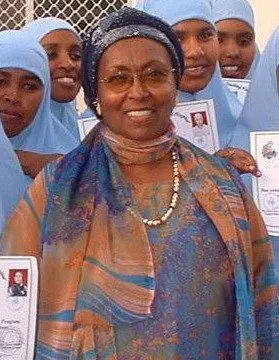
Edna Adan Ismail during a UN Envoy visit to Hargeisa, 2020 / United Nations photo / Public Domain via Wikimedia Commons
Edna Adan Ismail
A retired UN official, a garbage dump in Hargeisa, and 30,000 babies delivered safely.
Somaliland's first qualified nurse-midwife sold everything she owned to build a maternity hospital on a former garbage dump, where she has overseen the safe delivery of more than 30,000 babies and trained thousands of midwives.
Biography
The land they offered her was a garbage dump. It had also been an execution ground during the war. Edna Adan Ismail looked at it and saw a maternity hospital. She was in her sixties, a retired United Nations official who could have spent her pension comfortably anywhere in the world. Instead she sold her Mercedes, her jewelry, even her household goods, raised about 300,000 dollars, and started building in Hargeisa.
Edna was born on September 8, 1937, in Hargeisa, then British Somaliland, the daughter of a much-loved doctor. Girls were not sent to school, so her father quietly let her learn alongside the boys he hired a tutor for. But when Edna was eight, while her father was away, her mother and grandmother had her subjected to female genital mutilation, as tradition demanded. Her father was furious when he returned. The pain of that day, and his anger, shaped the rest of her life.
She became a woman of firsts. The first Somali girl to study in Britain, training as a nurse-midwife in London. Her country's first qualified nurse-midwife when she returned in 1961. The first Somali woman with a driving license. First Lady, through her marriage to Mohamed Haji Ibrahim Egal, who became Prime Minister of Somalia and later President of Somaliland. She spent decades with the World Health Organization, serving as a maternal and child health officer and as WHO Representative to Djibouti.
Then came the dump. The Edna Adan Maternity Hospital opened its doors on March 9, 2002. The next year she became Somaliland's Foreign Minister, serving from 2003 to 2006, the only woman in the cabinet. In 2023, at age 85, she won the Templeton Prize, worth 1.1 million pounds, the largest international prize ever awarded to an individual African woman.
Historical Context
Edna grew up in a British colonial territory where girls were rarely educated and nearly all underwent genital cutting, a practice so widespread that questioning it was almost unthinkable. Somaliland united with Italian Somalia in 1960 to form the Somali Republic, and for a time Edna served that new nation as its most qualified health professional.
Then the state turned on her homeland. In the 1980s, the dictatorship of Siad Barre bombed Hargeisa into rubble during the Somaliland war. When Somaliland declared its independence in 1991, it inherited a shattered healthcare system, some of the world's worst maternal and infant mortality rates, and a government almost no other country recognized. Trained doctors and nurses had fled or been killed.
This was the world Edna came home to: a city rebuilding itself from ash, mothers dying in childbirth for lack of a single trained midwife, and a tradition of cutting girls that endangered them at birth and in labor for the rest of their lives.
What She Fought For
Edna's fight began in her own body. What was done to her at eight years old, she saw done to millions of girls, and as a midwife she saw its full cost: infections, agonizing childbirth, babies and mothers lost. She became one of the world's most powerful voices against female genital mutilation, taking the fight to the WHO in 1976, when the subject was barely mentionable, and insisting that Islam forbids the practice. Ending it, she says, is "simply a matter of will."
Her second fight was against death in childbirth. Her own mother lost two of her five children at delivery. Edna's answer was not just one hospital but a multiplication strategy: train midwives, who train more midwives, who spread across the Horn of Africa. Her stated dream was to train 1,000 midwives for her country.
The turning point came when she retired. Everything she had, the pension, the car, the jewelry, went into the ground of that former garbage dump. People thought she was mad. Twenty years later, her hospital had delivered more than 30,000 babies, cut maternal mortality in its region by as much as 75 percent, and grown a university. She still lives at the hospital, and students still find her on the wards.
Major Achievements
- Became Somaliland's first qualified nurse-midwife in 1961, after training in Britain, and was the first Somali woman to drive
- Built the Edna Adan Maternity Hospital (opened 2002) on a former garbage dump and execution ground in Hargeisa, funding it with her UN pension and the sale of her possessions
- Oversaw the safe delivery of more than 30,000 babies and cut maternal mortality in her hospital's care by up to 75 percent
- Founded Edna Adan University (2010) and trained more than 4,000 midwives and health professionals
- Served as Somaliland's Foreign Minister (2003-2006) and earlier as its first female cabinet minister
- Awarded the 2023 Templeton Prize, the first African woman to receive it
Her Impact Today
Edna, now in her late eighties, still works at her hospital, which has become a teaching institution where 70 percent of students are women. The midwives she trained deliver babies in villages and towns across Somaliland and beyond, each one a link in the chain she started. Kate Grant of the Fistula Foundation called her "the Muslim Mother Teresa."
Her voice against FGM has traveled through the documentary Half the Sky, her memoir A Woman of Firsts, and platforms like BBC's Desert Island Discs. She reframed the practice for the world: not as culture, but as a preventable harm that a determined generation can end.
Perhaps her deepest legacy is proof of what one person's savings, stubbornness, and skill can build. A garbage dump became a place where life begins safely. As she puts it, being seen and copied is the point: young women in Somaliland now grow up knowing a nurse can become a foreign minister, and a retiree can build a hospital.
Wikipedia (Edna Adan Ismail), Templeton Prize / John Templeton Foundation announcement (2023), The Heroine Collective, Friends of Edna Maternity Hospital (friendsofedna.org), ABC News "Half the Sky" feature.
Cite this page
HerStory Africa. (1937). Edna Adan Ismail. HerStory Africa. Retrieved October 1, 2026, from https://herstoryafrica.com.ng/women/edna-adan-ismail
"Edna Adan Ismail." HerStory Africa, 1937, https://herstoryafrica.com.ng/women/edna-adan-ismail. Accessed 1 Oct 2026.
HerStory Africa. "Edna Adan Ismail." Accessed October 1, 2026. https://herstoryafrica.com.ng/women/edna-adan-ismail.