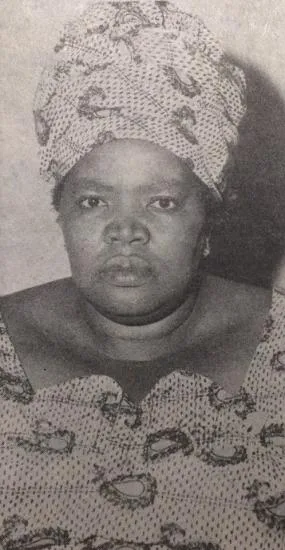
Author unknown / Public Domain via Wikimedia Commons
Elisabeth Domitien
The market trader who ran a government in 1975 and refused to bless an emperor's crown.
Businesswoman and politician who in 1975 became Prime Minister of the Central African Republic, the first woman ever to lead a government anywhere in Africa, and who lost the job within a year for telling Bokassa to his face that he should not crown himself emperor.
Biography
Elisabeth Domitien was born in 1925 near Bangui, in what was then the French colony of Ubangi-Shari. She had little formal schooling. What she had instead was a genius for commerce. Starting with small trade in the markets, she built interests in coffee, cattle and retail until she ranked among the wealthiest self-made women in the country. Market women knew her. Farmers knew her. When she spoke in Sango, the language of the streets and the villages, people stopped to listen.
Politics found her early. From around 1950 she was active in MESAN, the independence movement founded by Barthélemy Boganda, and she stayed with the party through independence in 1960 and the coup that brought Jean-Bédel Bokassa to power in 1966. Bokassa needed someone who could speak to ordinary Central Africans with credibility he lacked, and Domitien could. By 1972 she was vice-president of the party.
On 2 January 1975, Bokassa appointed her Prime Minister. No woman had ever held that office in any African country. The appointment made headlines around the world, though Bokassa kept real power in his own hands and seems to have intended her partly as decoration for a regime that badly needed good news. Domitien declined to play the part. When Bokassa began talking openly of turning the republic into a monarchy with himself as emperor, she opposed the idea publicly. In April 1976 he dismissed her, and in December of that year he crowned himself Emperor Bokassa I in a ceremony that consumed a quarter of the country's annual revenue.
After French troops removed Bokassa in 1979, Domitien was arrested and tried in 1980, accused of having concealed knowledge of the regime's crimes. She was briefly imprisoned and barred from political life. She went back to what she had always done well, business, and lived quietly in Bangui until her death on 26 April 2005.
Historical Context
The Central African Republic of the 1970s was a personal dictatorship wrapped in the costume of a state. Bokassa ruled by decree, whim and fear, and the space for dissent was close to zero. That is the setting in which Domitien's defiance has to be read. Ministers who displeased Bokassa were jailed or worse. She was a woman with no army, no French backing and no independent power base beyond her wealth and her popularity, and she still told the most dangerous man in the country that his imperial project was wrong. She paid for it with her office, and later, unjustly, with a trial for the very crimes she had been sidelined for resisting.
What She Fought For
A functioning republic rather than a throne. Domitien believed in MESAN's original promise, the movement of Boganda that had carried the country to independence, and she used her platform to argue for ordinary traders and farmers, the people she had risen from. As Prime Minister she pushed for sound management of the economy she knew firsthand as a businesswoman. Above all she defended the simple, costly principle that a head of state is not a king.
Major Achievements
- Built one of the most successful African-owned trading businesses in the Central African Republic, starting from market stalls.
- Rose to vice-president of MESAN, the country's ruling party, by 1972.
- Became Prime Minister on 2 January 1975, the first woman to head a government in the history of the African continent.
- Publicly opposed Bokassa's plan to declare himself emperor, one of the very few senior figures to do so, at direct personal risk.
- Remained, decades after her death, the only woman ever to have served as the country's Prime Minister.
Her Impact Today
Every list of Africa's women heads of government begins with her name. Ellen Johnson Sirleaf, Joyce Banda, Sahle-Work Zewde and Samia Suluhu Hassan all stand in a line that starts in Bangui in January 1975, with a market trader who had taught herself everything. In the Central African Republic she is remembered with a certain rueful pride: the leader who saw the catastrophe of the empire coming and said so out loud, when saying so was the most dangerous thing a person could do.
Wikipedia (Elisabeth Domitien), Encyclopædia Britannica, BBC obituary (2005), histories of the Bokassa regime.
Cite this page
HerStory Africa. (2005). Elisabeth Domitien. HerStory Africa. Retrieved October 1, 2026, from https://herstoryafrica.com.ng/women/elisabeth-domitien
"Elisabeth Domitien." HerStory Africa, 2005, https://herstoryafrica.com.ng/women/elisabeth-domitien. Accessed 1 Oct 2026.
HerStory Africa. "Elisabeth Domitien." Accessed October 1, 2026. https://herstoryafrica.com.ng/women/elisabeth-domitien.