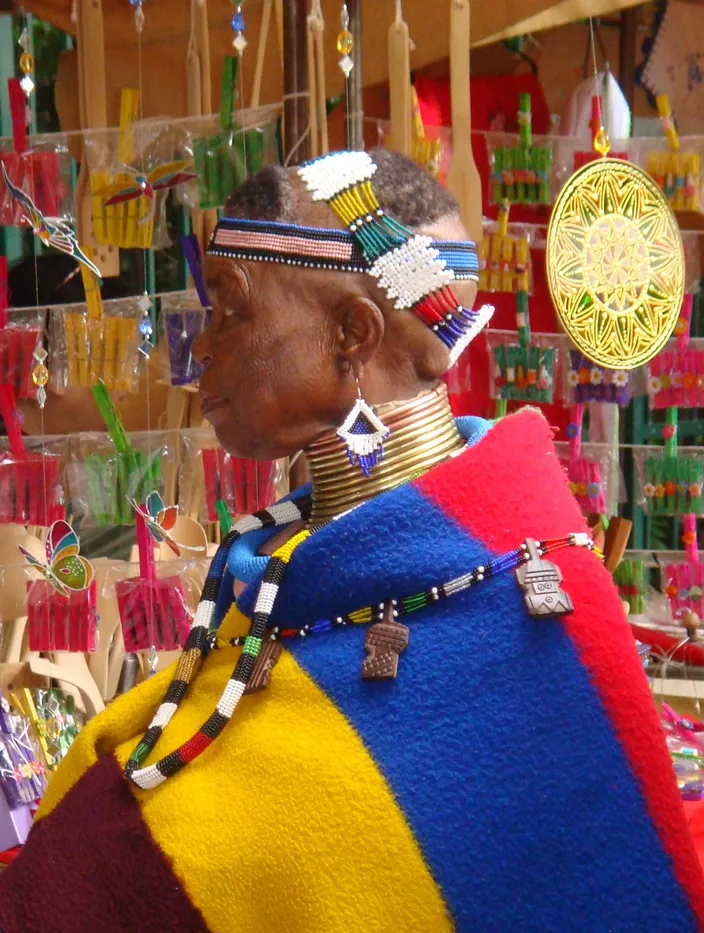
Photo: Claudia_midori / CC BY 2.0 via Wikimedia Commons
Esther Mahlangu
Painted a BMW in Ndebele patterns in 1991, freehand, with a chicken feather.
South African Ndebele artist who learned to paint murals at ten with chicken feathers, and in 1991 became the first woman and first African to paint a BMW Art Car, carrying her people's geometric patterns from a village wall to museums around the world.
Biography
In 1991, a BMW rolled out of a studio wearing the colours of a South African village. Zigzags, triangles, bold black outlines: the patterns Ndebele women had painted on their houses for generations now covered a German luxury car. The artist was Esther Mahlangu, a 55 year old woman who had never taken a formal art class. Before her, the BMW Art Car series had belonged to famous men like Andy Warhol and Roy Lichtenstein. She was the first woman, and the first African, ever asked.
Esther Nikwambi Mahlangu was born in November 1935 near Middelburg, in what is now Mpumalanga province, the eldest of nine children in a Southern Ndebele family. At ten she began learning the art that Ndebele mothers pass to their daughters: mixing pigments, steadying the hand, drawing crisp geometric designs on the walls of the homestead. Her brush was a chicken feather. "I always watched my mother and grandmother when they were decorating the house," she remembered. To this day she paints her perfectly straight lines freehand, without rulers, sketches or tape.
For decades her canvas was her own home. Then, in the late 1980s, French researchers documenting Ndebele house painting spotted her boldly decorated homestead, and in 1989 she was invited to Paris for the landmark exhibition Magiciens de la terre at the Centre Pompidou. During her two month stay she painted a life-size replica of her house while thousands watched. The BMW commission followed in 1991, then British Airways plane tails in 1997, a Belvedere vodka bottle for the (RED) campaign with singer John Legend in 2016, a hand-painted Rolls-Royce Phantom interior in 2020, and in 2024 a colour-changing BMW i5 concept car. In March 2022, at 86, she survived a brutal robbery in her home: an intruder punched her, tied her hands with a cable and strangled her unconscious before stealing money and her pistol. She recovered, and she kept painting. In November 2025 she celebrated her 90th birthday with a new exhibition in her honour, and her work headlined the 2026 LA Art Show.
Historical Context
The Ndebele people of South Africa developed their striking mural tradition partly as a language of identity. After their defeat by Boer settlers in the 1880s, Ndebele families were scattered onto white-owned farms, and painting their homes in bold geometric patterns became a quiet declaration: we are still here, and we are still ourselves. The work belonged to women. A well-painted wall told travellers who lived there and announced weddings, prayers and status. Girls learned it from their mothers, as Esther did in the 1940s.
Esther's rise to fame came at a charged moment. Through the 1970s and 1980s, apartheid South Africa was isolated from the world, its Black artists largely invisible to the international art market. When Magiciens de la terre opened in Paris in 1989, deliberately placing artists from Africa, Asia and Latin America alongside Western stars, the wall between "craft" and "art" was starting to crack. Nelson Mandela walked free in 1990. Mahlangu's BMW Art Car came the very next year, a piece of African art speeding into spaces that had never made room for it.
What She Fought For
Esther Mahlangu never carried a placard. Her fight was made of paint. Every mural, canvas and car she covered in Ndebele designs was an argument that the art of African women belongs in the same room as Picasso and Warhol, and that a tradition passed down in villages is not a relic but a living, moving thing.
The turning point came when she said yes to Paris in 1989. She could have painted her replica house quietly and gone home. Instead she painted in full traditional dress, in front of enormous crowds, exactly as she painted at home, and refused to change a single thing about her technique to seem more "modern". When BMW called two years later, she did the same on steel and chrome. The car was later shown at the National Museum of Women in the Arts in Washington in 1994 and at the British Museum in 2016. The patterns were never diluted. The world simply came to her.
Her second battle has been against forgetting. Worried that young Ndebele girls no longer sat beside their mothers learning to paint, she opened an art school at her own homestead, teaching children to mix pigment and pull straight lines with chicken feathers. "It is my passion to transfer this skill to the generations after me," she says. Even the violent attack she survived in 2022 did not stop the lessons or the work.
Major Achievements
- First woman and first African artist commissioned to paint a BMW Art Car (1991), joining a series that included Andy Warhol and Roy Lichtenstein
- Represented Ndebele mural art at the historic Magiciens de la terre exhibition at the Centre Pompidou in Paris (1989), painting a full-size replica of her house before huge audiences
- Global collaborations spanning British Airways (1997), Belvedere (RED) with John Legend (2016), a Rolls-Royce Phantom (2020) and the BMW i5 Flow Nostokana (2024)
- Awarded South Africa's Order of Ikhamanga (2006) and honorary doctorates from universities including Johannesburg, Durban, Tshwane and UNISA, which honoured the mathematics hidden in her geometry
- Major retrospective "Then I Knew I Was Good at Painting" opened in Cape Town in 2024 with more than 100 artworks, alongside her induction as a national arts legend
- Founded an art school at her home to pass Ndebele painting techniques to new generations
Her Impact Today
Walk through an airport, scroll an online gallery, or watch a sneaker release, and you may see Ndebele geometry: much of that global visibility traces straight back to Esther Mahlangu. She turned a house-painting tradition into one of Africa's most recognisable visual languages, and she did it while insisting on chicken feathers, freehand lines and full credit to the women who taught her.
Now in her tenth decade and still exhibiting, she has become living proof that "traditional" and "contemporary" are not opposites. Museums from Washington to London have shown her work, and young South African artists cite her as the person who kicked the door open. Her students, many of them girls from her own village, are already painting.
Her story also carries a quieter lesson about value. The world discovered her when she was over 50. Fame did not change her method, her village or her dress. As she told one interviewer, her calling was always the same: to paint, and to teach. The walls she painted first were her mother's. The walls she paints now belong to everyone.
Wikipedia (Esther Mahlangu); Artsy, "Esther Mahlangu Is Keeping Africa's Ndebele Painting Alive"; She Leads Africa interview; TimesLive (21 March 2022) on the robbery; Good Things Guy and Sowetan (November 2025) on her 90th birthday; BMW Group press materials; See Great Art on the 2026 LA Art Show.
Cite this page
HerStory Africa. (1935). Esther Mahlangu. HerStory Africa. Retrieved October 1, 2026, from https://herstoryafrica.com.ng/women/esther-mahlangu
"Esther Mahlangu." HerStory Africa, 1935, https://herstoryafrica.com.ng/women/esther-mahlangu. Accessed 1 Oct 2026.
HerStory Africa. "Esther Mahlangu." Accessed October 1, 2026. https://herstoryafrica.com.ng/women/esther-mahlangu.