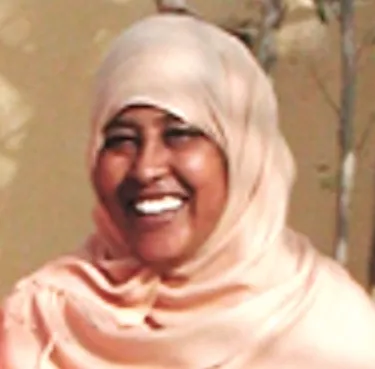
Solar Cookers International Network / Public domain via Wikimedia Commons
Fatima Jibrell
Talked Puntland into banning charcoal exports in 2000 and cut them by 80 percent.
Somali environmentalist who took on the warlord-financed 'charcoal wars' devastating her country's acacia forests, won an 80% cut in charcoal exports, and earned the Goldman Environmental Prize, all in a country with no functioning state.
Biography
Fatima Jama Jibrell was born on 30 December 1947 in the Sanaag region of northern Somalia to a nomadic pastoralist family; her father was a merchant marine who settled in New York City. She attended a British boarding school in Somalia until sixteen, then joined her father in the United States to finish high school. Married in 1969 to Somali diplomat Abdurahman Mohamoud Ali, she began her studies at the University of Damascus while posted abroad, completed a BA in English in the United States, and earned a Master's in Social Work at the University of Connecticut. She raised five daughters, including Degan Ali, now a prominent humanitarian leader in her own right.
When civil war and famine engulfed Somalia from 1991, Jibrell co-founded the Horn of Africa Relief and Development Organization (Horn Relief, renamed Adeso in 2012) and served as its executive director until 2006. Her signature battle was against the export charcoal trade: with no functioning government, warlords financed themselves by felling acacia trees, some centuries old, to burn into "black gold" charcoal for Gulf markets, stripping the rangelands that Somalia's pastoralists depend on. In 1999 Horn Relief organised a peace march in Puntland against the "charcoal wars," and in 2000 Jibrell persuaded Puntland's government to ban charcoal exports, cutting them by a reported eighty percent.
She co-founded Sun Fire Cooking to spread butterfly solar cookers as a charcoal alternative, helped create the Women's Coalition for Peace, and won the Goldman Environmental Prize in 2002, the National Geographic Society/Buffett Award for conservation leadership in 2008, and a UNEP Champions of the Earth award in 2014. In 2008 she wrote and co-produced the short film "Charcoal Traffic," and in 2011 co-authored the photo book "Peace and Milk: Scenes of Northern Somalia." She remains a senior adviser and lifetime board member of Adeso.
Historical Context
Somalia's state collapse in 1991 brought civil war, famine and lawlessness. With no government to regulate anything, unregulated charcoal exports to the Arabian Peninsula became a warlord revenue stream and an ecological catastrophe for the nomadic pastoralists who make up most of the population. Jibrell worked through the emerging regional administration of Puntland, established in 1998, pioneering environmental governance in a stateless context and proving that the environment could be defended even where the state had ceased to exist.
What She Fought For
Stopping the export charcoal trade; protecting old-growth acacia and pastoral rangelands; solar energy as a practical alternative to charcoal; women's role in peacemaking; and the insight that ran through all of it: that environmental degradation and armed conflict feed each other, and neither can be ended alone.
Major Achievements
- Co-founded the Horn of Africa Relief and Development Organization, now Adeso, one of Somalia's most important homegrown NGOs (1991).
- Organised the 1999 Puntland peace march against the "charcoal wars."
- Won a Puntland ban on charcoal exports in 2000, with exports reportedly falling around eighty percent.
- Goldman Environmental Prize for Africa (2002), the world's top grassroots environmental award.
- National Geographic Society/Buffett Foundation Award for Leadership in Conservation (2008).
- UNEP Champions of the Earth award (2014), the United Nations' highest environmental honour.
Her Impact Today
Adeso continues as a leading African-led humanitarian organisation, led for years by her daughter Degan Ali, a global voice for putting aid in local hands. Jibrell's framing of charcoal as a conflict resource shaped later UN Security Council action, which banned Somali charcoal exports in 2012. She remains the face of Somali environmentalism: proof that one woman, in a country the world had written off as ungovernable, could make trees a matter of national security.
Goldman Environmental Prize, Wikipedia (Fatima Jibrell), UNEP Champions of the Earth, Adeso, Wikimedia Commons, Worldpress.org.
Cite this page
HerStory Africa. (1947). Fatima Jibrell. HerStory Africa. Retrieved October 1, 2026, from https://herstoryafrica.com.ng/women/fatima-jibrell
"Fatima Jibrell." HerStory Africa, 1947, https://herstoryafrica.com.ng/women/fatima-jibrell. Accessed 1 Oct 2026.
HerStory Africa. "Fatima Jibrell." Accessed October 1, 2026. https://herstoryafrica.com.ng/women/fatima-jibrell.