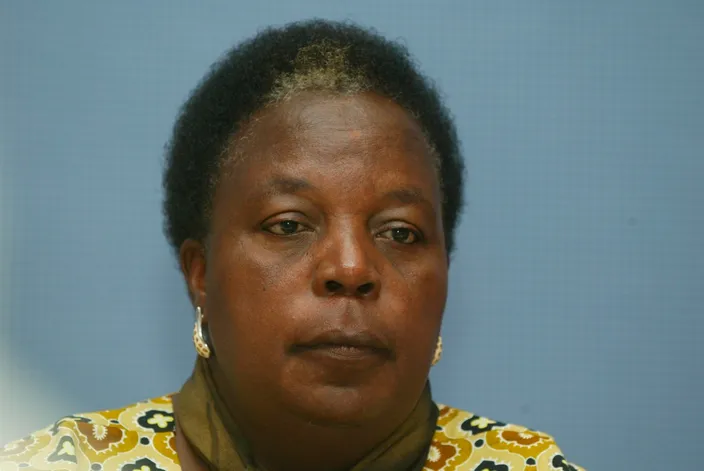
Jan Van de Vel / © European Communities 2003, EC Audiovisual Service / CC BY 4.0 via Wikimedia Commons
Gertrude Mongella
Ran the Beijing conference of 1995, and 189 countries signed what came out of it.
Tanzanian stateswoman who served as Secretary-General of the 1995 Beijing World Conference on Women, the summit that produced the world's defining gender-equality blueprint, and became the first President of the Pan-African Parliament.
Biography
Gertrude Ibengwe Mongella was born on 13 September 1945 on Ukerewe Island in Lake Victoria, in what was then Tanganyika. She graduated from the University of East Africa in Dar es Salaam in 1970, spent four years tutoring at the Dar es Salaam Teachers Training College, and worked as a curriculum developer at the Institute of Education from 1974 to 1978. Politics claimed her early: she sat in the East African Legislative Assembly in the mid-1970s and represented Ukerewe in Tanzania's Parliament from 1980 to 1993, and again from 2000 to 2010. She held successive cabinet posts, serving as Minister of State in the Prime Minister's office (1982–1988), Minister of Lands, Tourism and Natural Resources (1985–1987), and Minister without Portfolio (1987–1990), before serving as Tanzania's High Commissioner to India.
Her global profile was built at the United Nations. After serving as vice-chair of the 1985 Nairobi World Conference closing the UN Decade for Women, she was appointed Secretary-General of the Fourth World Conference on Women held in Beijing in 1995, the largest UN conference ever convened to that point, drawing some 50,000 participants. Under her stewardship, 189 countries adopted the Beijing Declaration and Platform for Action, the most comprehensive global agenda for women's equality ever agreed. She then served as UN Under-Secretary and Special Envoy on Women's Issues from 1996 to 1997.
In March 2004, delegates in Midrand, South Africa elected her the first President of the newly created Pan-African Parliament, the legislative body of the African Union, making her, in effect, the continent's first parliamentary leader. She served until 2009 and has remained an active elder stateswoman on gender and governance across Africa ever since.
Historical Context
Mongella came of age in Julius Nyerere's newly independent Tanzania, where the ujamaa era's expansion of education created rare openings for women in public life. Her Beijing role came at the high-water mark of the great UN world conferences of the 1990s, when global norms on human rights, population and gender were being rewritten. Her Pan-African Parliament presidency coincided with the African Union's founding push to give the continent shared democratic institutions.
What She Fought For
Her life's argument is that women's rights are human rights and must be written into the machinery of government, not left to goodwill. The Beijing Platform for Action she delivered institutionalised that idea across twelve critical areas, among them poverty, education, health, violence against women, and power-sharing. As Pan-African Parliament president she fought for a united, democratic Africa with women seated at the decision-making table rather than petitioning outside it.
Major Achievements
- Held a series of Tanzanian cabinet posts from 1982 to 1990, among the most senior women in the country's politics.
- Vice-chair of the 1985 Nairobi World Conference on the UN Decade for Women.
- Secretary-General of the Fourth World Conference on Women in Beijing (1995), at UN Assistant Secretary-General rank, delivering the Beijing Declaration and Platform for Action adopted by 189 nations.
- UN Under-Secretary and Special Envoy on Women's Issues (1996–1997).
- Elected first President of the Pan-African Parliament (2004–2009).
- Awarded the Delta Prize for Global Understanding (2005).
Her Impact Today
The Beijing Platform for Action remains the world's reference framework for gender-equality policy, revisited at every Beijing+25 and Beijing+30 review, and Mongella is celebrated across the continent as "Mama Beijing." She proved that an African woman could lead both the largest women's summit in history and Africa's first continental parliament, a double first that widened the horizon for every woman in public life who followed her.
Wikipedia (Gertrude Mongella), Pan-African Parliament records, UN Fourth World Conference on Women archives, EC Audiovisual Service, Delta Prize for Global Understanding.
Cite this page
HerStory Africa. (1945). Gertrude Mongella. HerStory Africa. Retrieved October 1, 2026, from https://herstoryafrica.com.ng/women/gertrude-mongella
"Gertrude Mongella." HerStory Africa, 1945, https://herstoryafrica.com.ng/women/gertrude-mongella. Accessed 1 Oct 2026.
HerStory Africa. "Gertrude Mongella." Accessed October 1, 2026. https://herstoryafrica.com.ng/women/gertrude-mongella.