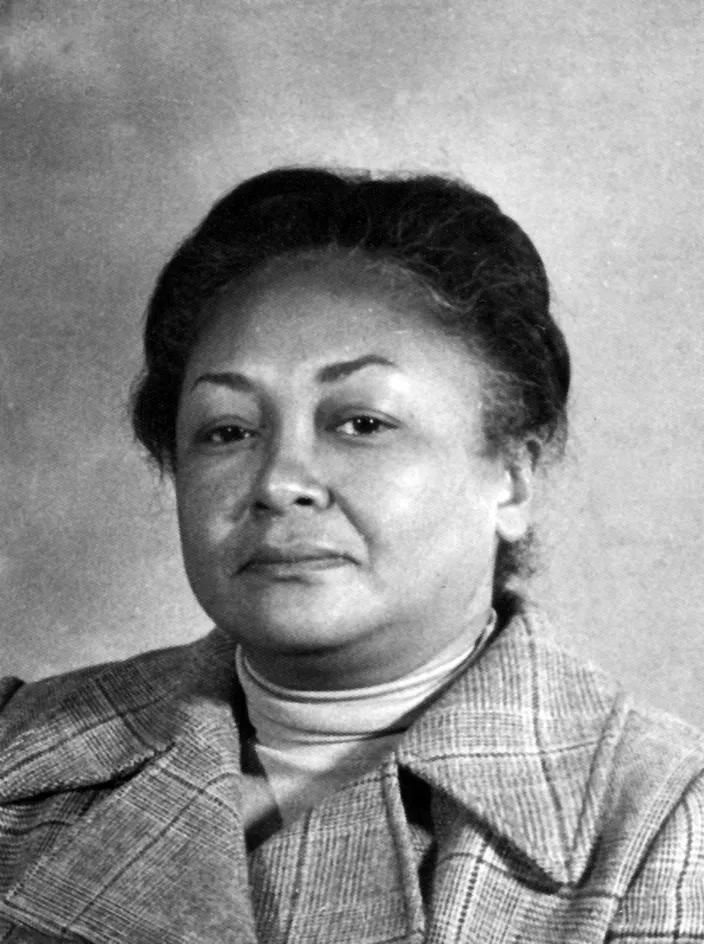
UNESCO 'Women in African History' / Rabesahala family archives / CC BY-SA via Wikimedia Commons
Gisèle Rabesahala
Defended the prisoners of 1947 when no one else in Madagascar would.
Madagascar's pioneering stateswoman: at 17 she joined the nationalist struggle, at 27 became the first Malagasy woman to lead a political party, and in 1977 became the country's first woman government minister.
Biography
Gisèle Rabesahala was born on 7 May 1929 in Antananarivo into a politically conscious family. Her father was a non-commissioned officer in the French colonial army, and the family lived in France, Tunisia and Mali before returning to Madagascar in 1942 after his death. Unusually for a Malagasy girl of her era, she received a formal education and trained in typing and stenography. She briefly considered religious life before choosing politics: at seventeen she entered nationalist circles in the aftermath of the 1947 Malagasy Uprising, which France crushed with mass killings and mass trials of nationalists.
She became secretary-general of the Comité de Solidarité de Madagascar, campaigning for amnesty and legal defence for political prisoners and support for the families of victims of the 1947 repression. In 1956 she made history twice: she was elected Madagascar's first female municipal councillor, in Antananarivo, and she founded the Union of the Malagasy People, becoming the first woman to lead a Malagasy political party. In 1958 she co-founded the AKFM, the Congress Party for the Independence of Madagascar, uniting five nationalist organisations, and she served for decades as a leading figure of the nationalist left while sitting on the editorial board of the newspaper Imongo Vaovao from its founding until her death.
After the 1975 socialist revolution she represented Antananarivo in the National Assembly, and in 1977 she became Madagascar's first woman government minister, responsible for culture, a post she held until 1991. In later life she remained active as a senator, adviser to president and prime minister, and journalist. She died on 27 June 2011, aged 82; UN Secretary-General Ban Ki-moon hailed her as "a great daughter of Madagascar and an example to the world."
Historical Context
Rabesahala's career spans the brutal aftermath of the 1947 uprising, in which French forces killed tens of thousands, the negotiated independence of 1960, the socialist Second Republic of 1975, and the 1990s transition to multiparty democracy. She was a protagonist in every phase, and for most of that time she was the only woman in the room.
What She Fought For
National independence; amnesty for the political prisoners of colonial repression; the dignity of Malagasy culture and language; women's place in public life; and the poor, whose cause she pressed while opposing foreign interference in Madagascar's affairs.
Major Achievements
- Secretary-general of the Malagasy Solidarity Committee, leading the defence and amnesty campaigns for prisoners of the 1947 uprising.
- First woman elected a municipal councillor in Madagascar (1956).
- First Malagasy woman to lead a political party, the Union of the Malagasy People (1956).
- Co-founded the AKFM independence party (1958).
- First woman minister in Madagascar's history, holding the culture portfolio from 1977 to 1991.
- Chosen by UNESCO as one of its "Women in African History" heroines.
Her Impact Today
Rabesahala broke every glass ceiling in Malagasy politics decades before quotas existed. UNESCO's "Women in African History" e-learning series carries her story to classrooms across the continent, and in Madagascar she is remembered as the conscience of the nationalist movement: the woman who defended the prisoners no one else would, and who never once used power for herself.
UNESCO "Women in African History" project, Wikipedia (Gisèle Rabesahala), Wikimedia Commons, UN Secretary-General statements (2011).
Cite this page
HerStory Africa. (2011). Gisèle Rabesahala. HerStory Africa. Retrieved October 1, 2026, from https://herstoryafrica.com.ng/women/gisele-rabesahala
"Gisèle Rabesahala." HerStory Africa, 2011, https://herstoryafrica.com.ng/women/gisele-rabesahala. Accessed 1 Oct 2026.
HerStory Africa. "Gisèle Rabesahala." Accessed October 1, 2026. https://herstoryafrica.com.ng/women/gisele-rabesahala.