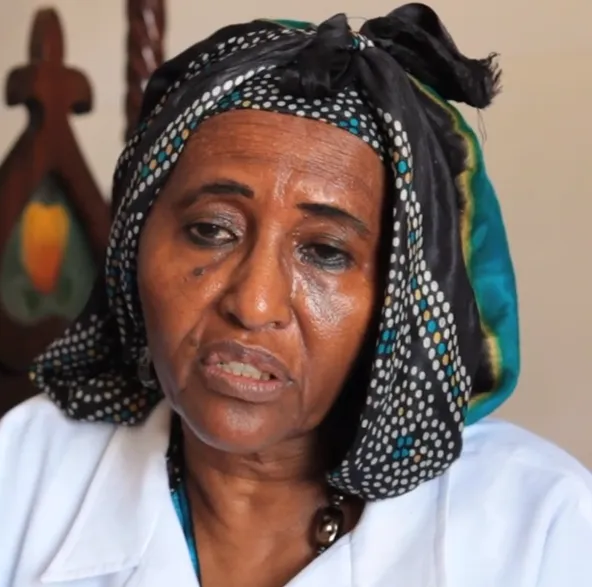
Still: Eunice Lau, from her documentary 'Through the Fire' / CC BY 3.0 via Wikimedia Commons
Hawa Abdi
She faced 750 gunmen at her hospital and made them apologise in writing.
One of Somalia's first female gynecologists turned her one-room farm clinic into a refuge for 90,000 displaced people, and faced down 750 militants who stormed it.
Biography
On May 5, 2010, around 750 armed militants of Hizbul Islam stormed the camp of a 63-year-old doctor near Mogadishu. They shelled the hospital, smashed Somalia's only four incubators, and held Hawa Abdi hostage, demanding she hand her life's work to men. She refused. "I may be a woman, but I am a doctor," she told them. "What have you done for your society?" Within a week, shamed by protests from the very women she had treated, the gunmen withdrew, and gave her a written apology: "We apologize to every hospital patient who suffered from the attack. We apologize to the entire Somali community."
Hawa Abdi Dhiblawe was born on May 17, 1947, in Mogadishu. Her childhood taught her exactly what was at stake: she watched her mother die of complications after a miscarriage, was subjected to genital cutting at seven, and was married off at thirteen. Her first baby died in infancy. At seventeen she won a Soviet scholarship and left for the Kiev Medical Institute, graduating in 1971 and returning as one of Somalia's first female gynecologists. Restless, she added a law degree from Somali National University in 1979 while practicing medicine.
In 1983, using family land and family gold, she opened a one-room clinic in the Lower Shabelle region, about 25 kilometers from Mogadishu, offering free care to rural women. Then the state collapsed. When civil war engulfed Somalia in 1991, desperate families streamed onto her farm, and Mama Hawa turned nobody away. The clinic grew into a 400-bed hospital with three operating theaters, a school for about 850 children, and feeding centers. At its height, roughly 90,000 displaced people, mostly women and children, lived on her 1,300 acres in what became known as Hawa Abdi Hope Village.
She ran it by two iron rules: no one could talk of clan inside her gates, and any man who beat his wife could expect a spell in the camp's small jail. She was nominated for the Nobel Peace Prize in 2012 and died in Mogadishu on August 5, 2020, at 73.
Historical Context
Hawa came of age in a newly independent Somalia where medicine was a man's profession and girls were routinely cut and married as children. Cold War politics opened her escape route: a Soviet scholarship program that trained a generation of Somali professionals abroad.
In 1991 the dictatorship of Siad Barre fell and Somalia descended into one of the longest state collapses in modern history. Clan militias tore Mogadishu apart, famine followed war, and hundreds of thousands fled along the Afgooye corridor, straight past Hawa's farm. There was no government, no public hospitals, no police. Aid agencies came and went as the danger rose and fell.
By the 2000s, Islamist insurgents, including Hizbul Islam and al-Shabaab, controlled much of southern Somalia and deeply resented the authority of an unveiled, educated woman running what amounted to a small, functioning state. Her camp was, as observers put it, one square mile of peace in a country at war with itself.
What She Fought For
Hawa believed medicine was a form of nation-building. Where the state had dissolved, she supplied its essentials herself: healthcare, schooling, food, and justice. Her camp's rules attacked the two forces she blamed for Somalia's agony, clan hatred and the abuse of women. Banning clan talk made her village one of the only places in Somalia where identity meant simply being Somali. Locking up wife-beaters, in a country with no courts, made women's safety law.
The 2010 siege was the moment her whole philosophy was put to the test at gunpoint. The militants told her that a woman could not run such an institution. Being held hostage in a room by five militia leaders while patients fled mid-surgery, she calculated that her dignity was worth more than her safety. "So they'll shoot me," she said later. "At least I will die with dignity." Her defiance, and the outcry of thousands of women, turned a massacre into a surrender. The apology came in writing because she demanded it in writing.
She fought famine with farmland and fishing cooperatives, ignorance with classrooms, and despair with stubborn, practical hope. Her grandmother's proverb guided her: "Sitting is empty, but working is plenty."
Major Achievements
- Became one of Somalia's first female gynecologists after graduating from the Kiev Medical Institute in 1971, later adding a law degree
- Opened a free one-room clinic on her family farm in 1983 that grew into a 400-bed hospital serving an estimated 2 million people over her lifetime
- Sheltered around 90,000 displaced people in Hawa Abdi Hope Village during Somalia's civil war, with a school, feeding centers, and courts of her own making
- Faced down about 750 Hizbul Islam militants in 2010, refusing to surrender her hospital and extracting a written apology
- Named a Glamour Woman of the Year in 2010 alongside her daughters, and nominated for the Nobel Peace Prize in 2012
- Published her memoir Keeping Hope Alive (2013) and received honorary doctorates from the University of Pennsylvania and Harvard
Her Impact Today
Mama Hawa's two daughters, Dr. Deqo Mohamed and Dr. Amina, both physicians, carry on her work through the Dr. Hawa Abdi Foundation, which still runs the hospital and village on the family land. The institution she began with one room and her family's gold has outlived her, and outlived the war that tried to destroy it.
She proved something radical: that in a failed state, a single determined woman could build and defend everything a government is supposed to provide. Journalists called her the Mother Teresa of Somalia; Hillary Clinton called her an inspiration. Somalia's government mourned her in 2020 as a national hero whose "legacy will live on through the lives she changed."
Her story is now taught, filmed, and retold across Africa as a model of civilian courage. The image endures: an unarmed doctor in her sixties, facing 750 guns, asking the young men holding them the question that shamed a militia, what have you done for your society?
Wikipedia (Hawa Abdi), Dr. Hawa Abdi Foundation (dhaf.org), Puntland Post obituary (2020), Global Citizen obituary (2020), Aquila Style profile, MY HERO project, NPR interview on Keeping Hope Alive (2013).
Cite this page
HerStory Africa. (2020). Hawa Abdi. HerStory Africa. Retrieved October 1, 2026, from https://herstoryafrica.com.ng/women/hawa-abdi
"Hawa Abdi." HerStory Africa, 2020, https://herstoryafrica.com.ng/women/hawa-abdi. Accessed 1 Oct 2026.
HerStory Africa. "Hawa Abdi." Accessed October 1, 2026. https://herstoryafrica.com.ng/women/hawa-abdi.