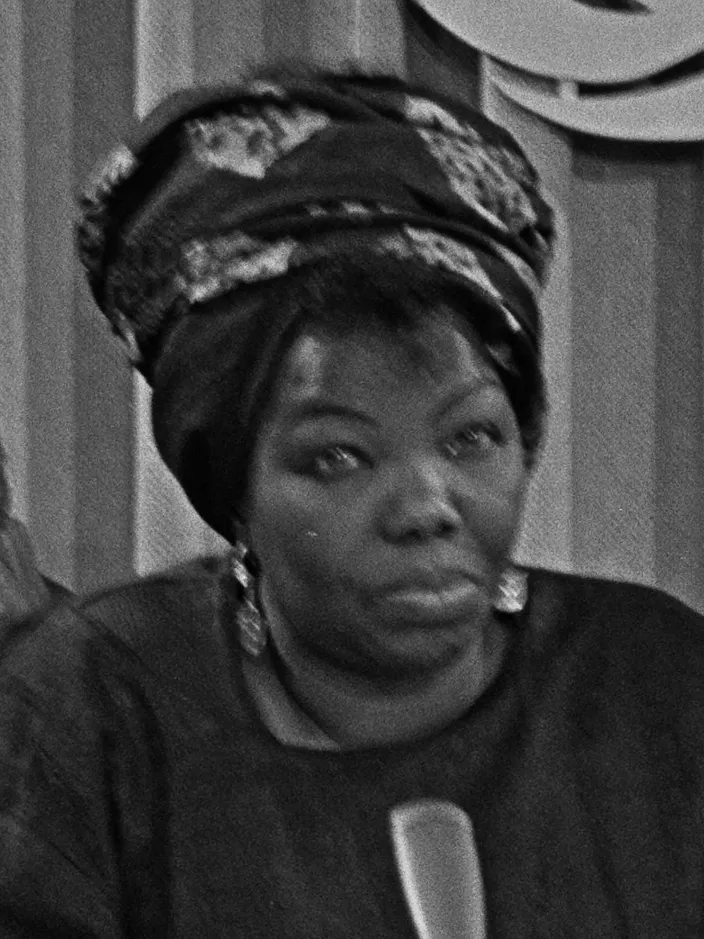
Victoria Missick for the Daily World / Public Domain via Wikimedia Commons
Jeanne Martin Cissé
A Kankan schoolteacher who became the first woman to chair the UN Security Council.
Guinean teacher and diplomat who became the first woman ever to preside over the United Nations Security Council, took delivery of 100,000 petitions against apartheid, and served her country from the classroom to the cabinet until a coup swept it all away.
Biography
Jeanne Martin was born on 6 April 1926 in Kankan, Upper Guinea, under French colonial rule. Bright and stubborn about it, she trained as a teacher at the famous normal school in Rufisque, Senegal, the forge that produced a generation of West African women leaders, and took her first classroom in 1945 at age nineteen. Teaching in colonial Guinea meant watching a system designed to educate as few Africans as possible, and it turned her political. She joined the Rassemblement Démocratique Africain, the great independence movement sweeping French West Africa, and threw herself into organising women alongside her teaching.
Then came 1958, and Guinea's thunderclap. Alone among France's African colonies, Guinea voted No to de Gaulle's proposed community and took immediate, total independence. France withdrew overnight, taking everything down to the office telephones. In the scramble to build a state from nothing, educated Guineans were gold, and Cissé rose fast: into the National Assembly, into the leadership of the ruling party's women's wing, and into the Pan-African Women's Organisation, where she worked with counterparts across the continent and served as secretary-general of the Conference of African Women in the early 1960s.
In 1972 President Sékou Touré sent her to New York as Guinea's Permanent Representative to the United Nations. That November, when the rotating presidency of the Security Council fell to Guinea, Jeanne Martin Cissé became the first woman in history to preside over it. She used the seat the way she used every platform, against colonialism and apartheid. In December 1975, on behalf of the UN Special Committee against Apartheid, she formally received a petition signed by 100,000 Americans demanding South Africa's expulsion from the United Nations. The Soviet Union awarded her the Lenin Peace Prize that same year.
She returned home in 1976 as Minister of Social Affairs, a post she held until 1984, when Sékou Touré died and the military seized power within days. The new junta arrested the old guard, Cissé among them. She was eventually released, withdrew from public life, and in 2009 published her memoir, La Fille du Milo, named for the river that runs through Kankan. She died on 21 February 2017, at ninety.
Historical Context
Cissé's career tracks the whole arc of Guinea's independence generation. The Rufisque normal school gave a handful of African women an education the colonial system never intended to scale. The 1958 No vote made Guinea a symbol of African defiance and a magnet for liberation movements. At the UN in the early 1970s, the Afro-Asian bloc was turning the General Assembly into a weapon against Portuguese colonialism and South African apartheid, and Guinea sat at the sharp end of that fight. But the same regime that lifted her was devouring itself at home. Sékou Touré's Guinea ran the Camp Boiro prison camp, where thousands of real and imagined opponents died, and when the regime fell, its servants, including those who had spent their careers abroad doing honourable work, were caught in the reckoning.
What She Fought For
Schooling for African girls, first as a teacher and always afterwards. Guinea's independence and the larger project of a decolonised Africa. The end of apartheid, pursued through every UN mechanism she could reach. And the then-radical proposition, which she embodied rather than argued, that a West African woman belonged at any table in the world, including the head of it.
Major Achievements
- Trained at Rufisque and began teaching at nineteen, part of the first generation of Guinean women educators.
- Served as secretary-general of the Conference of African Women, helping knit together the continent's early women's movements.
- Became Guinea's Permanent Representative to the United Nations in 1972.
- Presided over the UN Security Council in November 1972, the first woman ever to do so.
- Received 100,000 anti-apartheid petitions on behalf of the UN Special Committee against Apartheid in 1975; awarded the Lenin Peace Prize the same year.
- Served as Guinea's Minister of Social Affairs from 1976 to 1984.
Her Impact Today
Half a century after her Security Council presidency, women in that chair remain a minority, which is a measure of how far ahead of the world she was. In Guinea her name stands for the independence generation's promise before its corruption: the teacher's daughter of the Milo who reached the summit of world diplomacy and used the view to fight for people who had no seat at all. Her memoir is now a primary document of West African women's history, read wherever that history is taught.
Wikipedia (Jeanne Martin Cissé), UN records of the Security Council presidency and Special Committee against Apartheid, La Fille du Milo (2009), obituaries (2017).
Cite this page
HerStory Africa. (2017). Jeanne Martin Cissé. HerStory Africa. Retrieved October 1, 2026, from https://herstoryafrica.com.ng/women/jeanne-martin-cisse
"Jeanne Martin Cissé." HerStory Africa, 2017, https://herstoryafrica.com.ng/women/jeanne-martin-cisse. Accessed 1 Oct 2026.
HerStory Africa. "Jeanne Martin Cissé." Accessed October 1, 2026. https://herstoryafrica.com.ng/women/jeanne-martin-cisse.