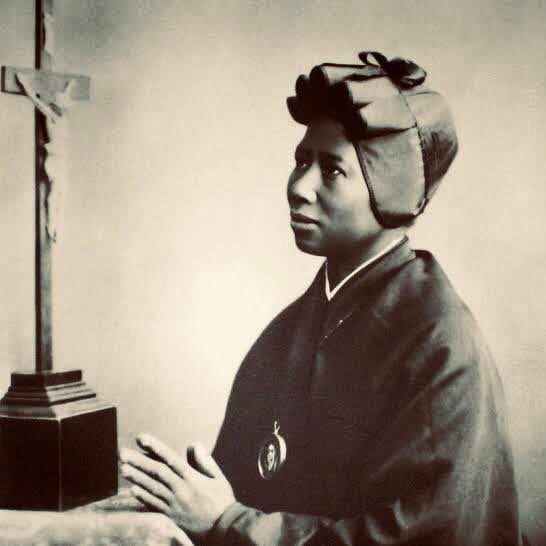
Photograph of Josephine Bakhita, c. 1910 / Wikimedia Commons / CC0
Josephine Bakhita
Kidnapped and enslaved as a child in Darfur, sold five times and scarred with 114 cuts, she won her freedom in an Italian courtroom in 1889 and is now the patron saint of survivors of human trafficking.
Biography
She could not remember her own name. The terror of being kidnapped, around the age of seven, wiped it from her memory forever. The slave traders who seized her from her village of Olgossa, in Darfur, gave her a new one as a cruel joke: Bakhita, Arabic for "lucky." Born around 1869 into a loving, prosperous family of the Daju people, she was marched roughly 600 miles on foot to the slave market at El-Obeid. Over the next twelve years she was sold five times.
Her owners' cruelty was written on her skin. In one household she was subjected to ritual scarification: 114 patterns cut into her chest, stomach, and right arm with a razor, the wounds packed with salt so the scars would rise. She later said that she hardly remembered a day in slavery without a wound. In 1883 her life turned when the Italian vice consul in Khartoum, Callisto Legnani, bought her. In his house, she recalled, no one used the lash to give her orders. It was the first kindness she could remember.
When Legnani returned to Italy, Bakhita begged to go with him. She arrived in Genoa in 1885 and passed to the Michieli family near Venice, caring for their little daughter, Mimmina. When the family's business called them back to Africa, Bakhita and the child were lodged with the Canossian Sisters in Venice, and there Bakhita found a faith that felt like coming home. When Mrs. Michieli returned to collect her, Bakhita refused to leave. The dispute went to court, and on November 29, 1889, an Italian judge ruled that since slavery had never been legal in Italy, Bakhita had been free the moment she set foot there. She was about twenty years old, and free for the first time since childhood.
She chose her own path at last. Baptized Josephine in 1890, kissing the baptismal font with joy, she entered the Canossian order and took her vows in 1896. From 1902 she lived in the town of Schio in northern Italy, spending some 45 years as cook, doorkeeper, and beloved presence. The townspeople called her "Madre Moretta," the Black Mother. She died on February 8, 1947, whispering "Our Lady! Our Lady!"
Historical Context
Bakhita's childhood was destroyed by one of history's great crimes in its final, frantic phase. In the late nineteenth century, the trans-Saharan and Nile Valley slave trades still devoured tens of thousands of people from Sudan and Central Africa each year, feeding markets in Khartoum, Cairo, and beyond. Darfur, remote and contested, was raided relentlessly. European powers had outlawed the Atlantic trade decades earlier, yet slavery within Africa and the Ottoman world persisted, often with colonial officials looking away.
Her rescue was full of irony. Italy, the country where she found freedom, was itself beginning its colonial expansion into Africa. But Italian law contained the principle that saved her: slavery had no legal standing on Italian soil. Her 1889 court case quietly affirmed that a Sudanese teenager's freedom outweighed a wealthy family's claim of ownership.
She lived her free years through two world wars. During the Second World War, the people of Schio came to believe their "Madre Moretta" protected the town; bombs fell, but Schio's people were spared. By the time she died in 1947, the girl once sold in a Darfur slave market was mourned by an entire Italian town.
What She Fought For
Bakhita's battlefield was her own life, and the turning point came in a Venice courtroom in November 1889. A woman who had been bought and sold five times, who had been property since the age of seven, stood before a judge and said no. She would not go back. The Canossian Sisters and the Patriarch of Venice stood with her, and the law agreed: she had never rightfully been a slave at all. In an age when African women were among the least powerful people on earth, Bakhita used a European court to declare her own freedom, and won.
What she did with that freedom is the heart of her story. She did not hide her past. She told it: the kidnapping, the marches, the 114 cuts. Her memoir, published in 1931, made Italians confront what slavery actually did to a child. She traveled across Italy speaking and preparing missionary sisters, turning her scars into testimony.
Most astonishing was what she refused to carry: hatred. "If I were to meet those who kidnapped me, and even those who tortured me," she said, "I would kneel and kiss their hands." She insisted that the people who had tried to make her a thing had failed; she was, as she said on the day of her baptism, "a daughter of God." Her fight was to prove that no chain, brand, or scar reaches the core of a human being.
Major Achievements
- Survived kidnapping, a 600-mile forced march, five sales in slave markets, and torture including 114 ritual scars
- Won her legal freedom in an Italian court on November 29, 1889, which affirmed that slavery had no standing under Italian law
- Became a Canossian sister in 1896, choosing her own life for the first time, and served the town of Schio for more than four decades
- Published her life story in 1931, giving Italy a firsthand account of the slave trade's cruelty
- Beatified in 1992 and canonized by Pope John Paul II on October 1, 2000, becoming the first Sudanese saint
- Named patron saint of Sudan, South Sudan, and survivors of human trafficking
Her Impact Today
Every February 8, the anniversary of her death, the Catholic Church marks the International Day of Prayer and Awareness against Human Trafficking in her name. For the estimated tens of millions of people trapped in modern slavery and trafficking today, Bakhita has become the emblem of survival: proof that a trafficked child can outlive her captors, reclaim her story, and be honored while their names are forgotten.
In Sudan and South Sudan, she is a national figure of hope across religious lines, the first saint of a land that has known slavery and war for centuries. Schools, hospitals, shelters for trafficking survivors, and even a South Sudanese radio network carry her name from Khartoum to Nairobi to Rome.
Her canonization in the Jubilee year 2000 turned a personal triumph into a universal claim: that human dignity cannot be sold, whatever the bill of sale says. The little girl who lost her name to trauma is now remembered by millions who never knew it either. They know the name the slavers gave her in mockery, and history has made it true. Bakhita. The lucky one, who made her own luck in a courtroom, and gave it away for the rest of her life.
Sources: Wikipedia ("Josephine Bakhita"); Vatican.va, biography of St. Josephine Bakhita for her canonization (October 1, 2000); Wikimedia Commons file records.
Cite this page
HerStory Africa. (1947). Josephine Bakhita. HerStory Africa. Retrieved August 23, 2026, from https://herstoryafrica.com.ng/women/josephine-bakhita
Know an African woman whose story should be here?
Suggest a woman