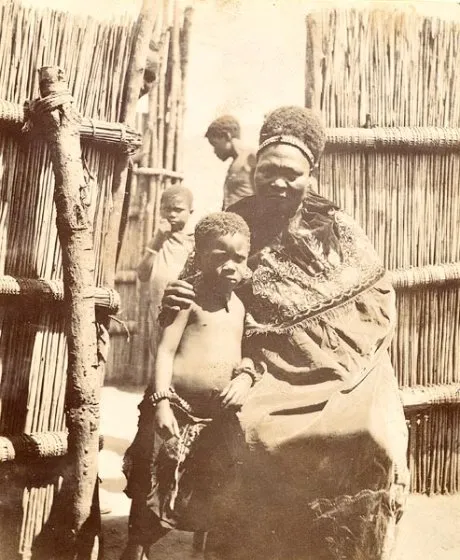
National Archives / Wikimedia Commons / Public Domain
Labotsibeni Gwamile Mdluli
The regent who chose schoolbooks over spears to win back Swaziland's partitioned land.
The formidable queen regent known as Gwamile, 'the indomitable', who ruled Swaziland through its harshest colonial decades, financed early Black South African nationalism, and preserved the monarchy for her grandson Sobhuza II.
Biography
Labotsibeni Mdluli was born around 1858 in northern Swaziland and raised at the royal court, where she learned the politics and diplomacy that would define her life. She married King Mbandzeni, and when her son Bhunu died young in 1899 she became queen regent for her infant grandson, Sobhuza II. She would rule for more than twenty years, through some of the most perilous decades in the kingdom's history, earning the praise-name Gwamile, the indomitable one.
The Turning Point
In 1907 the colonial partition of Swaziland stripped the Swazi of roughly two-thirds of their land, handing it to white concessionaires and the Crown. Labotsibeni made a strategic bet that would shape the nation's future. Rather than answer only with resistance, she chose knowledge as the weapon to win the land back. She insisted that her grandson and heir receive the best education then available to any Black person in the region, sending him to the elite Lovedale institution, and she raised a national fund to buy back land and to bankroll a modern political press. The future, she argued, would be won not by the spear but by the pen and the book.
Historical Context
Labotsibeni governed as European powers closed in, first the Transvaal Boers and then the British, at a time when concession-hunters had already tricked the Swazi out of vast land and mineral rights. Holding a small kingdom together between these forces demanded patience, cunning and alliance-building rather than open war, and she proved a match for the colonial officials she negotiated against.
Major Achievements
- Ruled as queen regent from 1899 to 1921, one of the longest and most powerful regencies in the region
- Preserved the Swazi monarchy through the colonial partition and delivered the throne intact to Sobhuza II, who led Swaziland to independence in 1968
- Championed formal education as national strategy, schooling the royal heir at the highest level then open to Black Africans
- Helped fund the newspaper Abantu-Batho, the organ of the early South African Native National Congress, a forerunner of the ANC
Her Impact Today
Labotsibeni handed power to the adult Sobhuza II in 1921 and remained an elder stateswoman until her death in 1925. Her grandson went on to reign for more than sixty years. In Eswatini she is remembered as a founder figure, affectionately woven into the nation's memory, proof that a small kingdom's survival could be secured by a woman's foresight.
Wikipedia (Labotsibeni Mdluli), The Journalist, Encyclopedia.com.
Cite this page
HerStory Africa. (1925). Labotsibeni Gwamile Mdluli. HerStory Africa. Retrieved October 1, 2026, from https://herstoryafrica.com.ng/women/labotsibeni
"Labotsibeni Gwamile Mdluli." HerStory Africa, 1925, https://herstoryafrica.com.ng/women/labotsibeni. Accessed 1 Oct 2026.
HerStory Africa. "Labotsibeni Gwamile Mdluli." Accessed October 1, 2026. https://herstoryafrica.com.ng/women/labotsibeni.