Wikimedia Commons / Public Domain
Ladi Kwali
Her pots went from the Emir of Abuja's household to the British Museum and the ₦20 note.
Gbagyi master potter who carried Nigerian hand-building tradition onto the world stage. The first woman at the Abuja Pottery Training Centre, an MBE, an NNOM holder, and the only woman on a Nigerian banknote.
Biography
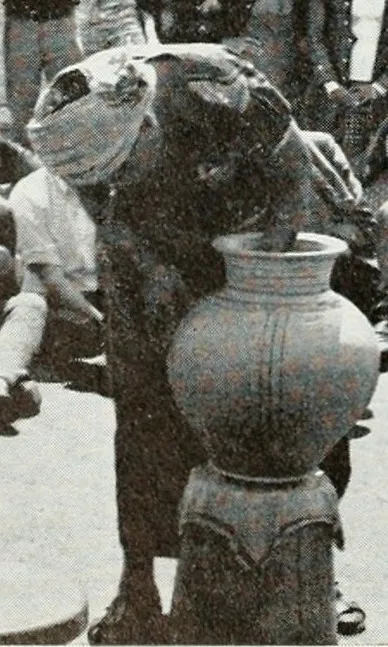
Ladi Dosei Kwali was born around 1925 in the village of Kwali, in the Gbagyi (Gwari) region of what is today the Federal Capital Territory of Abuja, Nigeria. In Gbagyi, "Ladi" is the name given to a girl born on a Sunday; "Kwali" is the name of her village. Among the Gbagyi, pottery was women's work, and Ladi learned to build pots as a child by watching her aunt — coiling clay by hand, beating the walls smooth from the inside with a wooden paddle, and finishing the surfaces with incised geometric patterns and stylised animals: scorpions, lizards, crocodiles, chameleons, snakes, birds, and fish.
Her water jars and cooking pots became locally famous for their balance and decoration. By the late 1940s, several were in the household of Alhaji Suleiman Barau, the Emir of Abuja, and it was there in 1950 that the visiting English studio potter Michael Cardew saw them. When Cardew opened the Pottery Training Centre at Suleja (then called Abuja) in 1952, he made it his business to bring her in. In 1954, Ladi Kwali joined the Centre as its first woman potter.
At Suleja she learned the new vocabulary of studio ceramics — the wheel, glazing, kiln firing, slip decoration, the use of saggars — and folded those techniques into her own hand-built work. She did not abandon coiling; she enlarged it. She trained other Gbagyi women — Halima Audu, Lami Toto, Asibi Iddo, and Kande Ushafa — and together they ran the workshop they called Dakin Gwari, "the Gwari room", building the huge ceremonial water pots the Centre became known for.
Historical Context
Ladi Kwali came of age in the last years of British colonial Nigeria, in a region where women's pottery was treated as domestic labour rather than art and where the products of African studios were assumed to need European "improvement." The Pottery Training Centre at Suleja was itself a colonial project — a workshop set up under the Department of Commerce and Industry to make Nigerian wares legible to European markets. What it produced was something less expected: a Gbagyi woman whose hand-built pots were exhibited in London and bought by international museums, on her own terms and with her own iconography intact.
Her career runs almost exactly alongside Nigerian independence (1960) and the post-independence project of building national institutions and a national identity. She gave that project a face — and a craft — that had not come from a colonial school.
What She Fought For
Ladi Kwali was not a political activist in the conventional sense. What she fought for, quietly and persistently across four decades, was the recognition of African women's traditional craft as art, of equal weight to anything coming out of European studios. She refused the framing that hand-building was primitive and the wheel was modern; she practised both and insisted, through her work, that they belonged together.
She also fought for the women who came after her. By teaching at Suleja and training a generation of Gbagyi women potters, she made sure the tradition she had inherited from her aunt did not die with one famous name.
Major Achievements
- First woman admitted to the Abuja Pottery Training Centre (1954); later a master instructor
- International exhibitions of Abuja pottery in 1958, 1959, and 1962
- Demonstrations at the Royal College of Art, Farnham, and Wenford Bridge in Great Britain (1961); later demonstrations in the United States, including at the University of Chicago (1972)
- MBE (Member of the Order of the British Empire), 1963
- Honorary doctorate from Ahmadu Bello University, Zaria, 1977
- Nigerian National Order of Merit (NNOM), 1980 — Nigeria's highest honour for intellectual and creative achievement
- Officer of the Order of the Niger (OON), 1981
- The Pottery Training Centre at Suleja was renamed the Ladi Kwali Pottery Centre in her honour
- Her image appears on the reverse of the Nigerian ₦20 note — the only woman to feature on any Nigerian banknote
- Work held in the British Museum, the Smithsonian, the National Museum of African Art, and other major collections
Her Impact Today
Ladi Kwali died on 12 August 1984 in Minna. Her legacy is unusually concrete: a road in central Abuja (Ladi Kwali Road), a pottery centre that bears her name, a banknote that puts her face in the hand of every Nigerian, and a continuing line of Gbagyi women potters trained in the techniques she preserved and taught. She is also a quietly radical figure for African feminism in the arts — proof that a woman from a small village, working in a "domestic" craft, in a language English-speaking curators could not initially read, could become one of the most internationally recognised African artists of the twentieth century without leaving her own tradition behind.
A note on a story that often circulates online: there is no evidence in any reliable biographical source that Ladi Kwali escaped a forced marriage or faked her own death. She was, by every credible account, recognised in her own community as a gifted potter from childhood, and her path to the Abuja Pottery Centre ran through the Emir's household, not through flight. Her real story did not need embellishment.
Wikipedia (Ladi Kwali), AWARE Women Artists, Crafts Council UK, Museum of Modern Art (post.moma.org), the Central Bank of Nigeria, and Wikimedia Commons.
Cite this page
HerStory Africa. (1984). Ladi Kwali. HerStory Africa. Retrieved October 1, 2026, from https://herstoryafrica.com.ng/women/ladi-kwali
"Ladi Kwali." HerStory Africa, 1984, https://herstoryafrica.com.ng/women/ladi-kwali. Accessed 1 Oct 2026.
HerStory Africa. "Ladi Kwali." Accessed October 1, 2026. https://herstoryafrica.com.ng/women/ladi-kwali.