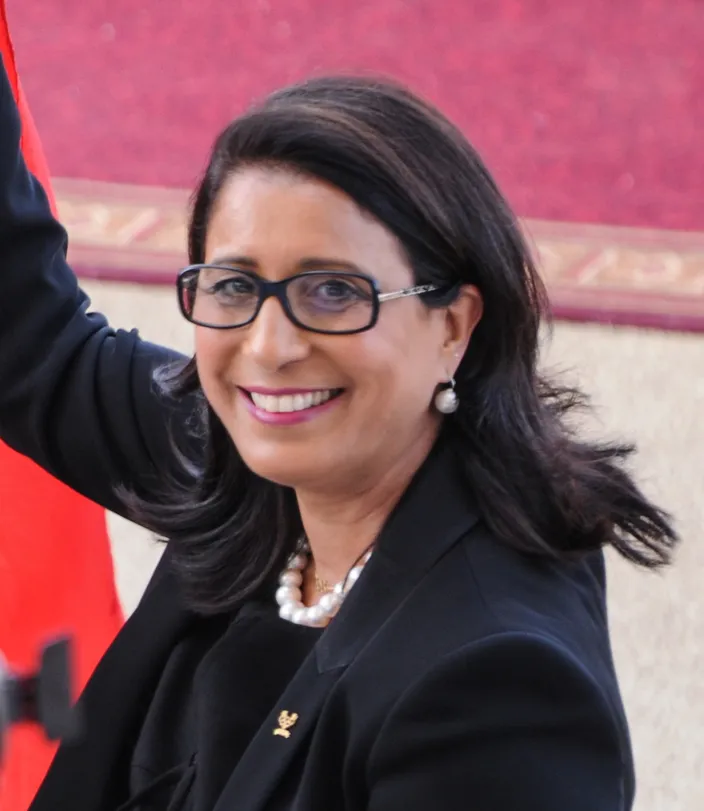
Photo: Citizen59, 2016 / CC BY 3.0 via Wikimedia Commons
Nawal El Moutawakel
Every girl born in Morocco on 8 August 1984 was named after her by royal decree.
The Moroccan hurdler who won the first ever women's 400m hurdles at the 1984 Olympics, becoming the first Moroccan, Arab, African, and Muslim woman to take Olympic gold, then rose to the top of world sport as an IOC Vice President.
Biography
August 8, 1984. Los Angeles. A 22-year-old from Casablanca settles into her blocks for a race no woman has ever run at the Olympics. She is 5 feet 1 inch tall. She is the only woman on Morocco's entire Olympic team. "I was really scared," she remembered later. "I was the only female athlete in the all Moroccan delegation, and everybody was counting on me." Fifty-four point six one seconds later, Nawal El Moutawakel crossed the line more than half a second clear of the field, and history split into before and after.
She grew up in a sports-mad family in Casablanca: her father was a judoka, her mother played volleyball, her siblings ran track. She started running at 14, with her father cheering her on at training when many fathers would not have. In 1983 she won a scholarship to Iowa State University in the United States to study physical education and physiotherapy. Before she left, her father told her: "You've won everything, you still have to win this Olympic gold." He died suddenly three months before the race, and because she was far from home, she only learned the news a month later. She turned grief into fuel. "I used this as a force, saying to myself in the mirror, you should win for your father because he let you leave, because he believed in you."
Her win was Morocco's first Olympic gold medal of any kind, and it made her the first Moroccan, the first Arab woman, the first woman from an African nation, and the first Muslim woman ever to win Olympic gold. King Hassan II telephoned her personally, then declared that all girls born in Morocco on the day of her victory would carry her name. When she flew home, the party stretched for miles: "It was a huge celebration from the airport to the highway all the way through my city Casablanca."
Knee surgery ended her racing career at 25, but not her race. She became a coach, an organizer, and then one of the most powerful people in world sport: a council member of the international athletics federation from 1995, an IOC member from 1998, Morocco's Minister of Sports in 2007, a member of the IOC executive board from 2008, and IOC Vice President from 2012 to 2016, re-elected in 2024.
Historical Context
When Nawal lined up in Los Angeles, the women's 400m hurdles was brand new to the Olympics. As she put it herself, it was "a highly technical event which at the international level was only a men's event." The 1984 Games were a turning point for women's athletics generally, but women from North Africa and the Muslim world were barely represented at all. Many countries had never sent a woman to the Olympics, and a Moroccan girl who ran in shorts on a public track was defying more than gravity.
Morocco in the 1980s was a young nation under King Hassan II, hungry for symbols of achievement on the world stage. Sport was one of the few arenas where a developing country could beat wealthy powers head to head. That is why one woman's 54.61 seconds mattered so much: it was not just a medal, it was proof, broadcast worldwide, of what a Moroccan woman could do.
What She Fought For
The turning point of Nawal's life was also a test of everything her father had given her. He was the one who let her run, let her travel alone to America, and set her the impossible goal of Olympic gold. Then he was gone, three months before the biggest race of her life. She could have collapsed. Instead she stood in front of the mirror and made his belief her engine. When she won, she was not just the fastest woman over ten hurdles. She was an answer to every voice that said girls like her should stay home.
She understood immediately that her medal belonged to more than herself. She had noticed, even in 1984, that there were no women journalists in her country's delegation. So she spent the next four decades prying open doors. As a sports official she pushed for women in every federation, in every sport, in every boardroom. "Countries whose women never attended Olympic Games," she observed, "were attending to win."
The proof came in Paris in 2024, the first Olympics with full gender parity among athletes, a goal she had worked toward inside the IOC for years. "We will witness for the first time now in Paris 2024, almost, equal opportunities for women in every field," she said. "This is the happiest moment for me."
Major Achievements
- Won the first ever women's 400m hurdles at the 1984 Los Angeles Olympics in 54.61 seconds, Morocco's first Olympic gold medal
- First Moroccan, Arab, African, and Muslim woman to win Olympic gold
- Became a council member of the international athletics federation (now World Athletics) in 1995 and a member of the International Olympic Committee in 1998
- Served as Morocco's Minister of Sports from 2007
- Joined the IOC executive board in 2008, the first Muslim woman to do so, and served as IOC Vice President from 2012 to 2016, re-elected in 2024
- Led IOC commissions overseeing Olympic host cities, including chairing the Coordination Commission for Rio 2016, and carried the Olympic flag at the Turin 2006 opening ceremony
Her Impact Today
Somewhere in Morocco there are women in their early forties named Nawal because of one race in Los Angeles. That royal decree made her victory a living, breathing legacy, written into birth certificates. More broadly, her win told girls across Africa and the Muslim world that the Olympic podium was theirs too. Generations of champions, from Algeria to Bahrain to Ethiopia, came of age with her image as proof of possibility.
Inside world sport, she moved from symbol to architect. As one of the highest-ranking women in Olympic history, she helped drive the movement toward gender equality that culminated in the fifty-fifty athlete split at Paris 2024, and she continues to shape the Games as part of the team preparing Los Angeles 2028, the city where it all began. From a lone woman in a national delegation to a Vice President of the Olympic movement: few athletes have ever cleared higher hurdles.
Wikipedia (Nawal El Moutawakel); World Athletics Heritage, "Nawal El Moutawakel: the 54 seconds that changed her life"; Yahoo Sports, "Changed the Game: Nawal El Moutawakel's stunning gold medal broke barrier for Muslim athletes"; The Olympic Museum via Google Arts & Culture; Olympics.com.
Cite this page
HerStory Africa. (1962). Nawal El Moutawakel. HerStory Africa. Retrieved October 1, 2026, from https://herstoryafrica.com.ng/women/nawal-el-moutawakel
"Nawal El Moutawakel." HerStory Africa, 1962, https://herstoryafrica.com.ng/women/nawal-el-moutawakel. Accessed 1 Oct 2026.
HerStory Africa. "Nawal El Moutawakel." Accessed October 1, 2026. https://herstoryafrica.com.ng/women/nawal-el-moutawakel.