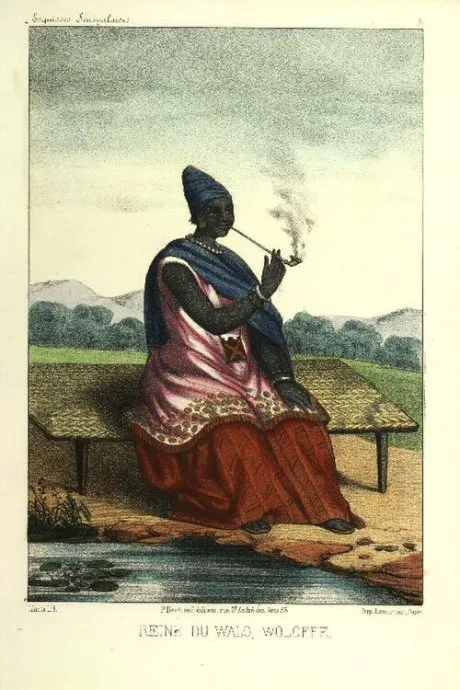
Lithograph after Abbé Boilat / Wikimedia Commons / Public Domain
Ndaté Yalla Mbodj
She wrote to the French governor that Waalo was not his, then met his guns in 1855.
The last great queen of Waalo in northern Senegal, who governed, taxed and went to war against French expansion in the 1850s. Defeated but never forgotten, she is one of Senegal's enduring symbols of resistance and female sovereignty.
Biography
Ndaté Yalla Mbodj was born around 1810 into the ruling Mbodj dynasty of Waalo, a Wolof kingdom in the lower Senegal River valley. Waalo gave its queens, its Lingeer, real power, and Ndaté Yalla inherited it fully. She was crowned Lingeer at the capital, Nder, on 1 October 1846, following her sister Ndjeumbeut, and she ruled with genuine political and military authority at a moment when her kingdom was being squeezed from every side.
The Turning Point
By the 1850s the French governor Louis Faidherbe was pushing hard to seize Waalo and the river trade that ran through it. Ndaté Yalla refused to yield her kingdom's sovereignty. She had already written to the French, years earlier, with a bluntness that still startles: Saint-Louis might belong to the Governor and Cayor to its ruler, she wrote, but Waalo belonged to its own king. In February 1855 her armies met Faidherbe's guns in the field. Waalo was overwhelmed, the capital Nder was burned, and the kingdom was annexed, ending centuries of independence. Even in defeat she had done what few dared, telling an advancing colonial power to its face that her land was not for the taking.
Historical Context
The 1850s were the decisive decade of French conquest in Senegal, driven from the coastal base at Saint-Louis by Faidherbe's drive to control the gum and grain trade of the river. Waalo, caught between French firepower downstream and Moorish raiders from the north, was the first major Wolof kingdom to fall. Ndaté Yalla's stand was the closing act of its independent history, and her son Sidya carried the resistance on until his own capture and exile.
Major Achievements
- Crowned Lingeer (queen) of Waalo in 1846 and ruled with full political and military power
- Organised armed resistance against both French colonial expansion and Trarza Moorish raids
- Asserted Waalo's sovereignty in writing directly to the French governor, a rare first-person act of defiance from a 19th-century African monarch
- Remembered across Senegal as a foremost anti-colonial heroine, with a statue in Dagana and schools that carry her name
Her Impact Today
Ndaté Yalla died in 1860, but her name never left Senegalese memory. A statue of her stands in Dagana, schools and even boats carry her name, and she appears in almost every account of Africa's great queens. In a history of conquest that so often erased the women who fought it, she is remembered precisely because she wrote her refusal down and made the record impossible to ignore.
Wikipedia (Ndaté Yalla Mbodj), Afrolegends (her 1847 correspondence), Senegalese historical archives.
Cite this page
HerStory Africa. (1860). Ndaté Yalla Mbodj. HerStory Africa. Retrieved October 1, 2026, from https://herstoryafrica.com.ng/women/ndate-yalla-mbodj
"Ndaté Yalla Mbodj." HerStory Africa, 1860, https://herstoryafrica.com.ng/women/ndate-yalla-mbodj. Accessed 1 Oct 2026.
HerStory Africa. "Ndaté Yalla Mbodj." Accessed October 1, 2026. https://herstoryafrica.com.ng/women/ndate-yalla-mbodj.