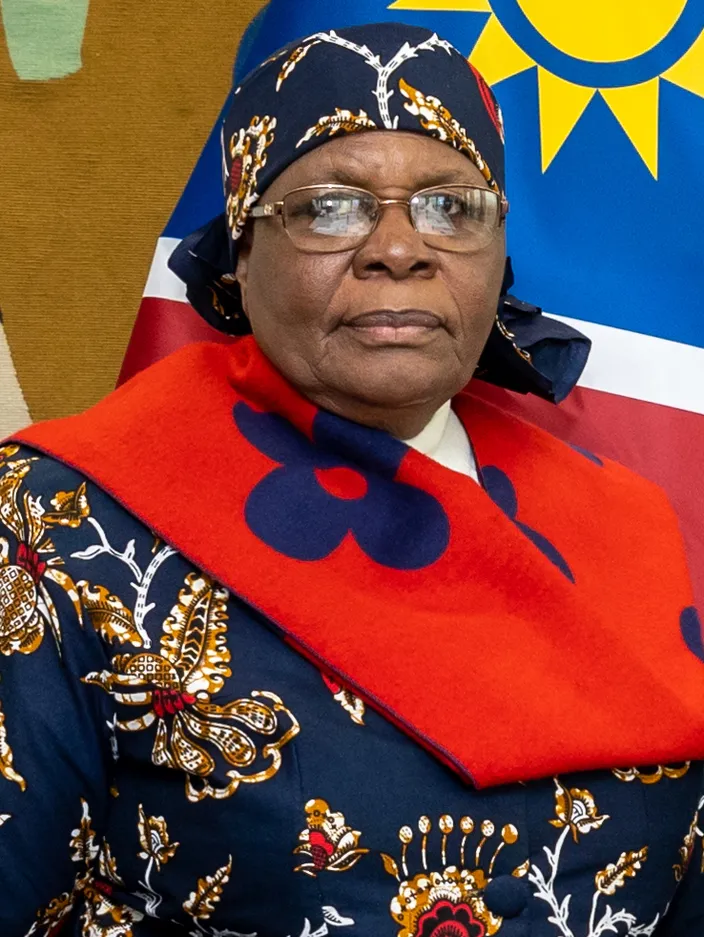
Photo: Emmanuel Berrod / WIPO / CC BY 2.0 via Wikimedia Commons
Netumbo Nandi-Ndaitwah
Joined SWAPO at 14, took the presidential oath at 72, on Namibia's Independence Day.
Namibian freedom fighter and veteran diplomat, known simply as NNN, who joined SWAPO at 14, survived arrest and exile under apartheid rule, and in March 2025 became Namibia's first female president, leading a country where women also held the vice presidency and the Speaker's chair.
Biography
On 21 March 2025, Namibia's 35th Independence Day, a 72 year old woman raised her right hand and took the presidential oath. Netumbo Nandi-Ndaitwah, known to the whole country by three letters, NNN, had waited most of a lifetime for that moment. She had joined the fight for Namibia's freedom at 14. Now she was its first woman president, and with Vice President Lucia Witbooi beside her and former prime minister Saara Kuugongelwa-Amadhila in the Speaker's chair, Namibia became one of the very few nations on Earth with women holding the presidency, the vice presidency and the speakership at once.
Netumbo Ndemupelila Nandi was born on 29 October 1952 in Onamutai village in northern Namibia, the ninth of 13 children of an Anglican clergyman. Her country was then called South West Africa and was ruled by apartheid South Africa. In 1966, at 14, she joined SWAPO, the South West Africa People's Organisation, which that year began its armed struggle for independence. By her early twenties she was chairing SWAPO's Youth League in the north. The regime noticed. In 1973 she was arrested for her political activity and given a suspended sentence, and in 1974 she slipped into exile.
Exile became her education. She worked at SWAPO's headquarters in Lusaka, Zambia, represented the movement in Central and East Africa, trained in Moscow, and later earned a master's degree in diplomatic studies at Keele University in Britain. She returned home in 1989 to help deliver the UN-supervised elections, and after independence in 1990 began three decades of unbroken service: deputy foreign minister, minister for women's affairs, information, environment and tourism, then foreign minister from 2012, deputy prime minister from 2015, and in February 2024, after President Hage Geingob's death, Namibia's first female vice president. In the election of November 2024 she won the presidency with about 58 percent of the vote, more than double her nearest rival.
Historical Context
Namibia's road to freedom was one of Africa's longest. Colonised by Germany in the 1880s, the territory suffered the genocide of the Herero and Nama peoples, then passed to South African rule after the First World War. Pretoria extended apartheid to the territory and clung to it in defiance of the United Nations for decades. For a village girl in the north, the liberation movement was everywhere: churches, schools and families all fed SWAPO's ranks. Joining at 14 was dangerous, and thousands of young Namibians like Netumbo ended up in prison cells or in exile in Zambia, Tanzania, the Soviet Union and beyond.
Independence finally came on 21 March 1990. SWAPO moved from liberation movement to governing party and has won every election since. But the generation of fighters was ageing, the economy leaned heavily on minerals, and youth unemployment was biting. By 2024 many young Namibians, born free, were demanding results rather than war stories. The election that made Nandi-Ndaitwah president was the closest-fought in the country's history, marked by ballot shortages, extended voting and an opposition court challenge that the Supreme Court dismissed in February 2025. Across the continent, meanwhile, women remained rare at the very top: her victory made her one of only a handful of women ever directly elected to lead an African state.
What She Fought For
Nandi-Ndaitwah's first cause was freedom itself. As a teenager she chose a banned movement over a quiet life, and paid with arrest, a criminal sentence and 15 years of exile. The discipline of those years, from Lusaka offices to Moscow classrooms, forged her reputation: devout, precise, incorruptible, a woman who did the work while louder men made speeches.
Her second cause was making independence mean something for women. As minister for women's affairs she pushed gender into national policy; as SWAPO's leadership battles raged, she kept insisting that capability, not gender, should decide who leads. When her moment came, she acted on it. "My election is not only a victory for me, but for every Namibian woman," she said. She cut the cabinet from 21 ministries to 14, filled key portfolios including finance, health and education with women, and international media described the result as one of the world's most gender-balanced governments.
The turning point of her story is really a half-century arc: the girl with a suspended sentence in 1973 became the president taking the salute in 2025, in the same country, under a flag she helped raise. At her inauguration she promised more than symbolism: over 500,000 new jobs in five years and free tuition at public universities and technical colleges from 2026. Weeks later she fired a minister facing bribery charges, a signal that "peace and stability", her campaign phrase, included clean hands. "The Namibian nation has voted for peace and stability," she declared after her win. Delivering on that vote is her final fight.
Major Achievements
- Elected Namibia's first woman president in November 2024 with about 58 percent of the vote, and inaugurated on 21 March 2025, the 35th anniversary of independence
- Rose from SWAPO Youth League activist at 14, through arrest in 1973 and 15 years of exile, to the highest office in the land
- Served over three decades in government, including as foreign minister (from 2012), deputy prime minister (2015 to 2024) and Namibia's first female vice president (2024 to 2025)
- Appointed a leadership in which women held the vice presidency (Lucia Witbooi), the Speaker's chair (Saara Kuugongelwa-Amadhila) and a large share of a streamlined 14-ministry cabinet
- Pledged and launched flagship programmes including free tertiary education from 2026 and a drive for more than 500,000 new jobs
- Became one of the few women in African history to be directly elected head of state, joining a global handful of countries led simultaneously by women in the top three state offices
Her Impact Today
For Namibian girls, the change is visible every night on the news: the president, the vice president and the Speaker of the National Assembly are all women. That picture, unthinkable when Netumbo Nandi was born under apartheid rule, quietly resets what a child in Onamutai or Windhoek believes is possible. Regional leaders and international observers now cite Namibia as evidence that liberation politics and women's leadership are not rivals but partners.
Her presidency is still being written. The promises are enormous: half a million jobs, free tertiary education, an oil and gas boom managed from her own office without the corruption that has cursed other producers. Her early moves, a slim cabinet, a fired minister, careful budgets, suggest she intends to be judged on delivery rather than history.
Yet history is already hers. NNN carried a banned movement's membership card at 14, a suspended sentence at 20, an exile's suitcase at 21, a diplomat's portfolio at 60, and the presidential sash at 72. Few leaders anywhere have walked the whole road from colonised child to elected head of state. In Namibia, the road now has her name on it.
Wikipedia (Netumbo Nandi-Ndaitwah; 2024 Namibian general election); Office of the President of Namibia official biography (op.gov.na); Al Jazeera (3 December 2024); Namibia Economist on the March 2025 cabinet; The EastAfrican and Council on Foreign Relations coverage of the inauguration.
Cite this page
HerStory Africa. (1952). Netumbo Nandi-Ndaitwah. HerStory Africa. Retrieved October 1, 2026, from https://herstoryafrica.com.ng/women/netumbo-nandi-ndaitwah
"Netumbo Nandi-Ndaitwah." HerStory Africa, 1952, https://herstoryafrica.com.ng/women/netumbo-nandi-ndaitwah. Accessed 1 Oct 2026.
HerStory Africa. "Netumbo Nandi-Ndaitwah." Accessed October 1, 2026. https://herstoryafrica.com.ng/women/netumbo-nandi-ndaitwah.