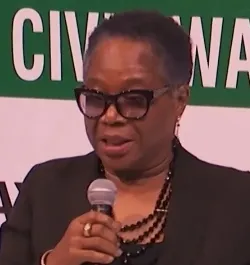
Plus TV Africa / CC BY 3.0 via Wikimedia Commons
Onyeka Onwenu
A 1984 documentary on squandered oil riches, then a hunger strike for her own royalties.
Nigeria's 'Elegant Stallion': singer, journalist, actress and public servant whose hit songs preached unity and family planning, whose 1984 documentary indicted oil corruption, and who spent a lifetime refusing to stay in one lane.
Biography
Onyeka Onwenu was born on 31 January 1952 in Obosi and raised in Port Harcourt, with family roots in Arondizuogu, Imo State. Her father, the educationist and politician D. K. Onwenu, died in a road accident when she was four, a week before he was to be appointed Minister for Education, leaving her mother Hope to raise five children alone after in-laws denied her access to his property. Onyeka studied International Relations and Communication at Wellesley College in Massachusetts, took a Master's in Media Studies at The New School in New York, and worked at the United Nations before returning to Nigeria in 1980 for national service with the Nigerian Television Authority, where she became a newsreader and reporter.
She launched a parallel music career in 1981 with "For the Love of You," followed through the decade by "Endless Life," "In the Morning Light," "One Love" and "Dancing in the Sun." Her duets with the Yoruba juju king Sunny Adé, most famously "Wait for Me," recorded for a family-planning campaign, became Igbo-Yoruba unity anthems in a country still healing from civil war. As a journalist she wrote and presented the landmark 1984 BBC and NTA documentary "Nigeria: A Squandering of Riches," widely called the definitive film on Nigerian corruption and Niger Delta environmental degradation. In 2000 she staged a hunger strike outside NTA headquarters over unpaid royalties for her song "Iyogogo," dragging artists' rights into the national conversation.
From 1999 she added Nollywood to her portfolio, winning the 2006 Africa Movie Academy Award for Best Supporting Actress for "Widow's Cot" and appearing in more than thirty films, including "Half of a Yellow Sun" and "Lionheart." She judged X Factor Nigeria, chaired the Imo State Council for Arts and Culture, and in 2013 was appointed Executive Director of the National Centre for Women Development. She published her autobiography, "My Father's Daughter," in 2021. On 30 July 2024 she collapsed shortly after performing at the 80th birthday celebration of Emzor Pharmaceuticals founder Stella Okoli in Lagos, and was pronounced dead at 72.
Historical Context
Her life tracked Nigeria's arc: an Igbo childhood interrupted by the civil war, the oil boom and bust her 1984 documentary indicted, military rule and democratic transitions in which she took political roles, and the rise of Nollywood and Afropop that she helped legitimise for women. She modelled a kind of public womanhood Nigeria had not seen: glamorous, learned, fearless and impossible to categorise.
What She Fought For
The dignity of Nigerian women in public life; honest reckoning with corruption and the ruin of the Niger Delta; HIV/AIDS awareness and family planning delivered through popular music; fair pay for artists; and national unity built through cross-ethnic collaboration, one duet at a time.
Major Achievements
- Wrote and presented the BBC/NTA documentary "Nigeria: A Squandering of Riches" (1984).
- A string of hit albums through the 1980s, including landmark unity duets with King Sunny Adé.
- High-profile royalties protest and hunger strike against NTA that advanced artists' rights in Nigeria (2000).
- Africa Movie Academy Award for Best Actress in a Supporting Role for "Widow's Cot" (2006).
- Appointed Executive Director of the National Centre for Women Development (2013); national honour MFR.
- Published her autobiography "My Father's Daughter" (2021).
Her Impact Today
Mourned nationally in 2024, with President Tinubu hailing her "immortal masterpieces," Onwenu remains the template of the multi-hyphenate African woman: musician, journalist, actress and public servant in one lifetime. Her songs are still Nigerian standards, her documentary is still cited in debates on oil and corruption, and her career remains the proof that a Nigerian woman never needed anyone's permission to do everything at once.
Wikipedia (Onyeka Onwenu), BBC and Premium Times obituaries, Africa Movie Academy Awards records, The Guardian Nigeria, Wikimedia Commons.
Cite this page
HerStory Africa. (2024). Onyeka Onwenu. HerStory Africa. Retrieved October 1, 2026, from https://herstoryafrica.com.ng/women/onyeka-onwenu
"Onyeka Onwenu." HerStory Africa, 2024, https://herstoryafrica.com.ng/women/onyeka-onwenu. Accessed 1 Oct 2026.
HerStory Africa. "Onyeka Onwenu." Accessed October 1, 2026. https://herstoryafrica.com.ng/women/onyeka-onwenu.