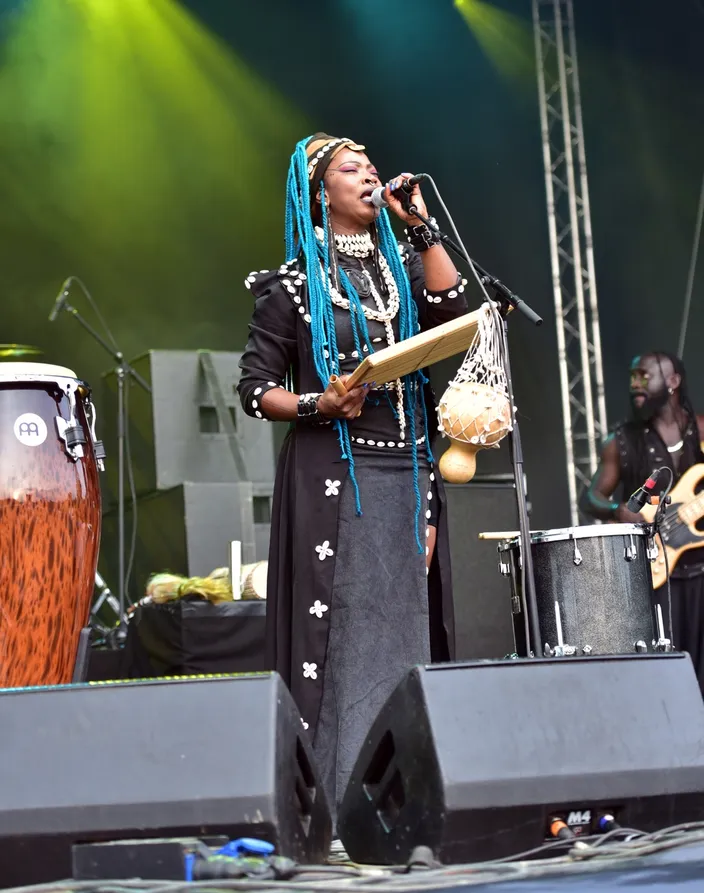
Frank Schwichtenberg / CC BY-SA 4.0 via Wikimedia Commons
Oumou Sangaré
A 1989 cassette about polygamy and forced marriage that nobody in Bamako could escape.
Malian Wassoulou singer known as the Songbird of Wassoulou who has used her voice since the late 1980s to challenge forced marriage, polygamy and the silencing of women, while building an international career that includes a Grammy and a sample on Beyoncé’s Lion King project.
Biography
Oumou Sangaré was born on 25 February 1968 in Bamako to parents who had migrated from the Wassoulou region of southern Mali. Her mother, Aminata Diakité, was a singer who performed at weddings and baptisms. When Oumou was two years old, her father took a second wife and left for Côte d’Ivoire, abandoning his pregnant wife and young children. That abandonment became the quiet engine of her life’s work.
She began singing almost as soon as she could talk. At five she won a kindergarten competition and performed before thousands at the Omnisports Stadium in Bamako. By her early teens she was already helping her mother earn money by singing at ceremonies, eventually leaving school to support the family. At sixteen she joined the percussion troupe Djoliba and toured Europe and the Caribbean. By eighteen she was ready to record under her own name.
In 1989 she released Moussolou (“Women”). The cassette was a shock: a young woman singing, in the language and rhythms of Wassoulou, about polygamy, forced marriage, female desire and the right to choose one’s own life. It sold more than 200,000 legal copies in West Africa and became impossible to escape in Bamako. Ali Farka Touré passed a copy to World Circuit Records. The rest is history.
Historical Context
In the Mali of the 1980s and 1990s, polygamy was widespread and arranged marriages were still common, especially for girls. Women were expected to endure quietly. Wassoulou music itself had long been a space where women sang, but the topics were usually traditional. Oumou Sangaré stepped into that tradition and turned it into a public conversation that many men found uncomfortable and many women found liberating.
She arrived on the international stage at a moment when “world music” was being packaged for Western audiences. She refused the role of exotic traditionalist. She kept the kamale n’goni and the calabash, but she also brought in modern production, worked with funk horn arranger Pee Wee Ellis, and later collaborated with artists across continents. The music stayed rooted. The message travelled.
What She Fought For
Oumou has said she sings to avenge the wrongs inflicted on her mother. Her songs name the things women were not supposed to name: the pain of sharing a husband, the loss of childhood to early marriage, the quiet dignity of mothers who raise children alone. She has also spoken against female genital mutilation and for the economic independence of women.
She never claimed to be inventing feminism. She simply refused to stay silent in a musical form that people already loved and trusted. That refusal, repeated across albums and decades, made her one of the most important feminist voices in modern West African music.
Major Achievements
- Released the landmark album Moussolou (1989/1990), which sold hundreds of thousands of copies and opened a new conversation about women’s lives in the region
- Won a Grammy Award in 2011 for Best Pop Collaboration with Vocals for her contribution to Herbie Hancock’s The Imagine Project
- Named FAO Goodwill Ambassador in 2003 and received the UNESCO International Music Prize in 2001
- Made a Commander of the Order of Arts and Letters of France
- Received the WOMEX Artist Award in 2017 specifically for her music and her advocacy for women’s rights
- Featured (and sampled) on Beyoncé’s “MOOD 4 EVA” from The Lion King: The Gift (2019)
- Built businesses in hotels, agriculture and automobiles while remaining a working artist and advocate
Her Impact Today
Oumou Sangaré proved that traditional music could carry radical ideas without losing its soul. Younger artists, from Aya Nakamura to a generation of West African women singers, cite her as proof that you can speak hard truths and still fill stadiums. Her voice appears on global stages and in unexpected places (including a Beyoncé track) without ever leaving behind the language and rhythms of Wassoulou.
She continues to perform with the same intensity that first made people stop and listen in Bamako more than thirty years ago. The dictatorships and silences she sang against have shifted, but the work of expanding what a Malian woman is allowed to say and become is unfinished. She is still doing that work, one song at a time.
Wikipedia (Oumou Sangaré), Encyclopædia Britannica, World Circuit Records artist biography, Financial Times interview (2026), AllMusic, WOMEX, FAO, WhoSampled (Diaraby Nene / MOOD 4 EVA).
Cite this page
HerStory Africa. (1968). Oumou Sangaré. HerStory Africa. Retrieved October 1, 2026, from https://herstoryafrica.com.ng/women/oumou-sangare
"Oumou Sangaré." HerStory Africa, 1968, https://herstoryafrica.com.ng/women/oumou-sangare. Accessed 1 Oct 2026.
HerStory Africa. "Oumou Sangaré." Accessed October 1, 2026. https://herstoryafrica.com.ng/women/oumou-sangare.