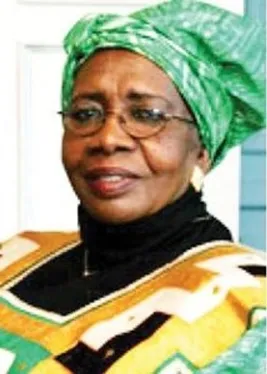
Copyright holder unknown / fair use (no free image known)
Ruth Sando Perry
A schoolteacher with no militia who disarmed Liberia's warlords in eleven months.
Liberian schoolteacher and senator who became the first woman to head an African state in modern times. Handed a country of warring warlords in 1996, she disarmed the fighters, brought the refugees home, and delivered free elections in eleven months.
Biography
Ruth Sando Fahnbulleh Perry was born on 16 July 1939 in rural Grand Cape Mount County, Liberia, to a Vai Muslim family. She trained at the Teachers College of the University of Liberia, taught elementary school in her home county, and from 1971 worked at the Monrovia office of Chase Manhattan Bank. She married McDonald Perry, a judge and legislator, and raised seven children. In 1985 she was elected to the Liberian Senate on the Unity Party ticket; when fellow opposition politicians boycotted the assembly to protest Samuel Doe's disputed election, she took her seat anyway, saying "You can't solve the problems by staying away," and served as effectively the lone opposition voice until 1989.
After civil war erupted in 1989, she threw herself into civilian peace advocacy through women's and conflict-resolution organisations. On 17 August 1996, after roughly a dozen failed peace attempts, West African negotiators named her Chairman of the Council of State of the transitional government. Sworn in on 3 September 1996, she became the first woman to head an African state in modern times, presiding over a council that included the rival warlords Charles Taylor, Alhaji Kromah and George Boley. ECOWAS chose her precisely because she commanded no militia and no faction: every armed leader could accept a schoolteacher and grandmother where they could accept no rival.
In eleven months she oversaw the disarmament of fighters, child soldiers among them, the repatriation and resettlement of refugees, and the July 1997 elections judged free and fair by international observers, handing power peacefully to the elected government on 2 August 1997. She later served as African President-in-Residence at Boston University's African Presidential Archives and Research Center. She died on 8 January 2017 in Columbus, Ohio, aged 77; Liberia's government honoured her as "a devoted public servant, women advocate, leader and great stateswoman."
Historical Context
Liberia's First Civil War (1989–1997) killed an estimated 150,000 to 200,000 people and displaced half the population. After the collapse of the Doe dictatorship and years of factional carnage, the country had exhausted its warlords' promises. Perry's appointment tested a proposition that would echo far beyond Liberia: that a woman with moral authority and no army could succeed where a dozen armed peace deals had failed. She proved it in under a year.
What She Fought For
Ending the civil war; getting guns out of the hands of fighters, including children; bringing the displaced home; credible elections; and the demonstration, made in the world's full view, that women could lead national reconciliation. The path she opened, Ellen Johnson Sirleaf would walk to the presidency a decade later.
Major Achievements
- Elected to the Liberian Senate in 1985, refusing the opposition boycott to serve as the assembly's lone opposition voice.
- Sworn in as Chairman of the Council of State on 3 September 1996, becoming the first woman head of state in modern African history.
- Presided over the disarmament of warring factions and the repatriation and resettlement of refugees (1996–1997).
- Delivered internationally acclaimed free and fair elections in July 1997 and a peaceful transfer of power.
- African President-in-Residence at Boston University (2004).
- Named among the "1000 PeaceWomen" collectively nominated for the Nobel Peace Prize (2005).
Her Impact Today
Ruth Sando Perry broke the ultimate glass ceiling in African politics a decade before Africa's first elected woman president; Liberians call her the matriarch who made Ellen Johnson Sirleaf possible. Her model of maternal, faction-free authority is cited in peace-mediation scholarship on women in conflict resolution, and her eleven months remain one of history's cleanest proofs that legitimacy can disarm what firepower cannot.
Wikipedia (Ruth Sando Perry), Encyclopedia.com, 1000 PeaceWomen, Liberian Ministry of Foreign Affairs, FrontPageAfrica, Boston University African Presidential Archives.
Cite this page
HerStory Africa. (2017). Ruth Sando Perry. HerStory Africa. Retrieved October 1, 2026, from https://herstoryafrica.com.ng/women/ruth-sando-perry
"Ruth Sando Perry." HerStory Africa, 2017, https://herstoryafrica.com.ng/women/ruth-sando-perry. Accessed 1 Oct 2026.
HerStory Africa. "Ruth Sando Perry." Accessed October 1, 2026. https://herstoryafrica.com.ng/women/ruth-sando-perry.