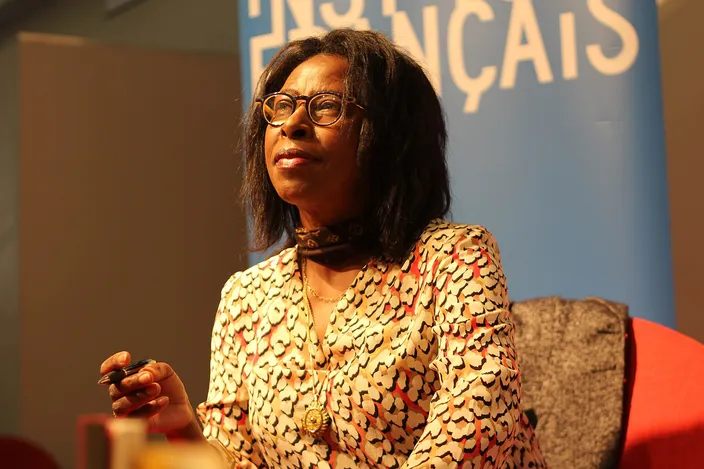
Photo: ActuaLitté / CC BY-SA 2.0 via Wikimedia Commons
Scholastique Mukasonga
A paper grave for the thirty-seven relatives she could not bury.
Rwandan writer who lost 37 members of her family, including her mother, in the 1994 genocide, and turned memory into literature, winning France's Renaudot Prize for Our Lady of the Nile.
Biography
She keeps a notebook. In it are the names of the dead: her mother Stefania, her pregnant sister Jeanne, thirty-seven members of her family in all, murdered in the Rwandan genocide of 1994 while she was far away in France, unable to save them. "I write down their names," Scholastique Mukasonga has said. "I have nothing left of my family but that paper grave."
She was born in 1956 in Gikongoro province, in the hills of southwest Rwanda. She was four when the trucks came. In 1960, her Tutsi family was deported with thousands of others to Nyamata, in the arid scrubland of the Bugesera, a place of dust, hunger and repeated massacres. She grew up a refugee inside her own country. Her mother Stefania held the family together, teaching her daughters the old stories while they weeded the sorghum, guarding a whole culture in exile.
Rwanda's quota system allowed Tutsi only about ten percent of secondary school places. Scholastique beat the odds and won a place, first at the Lycée Notre-Dame-de-Cîteaux in Kigali, then at the school of social work in Butare. In 1973, pogroms swept Tutsi out of schools and jobs, and she fled for her life to Burundi. She finished her studies there, worked for UNICEF, and in 1992 settled in France, working as a social worker in Normandy. Two years later, the genocide destroyed nearly everyone she loved.
In 2004, she went back. There were no graves to visit. The neighbor living beside her family's field claimed at first not to remember her parents at all. Two years later she published her first book, Inyenzi ou les Cafards (Cockroaches), and a great writer entered the world's literature at the age of fifty.
Historical Context
Mukasonga's life traces the long fuse of the Rwandan genocide. The violence of 1994 did not come from nowhere: it was prepared by decades of persecution. From 1959 onward, waves of killings and deportations drove Tutsi families like hers into internal exile or across borders. The Bugesera, where she grew up, was a dumping ground for the displaced, and the word inyenzi, cockroaches, was the slur used to dehumanize Tutsi long before it became the vocabulary of genocide radio.
Quotas rationed education. Identity cards stamped ethnicity onto every life. The pogroms of 1973, which forced Mukasonga out of school and out of the country, were a rehearsal that the world ignored. In April 1994, over about one hundred days, roughly 800,000 people were murdered, most of them Tutsi. Nyamata's church, near where her family lived, became one of the most terrible massacre sites and today is a genocide memorial.
Mukasonga writes from a particular position within this history: the survivor who was not there. Exile saved her life and denied her a farewell. Her books are how she keeps faith with the ones who could not leave.
What She Fought For
Everything turned in 2004, when she returned to Rwanda and stood on the land where her family had lived and died. Ten years had passed since the genocide. There were no tombs, no markers, nothing. In Rwandan tradition the dead must be honored; hers had been thrown into pits and silence. So she built what she could: a tomb made of paper. Cockroaches (2006) recorded her childhood in Nyamata and the fates of her family, in prose so precise it reads like testimony under oath. The Barefoot Woman (2008) raised a monument to her mother Stefania, who had once asked her daughters to cover her body when she died. A finalist for the National Book Award in translation in 2019, it lets readers everywhere meet the mother the killers tried to erase.
Then she did something harder: she turned memory into fiction. Our Lady of the Nile (2012) is set in an elite girls' boarding school in the Rwandan mountains in the 1970s, where the daughters of the powerful absorb, quota by quota, humiliation by humiliation, the logic that will one day become genocide. There is no massacre on the page until the end; there does not need to be. The novel won the Prix Renaudot, one of France's highest literary honors, along with the Ahmadou-Kourouma Prize, and became a film in 2019. Later books like Kibogo and Sister Deborah reclaimed Rwandan spiritual life and storytelling from the colonial archive.
She fights, sentence by sentence, against the second death of the dead: forgetting. Her books give names, faces and voices to people who were reduced to a slur. That is the war a writer can win.
Major Achievements
- Won the Prix Renaudot and the Ahmadou-Kourouma Prize in 2012 for Our Lady of the Nile, which was adapted into an acclaimed film in 2019
- Wrote Cockroaches (2006), one of the essential firsthand accounts of the persecution that led to the Rwandan genocide
- Honored her mother and the women of Nyamata in The Barefoot Woman (2008), a finalist for the 2019 National Book Award for Translated Literature in the United States
- Survived deportation in 1960, expulsion from school in the 1973 pogroms, and exile in Burundi, yet completed her training and served vulnerable families as a social worker in France
- Built an internationally translated body of work, including L'Iguifou, Kibogo and Sister Deborah, that preserves Rwandan memory, language and tradition
- Became the most celebrated Rwandan writer of her generation, read in more than twenty languages
Her Impact Today
Mukasonga transformed how the world reads the Rwandan genocide. Beyond statistics and news footage, her books restore the texture of the lives that were destroyed: a mother's inzu with its braided hearth, schoolgirls' rivalries, the taste of sorghum beer, the daily courage of displaced people who still planted fields and sent daughters to school. Scholars, students and readers across the world now enter that history through her pages, translated into many languages and taught internationally.
For survivors and children of survivors, her paper grave has become a shared memorial. She writes the names so they cannot be unwritten. In a century crowded with denial and forgetting, she stands with Primo Levi and Elie Wiesel in the small company of writers who turned surviving into witnessing.
And she is not finished. From her home in Normandy she keeps publishing, keeps returning to Rwanda, and keeps enlarging the story beyond catastrophe, insisting that her country is, in her phrase, more than just a genocide country. The girl who was deported at four now carries a nation's memory in her books, and because of her, so do we.
Wikipedia (Scholastique Mukasonga), scholastiquemukasonga.net (official biography), London Review of Books (Kevin Okoth, "Paper Grave," 2023), Brittle Paper, Archipelago Books.
Cite this page
HerStory Africa. (1956). Scholastique Mukasonga. HerStory Africa. Retrieved October 1, 2026, from https://herstoryafrica.com.ng/women/scholastique-mukasonga
"Scholastique Mukasonga." HerStory Africa, 1956, https://herstoryafrica.com.ng/women/scholastique-mukasonga. Accessed 1 Oct 2026.
HerStory Africa. "Scholastique Mukasonga." Accessed October 1, 2026. https://herstoryafrica.com.ng/women/scholastique-mukasonga.