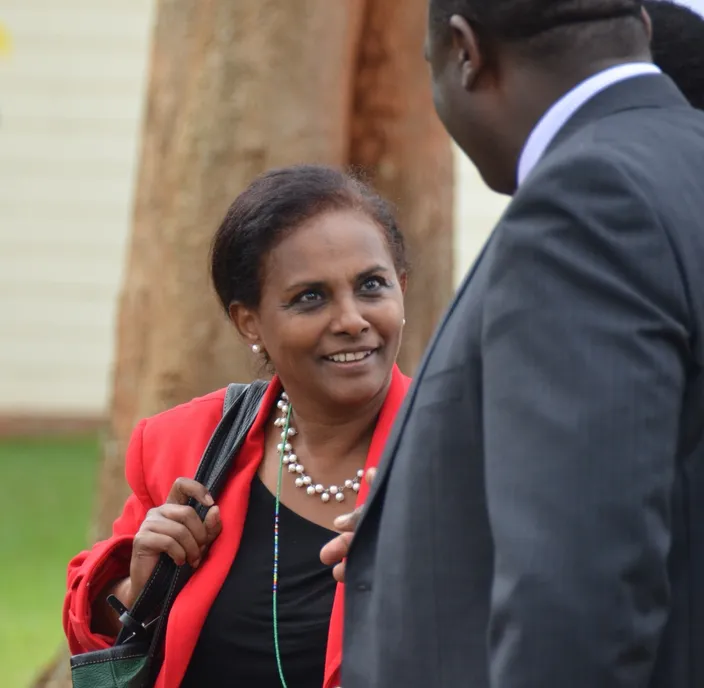
ILRI / Samuel Mungai / CC BY-SA 2.0 via Wikimedia Commons
Segenet Kelemu
A farm girl from Gojjam who ran Africa's insect science centre for a decade.
Ethiopian molecular plant pathologist who rose from a farming family in Gojjam to become the first woman to lead the International Centre of Insect Physiology and Ecology, putting insect science at the heart of Africa's food security.
Biography
Segenet Kelemu was born in 1956 in Finote Selam, a small town in the Gojjam region of Ethiopia, into a farming family. Defying expectations of early marriage, she became the first woman from her region to attend Addis Ababa University, where she was one of only a handful of women in a class of about two hundred. She went on to earn a Master's degree in plant pathology and genetics from Montana State University in 1985 and a PhD in molecular biology and plant pathology from Kansas State University in 1989, followed by postdoctoral research at Cornell University.
From 1992 to 2007 she worked at the International Center for Tropical Agriculture in Cali, Colombia, rising to Senior Scientist and leader of crop and agroecosystem health management. Her signature research used endophytes, microorganisms living inside plants, to improve the disease resistance and productivity of tropical forage grasses. Then she came home. From 2007 to 2013 she directed the Biosciences eastern and central Africa Hub at ILRI in Nairobi, building it into a premier research platform for African scientists, and after a brief spell as Vice President for Programs at AGRA, she became Director General and CEO of the International Centre of Insect Physiology and Ecology (ICIPE) in Nairobi in November 2013, the first woman to lead the institution, serving a full decade.
Her honours track her rise: the TWAS Prize for Agricultural Sciences (2011), the L'Oréal-UNESCO For Women in Science Award as Laureate for Africa and the Arab States (2014), a place on Forbes' list of the 100 most influential African women (2014), fellowship of TWAS (2016), recognition by Bill Gates as a "Hero in the Field" (2018), and election as a Fellow of the Royal Society.
Historical Context
Kelemu grew up in imperial and then Derg-era Ethiopia, when opportunities for rural girls were minimal and famine repeatedly struck the country. Her career spans the era of the African scientific "brain drain," and she became one of the most prominent examples of the reverse current: a world-class researcher who deliberately returned to build scientific institutions on the continent, just as African agriculture confronted climate change, crop disease, and locust and armyworm crises.
What She Fights For
Science done in Africa, by Africans, for African farmers: molecular tools against crop disease, insects harnessed for food, feed and pest control instead of fought only with chemicals, and laboratory doors opened wide to African women scientists.
Major Achievements
- PhD in molecular plant pathology, Kansas State University (1989), followed by pioneering endophyte research at CIAT in Colombia (1992–2007).
- Director of the BecA-ILRI Hub in Nairobi, a flagship bioscience platform for African researchers (2007–2013).
- TWAS Prize for Agricultural Sciences (2011).
- First woman Director General of ICIPE, serving a full decade (2013–2023).
- L'Oréal-UNESCO For Women in Science Award, Laureate for Africa and the Arab States (2014).
- Named one of Bill Gates's "Heroes in the Field" (2018); elected Fellow of the Royal Society.
Her Impact Today
Under her decade at ICIPE, insect science moved to the centre of African food-security strategy, from biological control of crop pests to insects as protein for food and feed. The BecA Hub she built continues to train a generation of African molecular biologists, and across the continent she is cited as living proof that a girl from rural Gojjam can run a world-class research institution, and then hand it over stronger than she found it.
Royal Society fellow profile, Wikipedia (Segenet Kelemu), L'Oréal-UNESCO For Women in Science, TWAS, ILRI/BecA Hub records, GatesNotes.
Cite this page
HerStory Africa. (1956). Segenet Kelemu. HerStory Africa. Retrieved October 1, 2026, from https://herstoryafrica.com.ng/women/segenet-kelemu
"Segenet Kelemu." HerStory Africa, 1956, https://herstoryafrica.com.ng/women/segenet-kelemu. Accessed 1 Oct 2026.
HerStory Africa. "Segenet Kelemu." Accessed October 1, 2026. https://herstoryafrica.com.ng/women/segenet-kelemu.