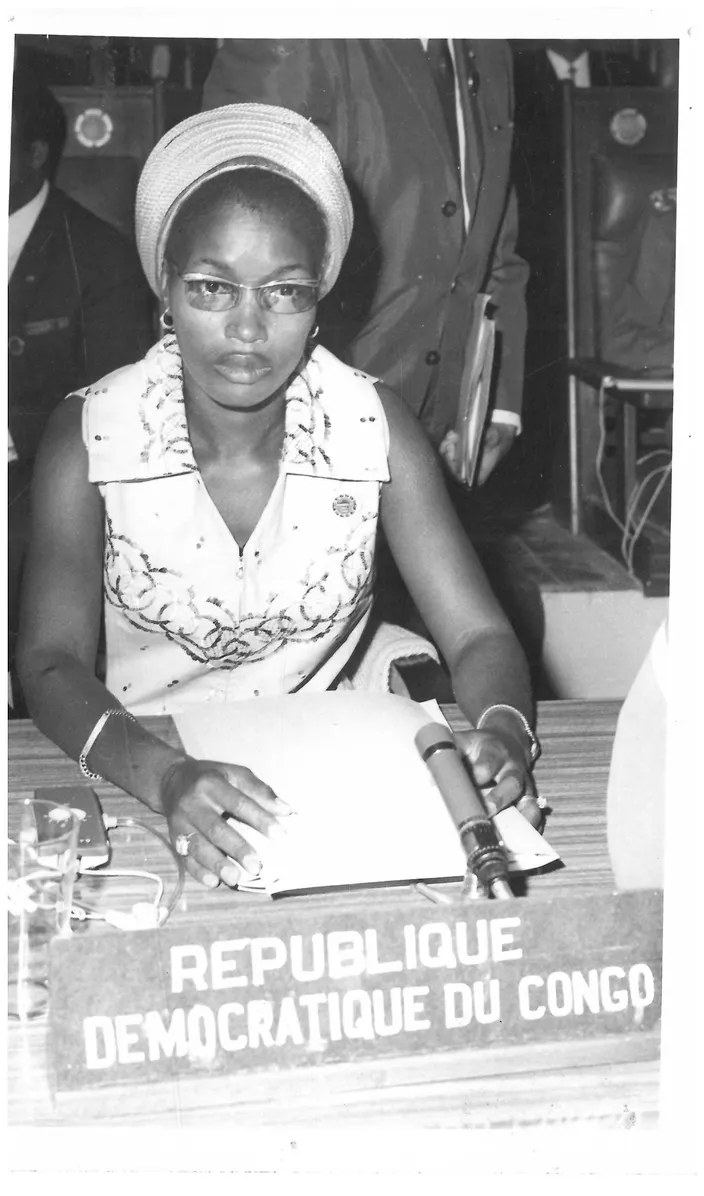
LihNka / CC BY-SA 4.0 via Wikimedia Commons
Sophie Kanza
Crossed the Congo River for schooling, then ran a ministry at twenty-six.
Sociologist and stateswoman who became the first Congolese woman to earn a university degree and, at twenty-six, the first woman ever to hold government office in the DRC, before rising to senior leadership at UNESCO.
Biography
Sophie Kanza was born on 8 February 1940 in Léopoldville, now Kinshasa, the sixth of seven children of Élisabeth Mansangaza and Daniel Kanza, a prominent politician who became vice-president of the ABAKO party. Colonial policy in the Belgian Congo effectively barred Congolese women from advanced schooling, so she crossed the river to Brazzaville for her education, becoming the first Congolese woman to receive a secondary education and graduating from the Lycée du Sacré-Cœur in June 1961. She then earned a sociology degree from the University of Geneva in 1964, making her the first Congolese woman to graduate from a university, and worked there as an assistant lecturer until 1966. In December 1964 she married Marcel Lihau, later President of the Supreme Court of Justice; they had six daughters.
On 31 October 1966 she was appointed Minister of Social Affairs, the first woman ever to hold government office in the DRC, serving until December 1970. In 1967 she joined the political bureau of the Mouvement Populaire de la Révolution and served as a delegate to the OAU summit in Kinshasa. She later added a master's degree and a PhD in sociology from Harvard University (1973–1976), served on the Board of Trustees of UNITAR, and rose through the United Nations system as Deputy Assistant Director-General of UNESCO (1981–1985) and Head of Mission to the UNESCO Director-General (1985–1988).
In 1998 a car accident in Paris left her paralysed. Characteristically, she turned her final months into advocacy, campaigning internationally for the rights of disabled persons. She died in Kinshasa on 2 April 1999, aged 59.
Historical Context
Kanza's life spanned the Belgian Congo, independence in 1960, and the turbulent early Mobutu era. Her firsts came at a moment when the entire country, of any gender, had only a handful of university graduates; Belgium had trained almost no Congolese for leadership. Every door she walked through, from the Geneva lecture hall to the cabinet room, had never before been opened to a Congolese woman.
What She Fought For
Opening secondary and university education to Congolese girls, women's presence in government, and a functioning social welfare system for a newly independent nation. In her final years she fought for the dignity and rights of people with disabilities, speaking from her own experience.
Major Achievements
- First Congolese woman to complete secondary education (1961).
- First Congolese woman to earn a university degree, in sociology at the University of Geneva (1964).
- First woman minister in DRC history, as Minister of Social Affairs (1966–1970).
- Appointed to the MPR political bureau and served as an OAU summit delegate (1967).
- PhD in sociology from Harvard University (1976).
- Senior UNESCO leadership roles, including Deputy Assistant Director-General (1981–1988).
Her Impact Today
Sophie Kanza was inducted into Congo's Pantheon of National History in 2004, with a bust in the Gallery of Memory. The Cercle Sophie Kanza, an association of Congolese female university professors, carries her name, and she remains the reference point for Congolese women in politics and academia: the proof, renewed with every citation of her story, that the country's daughters were never the ones lacking capacity, only opportunity.
Wikipedia (Sophie Kanza), Wikidata, African Shapers, Wikimedia Commons, Congo Pantheon of National History records.
Cite this page
HerStory Africa. (1999). Sophie Kanza. HerStory Africa. Retrieved October 1, 2026, from https://herstoryafrica.com.ng/women/sophie-kanza
"Sophie Kanza." HerStory Africa, 1999, https://herstoryafrica.com.ng/women/sophie-kanza. Accessed 1 Oct 2026.
HerStory Africa. "Sophie Kanza." Accessed October 1, 2026. https://herstoryafrica.com.ng/women/sophie-kanza.