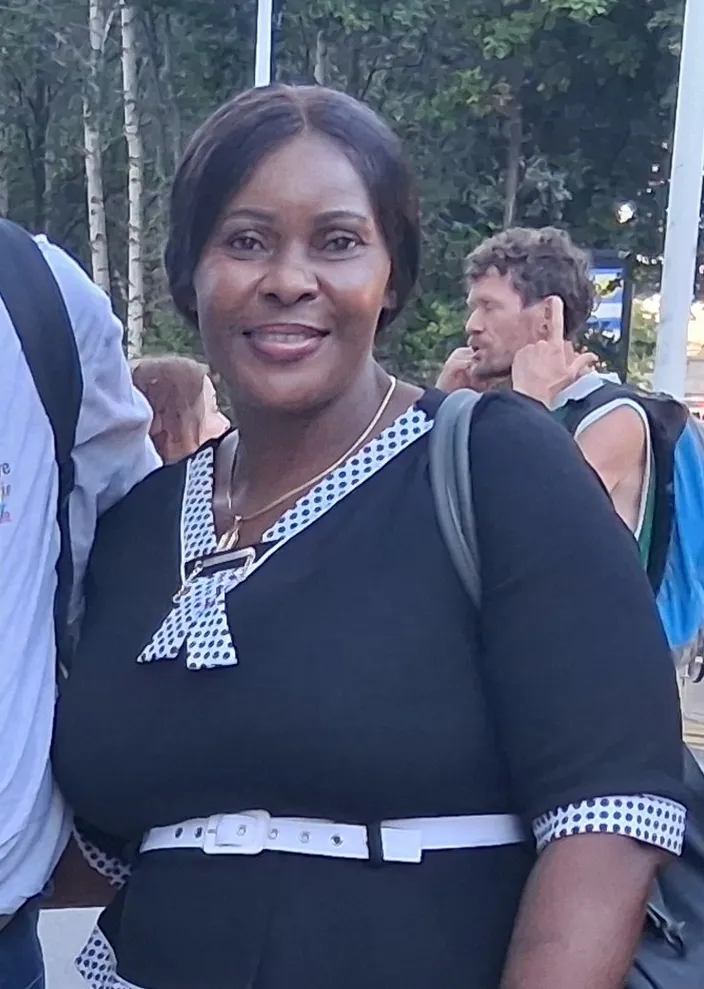
German Coalition to Abolish the Death Penalty (GCADP) / CC BY 4.0 via Wikimedia Commons (cropped from group photo)
Susan Kigula
No one has been executed in Uganda since her petition from death row.
Sentenced to death at 23, she studied law from her cell, led a petition on behalf of all 417 people on Uganda's death row, and won the landmark ruling that abolished the country's mandatory death penalty.
Biography
Susan Kigula was born in 1977 in Masaka District, Uganda, and was working in a small Kampala gift shop when her life changed in July 2000. She was arrested, alongside her housemaid, for the murder of her partner Constantine Sseremba, a charge she has always denied and which rested heavily on the testimony of her three-year-old stepson. In 2002 she was convicted, and because Uganda then imposed a mandatory death penalty for murder, the judge had no discretion: she was sentenced to death and sent to the condemned section of Luzira Women's Prison.
Rather than despair, she organised. She led the death row women's choir, whose songs against the death penalty travelled beyond the prison walls, and she began to study, earning a diploma and then a University of London law degree through a correspondence programme supported by what became Justice Defenders. She was reported as the first female inmate in Uganda to earn a University of London law degree begun behind bars, completing the LLB in 2018. In 2003 she became lead petitioner in Susan Kigula and 416 Others v Attorney General, filed on behalf of every person then on Uganda's death row. Uganda's Constitutional Court ruled in 2005 that the mandatory death penalty was unconstitutional, and the Supreme Court affirmed the decision in 2009, also holding that death sentences not carried out within three years convert to life imprisonment.
At her 2011 re-sentencing, with courts now free to consider mitigation, her sentence was reduced to 20 years; with remission she walked free in January 2016 after nearly sixteen years inside. She now works as a global ambassador for Justice Defenders, helping to build legal offices inside prisons and train paralegal prisoners in Uganda and Kenya, and speaks at international forums including the World Congress Against the Death Penalty.
Historical Context
Uganda inherited the mandatory death penalty from colonial-era law. By the early 2000s, hundreds of people sat on death row at Luzira, many for decades, and judges were powerless to weigh individual circumstances. The Kigula case changed that, and became the template for mandatory-death-penalty challenges across the Commonwealth: a legal revolution started not by a law firm, but by a condemned prisoner with a correspondence course.
What She Fought For
The right of every accused person to be sentenced as an individual; an end to executions in Uganda; and education and legal empowerment for prisoners, on the conviction that justice systems work better when the people inside them understand the law.
Major Achievements
- Filed the constitutional petition as lead applicant for all 417 death row inmates (2003).
- Won the Constitutional Court ruling declaring the mandatory death penalty unconstitutional (2005).
- Supreme Court affirmation in Attorney General v Susan Kigula and 417 Others (2009); around 180 death sentences were rescinded and over 900 people ultimately benefited.
- Re-sentenced to 20 years once courts gained sentencing discretion (2011); released in January 2016.
- Completed her University of London law degree, begun on death row (2018).
- Became a global ambassador for Justice Defenders, training paralegal prisoners across East Africa.
Her Impact Today
No execution has been carried out in Uganda since her case reshaped the law, and judges must now weigh mitigating circumstances in every capital case. Her TEDx talk delivered inside Luzira Prison, "How I Made It Through Death Row," has carried her story worldwide. She embodies a rare kind of legal history: the prisoner who freed not just herself but hundreds of others, using nothing but the law her captors had denied her the right to invoke.
The Death Penalty Project, Justice Defenders, Wikipedia (Susan Kigula), ECPM, World Coalition Against the Death Penalty, Foundation for Human Rights Initiative, TED.
Cite this page
HerStory Africa. (1977). Susan Kigula. HerStory Africa. Retrieved October 1, 2026, from https://herstoryafrica.com.ng/women/susan-kigula
"Susan Kigula." HerStory Africa, 1977, https://herstoryafrica.com.ng/women/susan-kigula. Accessed 1 Oct 2026.
HerStory Africa. "Susan Kigula." Accessed October 1, 2026. https://herstoryafrica.com.ng/women/susan-kigula.