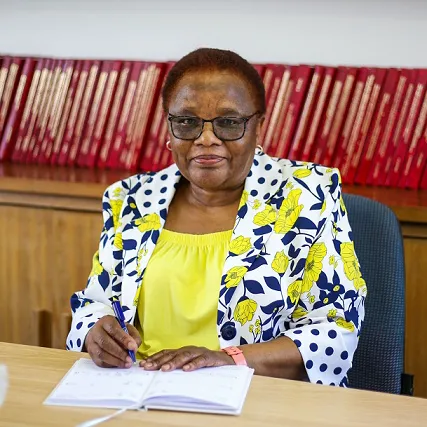
The Royal Society (royalsociety.org); permission recommended, as no freely licensed portrait exists
Tebello Nyokong
A shepherd girl on alternate school days, now a Fellow of the Royal Society.
Lesotho-born South African chemist, a shepherd girl who became a Fellow of the Royal Society, whose light-activated cancer therapy research aims to give Africa a gentler, cheaper alternative to chemotherapy.
Biography
Tebello Nyokong was born on 20 October 1951 in Maseru, Lesotho. She spent part of her childhood with her grandparents in Lesotho's mountains, alternating school days with herding sheep, an experience she credits with teaching her resilience and observation. She initially enrolled to study humanities before a teacher steered her into science. She earned a BSc in chemistry and biology from the National University of Lesotho in 1977, then went to Canada for an MSc at McMaster University (1981) and a PhD at the University of Western Ontario (1987), followed by a Fulbright postdoctoral fellowship at the University of Notre Dame in the United States.
In 1992 she joined Rhodes University in Makhanda, South Africa as a lecturer, rising to Distinguished Professor of Chemistry. Since 2007 she has held the DST/NRF South African Research Chair in Medicinal Chemistry and Nanotechnology and directs the DSI/Mintek Nanotechnology Innovation Centre node at Rhodes. Her research centres on phthalocyanines, intensely coloured dye molecules related to chlorophyll, as photosensitizers for photodynamic therapy: a light-activated cancer treatment intended as a gentler, cheaper alternative to chemotherapy. Her group also builds multifunctional nanodrugs and photocatalytic systems for water purification, and she has trained hundreds of postgraduate researchers, a substantial share of them women, making her one of the most cited chemists in Africa.
Her honours span the continent and the world: the Order of Mapungubwe from South Africa, the L'Oréal-UNESCO For Women in Science Award, the African Union's Kwame Nkrumah Award for Scientific Excellence, and in 2023 election as a Fellow of the Royal Society in London, among the first South African women chemists so honoured.
Historical Context
Nyokong grew up in newly independent Lesotho with scarce educational resources, pursued advanced degrees abroad because opportunities at home were limited, and built her career in South Africa across the apartheid-to-democracy transition. In the post-1994 era she became a flagship example of South Africa's drive to transform a science establishment that had been overwhelmingly white and male, not by lowering any bar, but by clearing every one of them.
What She Fights For
Getting African science to solve African problems: affordable cancer diagnostics and treatment, clean water, and homegrown nanotechnology capacity. She campaigns to convince girls that "science is not for special people," fights for funding and infrastructure for African researchers, and works to bridge the "innovation chasm" between laboratory research and real products in African hands.
Major Achievements
- Order of Mapungubwe (Bronze), one of South Africa's highest national honours (2005).
- DST/NRF South African Research Chair in Medicinal Chemistry and Nanotechnology (2007).
- L'Oréal-UNESCO For Women in Science Award, laureate for Africa and the Arab States (2009).
- NRF Lifetime Achievement Award, South Africa (2013).
- African Union Kwame Nkrumah Award for Scientific Excellence (2016).
- Elected Fellow of the Royal Society (2023).
Her Impact Today
Nyokong's laboratory at Rhodes is a leading African research hub, and her students now populate universities and industries across the continent. She is repeatedly named among the most influential women in African science, and her life story, from shepherd girl on alternate school days to Fellow of the Royal Society, is used across Africa to recruit girls into STEM. Her deepest impact may be the simplest: she made it impossible to argue that world-class science cannot be done from Africa, by an African woman, for Africans.
Royal Society fellow profile, Rhodes University, Wikipedia (Tebello Nyokong), South African Department of Science and Innovation, Royal Society of Chemistry.
Cite this page
HerStory Africa. (1951). Tebello Nyokong. HerStory Africa. Retrieved October 1, 2026, from https://herstoryafrica.com.ng/women/tebello-nyokong
"Tebello Nyokong." HerStory Africa, 1951, https://herstoryafrica.com.ng/women/tebello-nyokong. Accessed 1 Oct 2026.
HerStory Africa. "Tebello Nyokong." Accessed October 1, 2026. https://herstoryafrica.com.ng/women/tebello-nyokong.