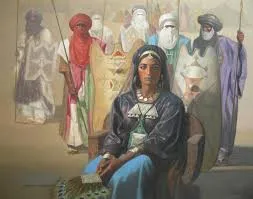
Public domain
Tin Hinan
Mother of us all, buried at Abalessa with gold bracelets and Roman coins.
Legendary 4th-century Tuareg queen and ancestral mother of the Kel Ahaggar confederacy, whose tomb in the Algerian Sahara remains one of the most significant archaeological discoveries in North African history.
Biography
Tin Hinan is the founding ancestral queen of the Tuareg people of the Ahaggar (Hoggar) mountains in what is today southern Algeria. Oral tradition, passed down across generations of Kel Ahaggar Tuareg, holds that she was a noblewoman of the Tafilalt region — likely in present-day Morocco — who journeyed south across the Sahara accompanied by a servant named Takamat. After a long and difficult crossing of the desert, she settled in the Ahaggar massif, where she became a leader of great authority and gave birth to the lineage from which all Kel Ahaggar nobles trace their descent.
The Tuareg word Tin Hinan translates roughly as "She of the tents" or "Mother of us all" — a title that reflects her role not just as an individual but as the symbolic origin of an entire people. She is remembered not as a warrior but as a founding mother: a woman whose authority was political, spiritual, and genealogical.
Her existence was long considered purely legendary until 1925, when French explorer and officer Byron Khun de Prorok led an excavation at Abalessa, an ancient stone structure in the Algerian Sahara. Inside, archaeologists uncovered the skeleton of a tall woman buried with extraordinary grave goods: gold and silver bracelets, beads, and Roman-era coins dating to the 4th century AD. The Tuareg people immediately identified the site as the tomb of Tin Hinan, a recognition that has shaped how the burial has been interpreted ever since. The remains were removed to the Bardo National Museum in Algiers, a decision that remains a source of pain and contested memory for the Tuareg communities who consider her their foremother.
Historical Context
The 4th century AD was a period of deep transition across the Sahara. Roman influence extended to parts of North Africa, trans-Saharan trade routes were active, and the pastoralist Berber peoples of the desert interior were developing political structures adapted to an arid, mobile world. The Tuareg — a Berber people — organised themselves into confederacies, and within those confederacies, noble lineages held authority traced through the maternal line.
This matrilineal inheritance is critical to understanding Tin Hinan's place in history. Among the Tuareg, identity, nobility, and leadership passed through mothers. A founding mother was not a metaphor — she was the literal source of a lineage's legitimacy. Tin Hinan's story, whether fully historical or partly mythological, reflects a real political structure in which women's ancestry determined power.
The Ahaggar region she settled was — and remains — one of the most remote and climatically extreme environments on earth. Her journey across the Sahara, in oral tradition, was itself an act of extraordinary courage and determination.
What She Fought For
Tin Hinan's story is not one of armed resistance but of foundation. She represents the act of crossing an impossible landscape and making a home, of establishing order and kinship in a vast desert, and of becoming the root from which a people's identity grows. In the Tuareg world, where women have historically enjoyed comparatively high social standing — including the right to own property, initiate divorce, and be the source of noble lineage — Tin Hinan stands as the originating symbol of that tradition.
She also represents the right of indigenous peoples to define their own history. The contested removal of her remains, and ongoing Tuareg calls for their return, situates her story within a modern struggle: the fight for indigenous communities to hold, tell, and reclaim their own ancestral narratives.
Major Achievements
- Recognised across generations as the founding ancestral queen of the Kel Ahaggar Tuareg, one of the major confederacies of the central Sahara.
- Her tomb at Abalessa, dated archaeologically to approximately the 4th century AD, remains one of the most significant pre-Islamic burial sites in the Sahara.
- Embodied and anchored the matrilineal principle at the heart of Tuareg social and political organisation.
- Her story has been preserved for over 1,600 years entirely through oral tradition — a testament to her enduring significance in the cultural memory of the Tuareg people.
Her Impact Today
Tin Hinan remains a living symbol for Tuareg identity. Her image appears on Algerian currency; a monument to her stands in the town of Tamanrasset, the main city of the Ahaggar region. For Tuareg communities across Algeria, Mali, Niger, and Burkina Faso — who have faced decades of political marginalisation — she is a source of pride and a point of cultural cohesion.
The ongoing campaign to repatriate her remains from the Bardo Museum to Abalessa has become a focal point for discussions about colonial-era excavations, museum ethics, and the rights of indigenous communities over their ancestral heritage. In this sense, Tin Hinan is not only a figure of the past but an active presence in contemporary debates about who owns history and who gets to tell it.
Encyclopædia Britannica ("Tin Hinan"); Wikipedia ("Tin Hinan"); Keenan, J. (2004). The Tuareg: People of Ahaggar. Sickle Moon Books; Barich, B.E. (2014). Archaeology of the Sahara. Cambridge University Press; Ag Solimane, I. — Tuareg oral traditions documented by the Centre National de Recherches Préhistoriques, Anthropologiques et Historiques (CNRPAH), Algiers.
Cite this page
HerStory Africa. (n.d.). Tin Hinan. HerStory Africa. Retrieved October 1, 2026, from https://herstoryafrica.com.ng/women/tin-hinan
"Tin Hinan." HerStory Africa, n.d., https://herstoryafrica.com.ng/women/tin-hinan. Accessed 1 Oct 2026.
HerStory Africa. "Tin Hinan." Accessed October 1, 2026. https://herstoryafrica.com.ng/women/tin-hinan.