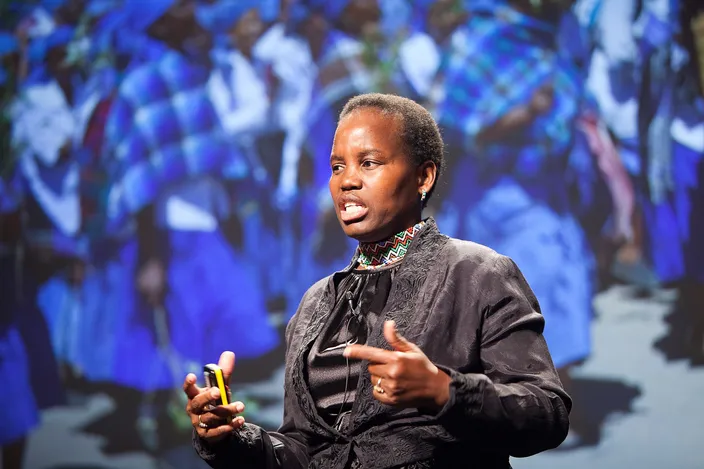
Photo: Kris Krüg / PopTech / CC BY-SA 2.0 via Wikimedia Commons
Unity Dow
She sued Botswana so her own children would stop being foreigners at home.
Botswana lawyer who took her own government to court in the landmark Attorney General v Dow case, forced the rewriting of a citizenship law that treated women as lesser parents, and went on to become her country's first female High Court judge, a cabinet minister and a novelist.
Biography
In 1990, a young lawyer in Botswana looked at her two youngest children and saw a legal absurdity. They had been born in Botswana. Their mother was a citizen of Botswana. Yet in the eyes of the law they were foreigners, because their father was American. Under the Citizenship Act of 1984, a Motswana man could pass citizenship to his children, but a Motswana woman married to a foreigner could not. Unity Dow decided the law itself was the problem. So she sued the government.
Unity Diswai was born on 23 April 1959 in Mochudi, in what was then the Bechuanaland Protectorate, to a farmer father and a seamstress mother, in a village without electricity or running water. Her parents refused to divide chores between sons and daughters, an ordinary household habit that quietly taught her that gender should never set the limits of a life. She won a scholarship to study law, earned her degree in 1983 through the University of Botswana and Swaziland, and spent two years at the University of Edinburgh, where she began to see how deeply inequality was stitched into legal language. In 1984 she married Peter Dow, an American who had come to Botswana with the Peace Corps.
Her case, Attorney General v Dow, took years and made her famous, and to some, infamous. She argued that the Act "renders her children aliens in their home country and land of birth." In 1991 Judge Martin Horwitz of the High Court ruled in her favour. The government appealed, and in 1992 the Court of Appeal upheld her victory by three judges to two. In 1995, Parliament rewrote the Citizenship Act. Dow went on to co-found the Metlhaetsile Women's Information Centre in 1990, became Botswana's first female High Court judge in 1998, helped decide the historic Kalahari case of 2006, served as a cabinet minister including Minister of International Affairs and Cooperation from 2018 to 2020, published five books, and returned to Parliament in 2024.
Historical Context
Botswana in 1990 was a peaceful, fast-growing democracy, often praised as an African success story. But like many countries across the Commonwealth, its nationality law carried an old colonial assumption: that a family's identity flows through the father. A child's passport followed the man. The idea that a mother's citizenship counted for less was written down in plain statutory language, and almost nobody questioned it.
Challenging that law meant challenging more than a paragraph. Government lawyers argued that Botswana society was patrilineal, and that the constitution had deliberately left out "sex" as a protected ground of discrimination. Customary expectations pressed on Dow too: a married woman was supposed to follow her husband, not drag her own government before a judge. Women's movements across Africa were just beginning to test constitutions against discriminatory family and nationality laws, and everyone understood that the Dow case would echo far beyond one household in Mochudi.
What She Fought For
At its heart, Unity Dow's fight was about a simple sentence: a woman is a full citizen, and her children belong to her country as much as any man's. The Citizenship Act told her otherwise every time her family crossed a border, every time a residence permit needed renewing, every time she imagined her children's future in the only home they knew.
The turning point came when she stopped treating the law as fixed. Filing suit in 1990, as a young mother against her own Attorney General, was an act of extraordinary nerve. The litigation stretched over years under intense public scrutiny. When the Court of Appeal ruled in 1992 that sections of the Act were unconstitutional discrimination, the judgment did not just fix her family's paperwork. It declared that Botswana's constitution protected women even where the text was silent, and that citizenship could not be rationed by sex. Three years later the law itself was rewritten.
She kept fighting from every seat she held. At Metlhaetsile she gave poor women legal help they could never have afforded. On the High Court bench from 1998 she was known for rulings that put rights before convenience. In 2006, in the marathon Sesana case, she and her fellow judges found that the Basarwa (San) people had been unlawfully removed from their ancestral lands in the Central Kalahari Game Reserve, affirming that the country's oldest inhabitants had rights the state could not simply bulldoze. And in her novels, beginning with Far and Beyon' in 2000, she dragged hidden subjects, from gender violence to ritual murder, into Botswana's public conversation.
Major Achievements
- Won Attorney General v Dow (1991 to 1992), the case that struck down gender-discriminatory citizenship law in Botswana and led to the new Citizenship Act of 1995
- Became Botswana's first female High Court judge, appointed in 1997 and taking the bench in January 1998, where she served for over a decade
- Sat on the panel in the 2006 Sesana case, ruling that the eviction of the Basarwa from the Central Kalahari Game Reserve was unlawful and unconstitutional
- Co-founded pioneering organisations including Women and Law in Southern Africa (1988), the Metlhaetsile Women's Information Centre (1990) and the AIDS Action Trust (1991)
- Served in cabinet, including as Minister of Basic Education and as Minister of International Affairs and Cooperation (2018 to 2020)
- Published five books, including the novels Far and Beyon' and The Screaming of the Innocent, and received France's Legion of Honour in 2010
Her Impact Today
The Dow case became a travelling precedent. Courts and campaigners from Zimbabwe to the Caribbean have cited it when attacking nationality laws that treat mothers as second-class parents, and women's organisations across Africa used it as a blueprint for reforming their own citizenship statutes. Today, when a child in Botswana inherits citizenship from either parent equally, that ordinary fact is Unity Dow's monument.
Her career also redrew the map of what a woman in Botswana could be: litigant, judge, minister, novelist, and legislator, sometimes all in the same decade. Young African women lawyers, many trained in clinics descended from the ones she helped found, point to her as proof that the law can be turned from a wall into a door.
Perhaps her deepest legacy is an idea she has repeated in courtrooms, novels and lectures alike: rights that exist only on paper are not rights at all until someone insists on them. In 1990 she insisted. An entire region is still collecting the winnings.
Wikipedia (Unity Dow; Attorney General of Botswana v. Unity Dow); Institute for African Women in Law profile of Unity Dow; PopTech talk materials; Kiddle encyclopedia (Unity Dow).
Cite this page
HerStory Africa. (1959). Unity Dow. HerStory Africa. Retrieved October 15, 2026, from https://herstoryafrica.com.ng/women/unity-dow
"Unity Dow." HerStory Africa, 1959, https://herstoryafrica.com.ng/women/unity-dow. Accessed 15 Oct 2026.
HerStory Africa. "Unity Dow." Accessed October 15, 2026. https://herstoryafrica.com.ng/women/unity-dow.