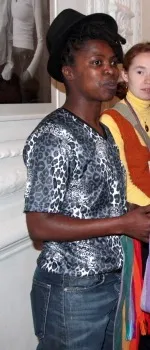
Side by Side International LGBT Film Festival (Bok-o-Bok), St. Petersburg / CC BY-SA 3.0 via Wikimedia Commons (cropped)
Zanele Muholi
Twenty hard drives of the archive stolen in 2012, and the portraits kept coming.
South African visual activist whose portrait archives of Black lesbian and trans lives, and searing self-portrait series 'Somnyama Ngonyama', have filled the world's great museums and won photography's most prestigious prize.
Biography
Zanele Muholi was born in 1972 in Umlazi township, Durban, the youngest of eight children. Their father died shortly after their birth, and their mother, Bester, worked as a domestic worker under apartheid, so Muholi was raised largely by extended family. Muholi is non-binary, uses they/them pronouns, and self-describes not as an artist but as a "visual activist." They completed the Advanced Photography course at the Market Photo Workshop in Johannesburg in 2003 and in 2009 earned an MFA in Documentary Media from Ryerson University in Toronto, with a thesis mapping the visual history of Black lesbian identity in post-apartheid South Africa.
Activism preceded art-world fame. In 2002 Muholi co-founded the Forum for the Empowerment of Women, supporting Black lesbians, and in 2009 founded Inkanyiso, a collective for queer visual media under the banner "Queer Activism = Queer Media." The life's-work project "Faces and Phases," begun in 2006 with a portrait of activist Busi Sigasa, now numbers hundreds of black-and-white portraits of Black lesbians and trans people: a living archive of a community targeted by violence. Other major series include "Brave Beauties," portraits of trans women, and the acclaimed ongoing self-portrait series "Somnyama Ngonyama" ("Hail the Dark Lioness," begun 2012), in which Muholi darkens their skin and fashions props from everyday materials to confront the politics of race and representation. In 2012 burglars stole more than twenty hard drives of irreplaceable archive footage from their Cape Town flat in an apparently targeted attack; the work continued anyway.
Muholi became one of the world's most exhibited photographers: Documenta in 2012, the Stedelijk Museum Amsterdam in 2017, a landmark Tate Modern retrospective in 2020, and major shows in Paris, Milan and San Francisco. Honours include the Prince Claus Award (2013), the ICP Infinity Award (2016), France's Chevalier de l'Ordre des Arts et des Lettres (2016), and, announced in March 2026, the Hasselblad Award, photography's most prestigious prize. Their work is held by MoMA, the Guggenheim, Tate and the Art Institute of Chicago.
Historical Context
Post-apartheid South Africa's 1996 constitution was the world's first to ban discrimination on the basis of sexual orientation, yet Black lesbians and trans people continued to face murders and so-called "corrective rape." Muholi's archive fills the gap between constitutional promise and lived reality, insisting that the people the constitution names are seen, named and remembered.
What They Fight For
Visibility, safety and self-representation for Black LGBTQIA+ South Africans; a queer visual archive made by the community itself rather than about it; and recognition that Black queer lives are part of national history. Muholi's cameras are pointed at a simple proposition: existence, documented, becomes undeniable.
Major Achievements
- Co-founded the Forum for the Empowerment of Women (2002).
- Launched "Faces and Phases," the ongoing portrait archive of Black lesbians and trans people (2006).
- Began the "Somnyama Ngonyama" self-portrait series and exhibited at Documenta (2012).
- ICP Infinity Award and Chevalier de l'Ordre des Arts et des Lettres (2016).
- Career retrospective at Tate Modern, London (2020).
- Hasselblad Award laureate (2026).
Their Impact Today
Muholi redefined who gets archived: museums treat "Faces and Phases" as both art and historical record, and a generation of African queer image-makers traces its lineage to Inkanyiso. While their work fills the world's leading collections, Muholi funnels resources into education projects in South African townships, keeping the archive rooted in the community it documents.
Hasselblad Foundation, Wikipedia (Zanele Muholi), Tate Modern, Artforum, ARTnews, Wikimedia Commons.
Cite this page
HerStory Africa. (1972). Zanele Muholi. HerStory Africa. Retrieved October 1, 2026, from https://herstoryafrica.com.ng/women/zanele-muholi
"Zanele Muholi." HerStory Africa, 1972, https://herstoryafrica.com.ng/women/zanele-muholi. Accessed 1 Oct 2026.
HerStory Africa. "Zanele Muholi." Accessed October 1, 2026. https://herstoryafrica.com.ng/women/zanele-muholi.