We Are Not Angry Enough
A lawsuit names seven Cornell Chi Phi members over an alleged gang rape. Two were expelled. Five got lesser sanctions, including essays. She left Cornell. The numbers behind why that outcome is ordinary.
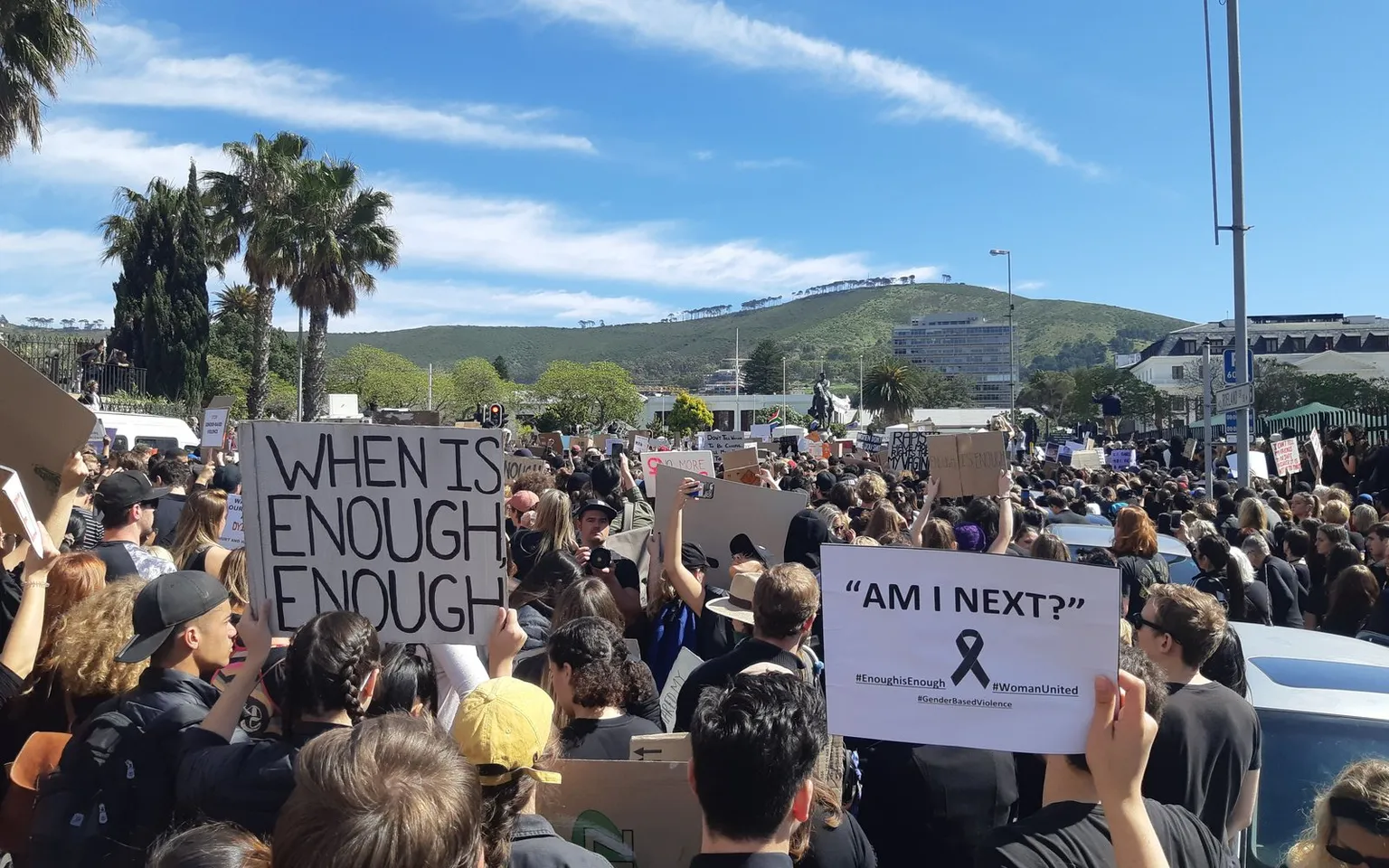
Anti-femicide protest outside Parliament, Cape Town, 5 September 2019, after the rape and murder of student Uyinene Mrwetyana / Discott / Wikimedia Commons / CC BY-SA 4.0
A university can expel you for plagiarism. It can expel you for bringing a phone into an exam hall, for buying an essay, for putting your name on work that was not yours. Institutions have decades of practice at this. The letter arrives, the transcript is annotated, the student goes home.
At Cornell University, according to a civil lawsuit filed on 16 September 2026, some of the men accused of gang raping a 20-year-old student were told to write one.
Sit with the shape of that. Not the outrage. The shape. A system that has an efficient, well-rehearsed, unambiguous response to a stolen paragraph, and a hesitant, committee-shaped, carefully worded response to a woman on a fraternity house floor.
What the Cornell lawsuit actually says
The woman is identified in the filing only as Jane Doe. She was 20 years old on 19 October 2024, the night she says she was drugged and raped at Cornell's Chi Phi fraternity house. The complaint runs to 101 pages. It alleges that the assault went on for hours, that she blacked out around 5:45 in the morning, and that members of the fraternity used a group chat to invite others to come and join in.
The lawsuit names seven Chi Phi members as defendants: Matthew Ingalls, Johnathan Newell, Winston Lee, Gillio Lopes, Diego Sarabia, Scott Norris and Scott Kretzschmar. It also names Cornell University, the Chi Phi fraternity, her own sorority, and the off-campus bar that allegedly served her alcohol while she was under the legal drinking age.
None of this has been proven in court. That matters and I am going to say it plainly: these are allegations in a civil suit, the men have not been criminally charged, and the university disputes part of the account. Hold that. Then hold the rest.
Her lawyer, Thomas Giuffra, says two of the seven were expelled and the other five received lesser sanctions, including suspensions, workshops and essay assignments. Cornell's response was not that this did not happen. Cornell's response was that "none of the individuals charged were offered the opportunity to write essays as a sole consequence of their involvement." Read the sentence again. The defence is the word sole. The essays are not in dispute. Their sufficiency is.
The Tompkins County District Attorney, Matthew Van Houten, declined to bring charges in 2024. His stated reason is that the statement she gave that November described what happened as voluntary and consensual. Her lawyer's answer is that after her initial contact with Cornell police, she was never interviewed by anyone trained to interview a rape survivor. Both of those things can be true at once, and if they are, that is not a case that failed. That is a case that was never built.
She left Cornell. In September 2026, after the lawsuit went public and the internet did what the process had not, Van Houten reopened the matter and said he would put it to a grand jury. Governor Kathy Hochul called for an independent review of how the university handled it. Two years after the night in question. Twelve days after a court filing made it impossible to ignore.
The arithmetic: 975 out of every 1,000
Here is the part nobody can argue with, because it is not an opinion.
RAINN, working from United States Justice Department and FBI data, puts it this way. Out of every 1,000 sexual assaults: roughly 310 are reported to police. 50 lead to an arrest. 28 lead to a felony conviction. 25 end in the perpetrator being incarcerated.
975 out of 1,000 walk free.
People like to respond to that number by interrogating it. Fine. Interrogate it. Then look at South Africa, where the police service recorded 43,037 rapes between April 2022 and March 2023, and where the conviction rate for reported rape has hovered around 6 percent in the government's own annual reporting. The average time from report to trial has been measured at more than four years. The majority of cases are withdrawn before they ever reach a courtroom.
So when a woman decides not to report, she is not being irrational, hysterical, or difficult. She is doing maths. She is weighing four years of her life, cross-examination about her clothes and her drinking, her name in her cousins' mouths, against a roughly one-in-twenty chance that the state does anything at all. Most people would not buy a lottery ticket at those odds. We ask women to buy one with their reputation.
Tokyo Medical University just changed the number
Discrimination is usually deniable. Someone was more qualified. It was a culture fit. She was not ready. There is never a document.
Except at Tokyo Medical University, where there was.
In 2018, an investigation confirmed that the school had been rigging its entrance exams for at least twelve years. The method was not subtle. First-stage scores were cut by 20 percent across the board, then at least 20 points were added back for male applicants. The purpose was to keep women at around 30 percent of each intake, because administrators believed women would go off and have children and leave the hospital short-staffed.
The results that year: 8.8 percent of male applicants admitted, 2.9 percent of female applicants. Girls who had studied for years, sat the same paper, and scored higher than men who got in, were failed by arithmetic performed after the fact.
This is the thing I want you to keep. Every one of those women went home believing she had not been good enough. That belief was manufactured in an office. And the only reason we know is that somebody eventually looked. Nobody looks at most institutions.
Who does the work and who holds the power
The World Health Organization counts women as about 67 percent of the global health and care workforce. Women hold roughly 25 percent of senior leadership roles in the sector.
Two thirds of the hands. A quarter of the decisions.
This is the pattern that makes sexism so hard to litigate case by case. In male-dominated fields, men lead. In female-dominated fields, men also lead. There is no single moment you can point to, no memo, no slur. There is only the aggregate, and the aggregate is not an accident.
The same logic is built into objects. The crash test dummy used as the industry default is a mid-sized male body. The so-called female dummy is a scaled-down version of it. Researchers found that a belted woman driver had roughly 47 percent higher odds of serious injury than a belted man in a comparable crash, even after controlling for weight and body mass. Nobody sat in a room and decided women should be hurt more. Somebody simply decided what a body is, and moved on.
Africa has been here before
None of this is foreign to African women. We have our own archive of institutions declining to be serious.
The photograph at the top of this page was taken in Cape Town on 5 September 2019. Uyinene Mrwetyana, a 19-year-old University of Cape Town student, had gone to a post office to collect a parcel and was raped and murdered by the man working the counter. What followed was not a statement of condolence. It was tens of thousands of people in the street outside Parliament under placards reading when is enough, enough and am I next, the hashtag #AmINext moving faster than any official process, and a president forced out onto a stage to address a crowd that did not want to hear from him.
That is what a country looks like when it stops waiting to be told the process is ongoing. And it still took a young woman's death to produce it.
In 1929, Nwanyeruwa was a widow in Oloko who was grabbed by the throat by a census taker counting her property for taxation. The argument that followed became Ogu Umunwanyi, the Aba Women's War, and tens of thousands of Igbo and Ibibio women shut down six thousand square miles of colonial administration. The British convened a commission of inquiry. The commission heard her evidence. It then recommended that the man who put his hands on her, and the chief who sent him, both be pardoned.
An essay, a pardon. Ninety-seven years apart, the same instinct: process the woman's complaint in a way that leaves the man's life intact.
In Ethiopia in 1996, a 14-year-old named Aberash Bekele was abducted, beaten and raped under the custom of telefa, which the law had quietly tolerated for generations, even providing a route for an abductor to escape punishment by marrying his victim. She took her attacker's rifle and shot him. The state charged her with murder. It took Meaza Ashenafi and the Ethiopian Women Lawyers Association to win her acquittal, and eight more years after that before the criminal code made marriage by abduction a crime.
In 2019, BBC Africa Eye's Sex for Grades, reported by Kiki Mordi, put hidden cameras on lecturers at the University of Lagos and the University of Ghana and broadcast them propositioning and attempting to blackmail undercover reporters posing as students. Suspensions followed within days. Students had been saying this for years and it took three months of hidden camera footage, aired internationally, to make it actionable. That is the going rate for a woman's word.
And in the Democratic Republic of Congo, Julienne Lusenge has spent a quarter of a century documenting rape used as a weapon of war and dragging cases towards prosecution, one file at a time, because nobody else was going to.
What I am actually asking for
I am not asking you to be upset. Upset is cheap and it expires in about forty-eight hours, which is roughly the length of a news cycle, which is exactly why institutions wait it out. Cornell's process took two years and produced essays. Public attention took twelve days and produced a grand jury.
Anger, on its own, is also cheap. What every woman in this archive did was convert it into something with a longer half-life. Nwanyeruwa's anger became an organised movement that broke the warrant chief system. Meaza's anger became a criminal code. Funmilayo Ransome-Kuti's anger became 20,000 women outside a palace and an abdicated king. The anger was never the achievement. The structure it was poured into was.
So the question is not whether this story made you angry. It is what your anger is load-bearing for.
Ask what your university's sexual misconduct policy actually says, and what the sanction range is, and whether anyone has ever received the top of it. Ask why the case withdrawal rate in your country is what it is. Ask who sits on the panel. Ask what happens to the complainant while the process runs, because at Cornell the answer was that she left and they stayed.
You can argue with my tone. You can argue with my politics. You can decide I am too loud about this. You cannot argue 975 out of 1,000 into something smaller, and you cannot argue 20 points added to a boy's exam score into something other than what it was.
What to take away
- A civil lawsuit filed on 16 September 2026 names seven Cornell Chi Phi members over an alleged gang rape in October 2024. The allegations are unproven and no criminal charges have been filed; the district attorney reopened the case and referred it to a grand jury only after it became public.
- The plaintiff's attorney says two of the seven were expelled and five received lesser sanctions, including workshops and essays. Cornell's rebuttal is that essays were not the sole consequence.
- The woman left the university. The men did not leave in handcuffs.
- RAINN's analysis of US data: of every 1,000 sexual assaults, 310 are reported, 50 lead to arrest, 28 to felony conviction, 25 to incarceration. 975 perpetrators walk free.
- In South Africa, 43,037 rapes were recorded by police in 2022/23, with a conviction rate hovering around 6 percent of reported cases.
- Tokyo Medical University cut every applicant's score by 20 percent and added at least 20 points back for men, for at least twelve years, to hold women to 30 percent of the intake.
- Women are 67 percent of the global health workforce and hold about 25 percent of its senior roles, per the WHO.
- Belted women drivers face roughly 47 percent higher odds of serious injury than belted men in comparable crashes. The default crash test dummy is a male body.
- Anger is not the problem. Anger with nowhere to go is.
Cite this page
HerStory Africa. (2026). We Are Not Angry Enough. HerStory Africa. Retrieved September 30, 2026, from https://herstoryafrica.com.ng/articles/we-are-not-angry-enough
"We Are Not Angry Enough." HerStory Africa, 2026, https://herstoryafrica.com.ng/articles/we-are-not-angry-enough. Accessed 30 Sept 2026.
HerStory Africa. "We Are Not Angry Enough." Accessed September 30, 2026. https://herstoryafrica.com.ng/articles/we-are-not-angry-enough.