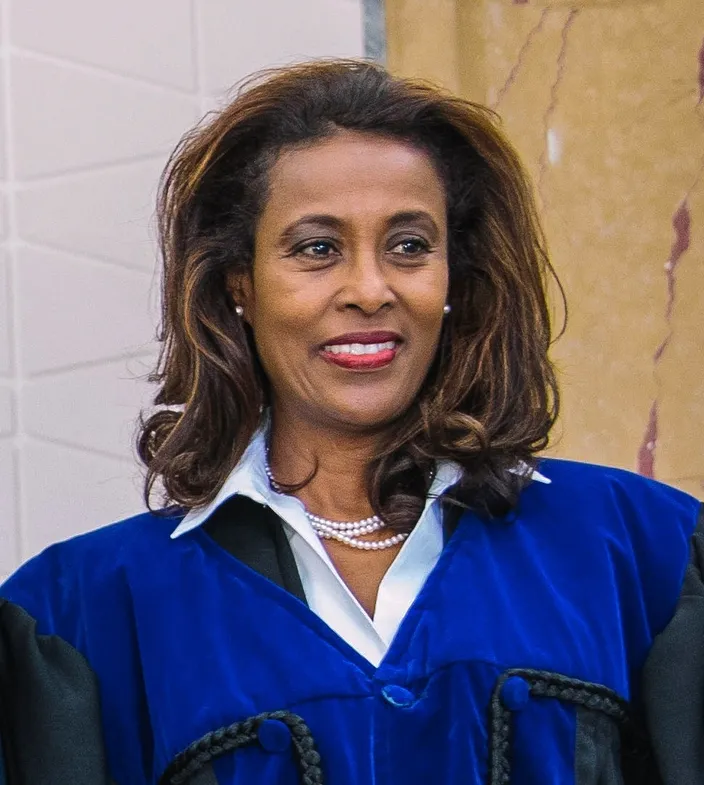
Photo: Office of the Prime Minister of Ethiopia, 2018 (cropped) / Public domain via Wikimedia Commons
Meaza Ashenafi
Amharic had no word for sexual harassment, so her lawyers' association coined one.
The lawyer who defended a 14-year-old girl for killing her abductor, helped outlaw marriage by abduction, and became the first woman to lead Ethiopia's Supreme Court.
Biography
In 1996, on the day she was promoted to the fifth grade, a 14-year-old Ethiopian girl named Aberash Bekele was seized by men on horseback. Under the old custom of telefa, marriage by abduction, her kidnapper beat and raped her, expecting the law to look away, as it always had. Aberash grabbed his rifle, ran, and when the men came after her, she shot her abductor dead. She was charged with murder and faced a possible death sentence. The lawyer who took up her cause was Meaza Ashenafi.
Meaza was born in 1964 in Asosa, a remote town in western Ethiopia, and made it from there to Addis Ababa University's law school, one of very few women in the room. She served as a High Court judge from 1989 to 1992, then advised the commission drafting Ethiopia's 1995 constitution, making sure women's rights were written into it. In 1995 she founded the Ethiopian Women Lawyers Association (EWLA) with two colleagues, offering free legal aid to women who had never had a lawyer on their side.
The Aberash case made EWLA famous and Meaza a target. The trial riveted the nation and forced Ethiopians to debate a practice that, in parts of the south, lay behind an estimated one in five marriages. Aberash was acquitted on grounds of self-defense, a verdict that changed Ethiopian legal history, though she paid a bitter price: she could never safely return to her village. In 2004, Ethiopia adopted a new criminal code that criminalized marriage by abduction, alongside domestic violence and female genital mutilation, reforms EWLA had fought for over a decade.
Meaza kept building. She co-founded Enat Bank, Ethiopia's first bank focused on women, and chaired its board. She advised the UN Economic Commission for Africa on gender. And on November 1, 2018, Prime Minister Abiy Ahmed appointed her President of the Federal Supreme Court, the first woman ever to lead Ethiopia's judiciary. She served until January 2023.
Historical Context
Meaza grew up under Emperor Haile Selassie and then the Derg military dictatorship, in a country where customary law governed most women's lives regardless of what statutes said. Telefa was tolerated by police and courts; a 1960 legal provision even allowed an abductor to escape punishment by marrying his victim. Girls who resisted had almost nowhere to turn.
The fall of the Derg in 1991 opened a rare window. A new constitution was being written, and Meaza was in the room, one of the few advocates insisting that women's equality be spelled out. Civil society was fragile and often unwelcome: EWLA's confrontational cases irritated officials, and the organization was at one point suspended, yet it built a network of volunteer lawyers serving thousands of poor women.
When Abiy Ahmed became prime minister in 2018, he appointed women to half his cabinet and gave the presidency and the Supreme Court to women, a political earthquake in a state long dominated by men. One activist described watching the announcement: "I screamed at the TV. This wasn't just a woman; it was an extremely outspoken woman."
What She Fought For
Meaza's core belief was that the law itself had been built without women, so it had to be rebuilt, word by word. Sometimes literally: when EWLA began taking harassment cases, Amharic had no term for sexual harassment. "We had to improvise," she recalled. "We literally had to create the word." The term they coined, wesibawi tinkosa, entered the language.
The Aberash Bekele case was the turning point. Defending a village girl accused of murder meant putting telefa itself on trial. Meaza argued that a child who shot the man who abducted and raped her was not a criminal but a survivor acting in self-defense. Death threats followed. So did victory: acquittal for Aberash, a national reckoning with abduction, and eventually the 2004 criminal code that made telefa punishable with years in prison. As Meaza said, "this case opened up a discussion and dialogue around this traditional practice."
She also understood that rights on paper mean little without economic power, hence Enat Bank, built to bring women into the financial system. And when she took over the Supreme Court, she warned the prime minister's office with characteristic bluntness: "You might not be happy with the decisions that I make in this position."
Major Achievements
- Founded the Ethiopian Women Lawyers Association in 1995, providing free legal aid to women and driving landmark reforms of Ethiopia's family and criminal law
- Won the 1996-97 defense of 14-year-old Aberash Bekele, whose acquittal on self-defense grounds put marriage by abduction on trial before the whole nation
- Helped secure the 2004 criminal code that criminalized marriage by abduction, domestic violence, and female genital mutilation
- Her most famous case became the film Difret (2014), executive produced by Angelina Jolie, winner of audience awards at Sundance and Berlin
- Co-founded Enat Bank, Ethiopia's first women-focused bank, and chaired its board
- Became the first woman President (Chief Justice) of Ethiopia's Federal Supreme Court in November 2018, serving until 2023
Her Impact Today
Every Ethiopian girl who cannot legally be married off to her kidnapper lives under the protection Meaza's generation of lawyers fought to write into law. EWLA still provides legal aid across the country, and the lawyers she trained and inspired now fill Ethiopia's courts, ministries, and law faculties.
The film Difret, whose title means "courage" in Amharic, carried the Aberash case to audiences worldwide and helped make telefa an international byword for a harm that can be defeated. Aberash herself, once forced into anonymity, now campaigns openly against child marriage, saying of survivors: "we are not victims, we have powerful voices."
As chief justice, Meaza pushed judicial independence and reform at the highest level, proof that a girl from Asosa could rise to lead the very institution that once had no place for her. She was nominated among the 1,000 women for the Nobel Peace Prize in 2005, and she remains, for young African lawyers, the model of what one stubborn advocate with a law degree can change.
Wikipedia (Meaza Ashenafi), Christian Science Monitor (2019), Institute for African Women in Law, Equality Now, Ms. Magazine interview with Aberash Bekele (2015), The World / PRX on Difret (2015).
Cite this page
HerStory Africa. (1964). Meaza Ashenafi. HerStory Africa. Retrieved October 1, 2026, from https://herstoryafrica.com.ng/women/meaza-ashenafi
"Meaza Ashenafi." HerStory Africa, 1964, https://herstoryafrica.com.ng/women/meaza-ashenafi. Accessed 1 Oct 2026.
HerStory Africa. "Meaza Ashenafi." Accessed October 1, 2026. https://herstoryafrica.com.ng/women/meaza-ashenafi.