What Is Patriarchy and How Does It Show Up in Everyday Life?
A clear and simple explanation of what patriarchy means, how it works, and how young people can learn to recognise it in the world around them.
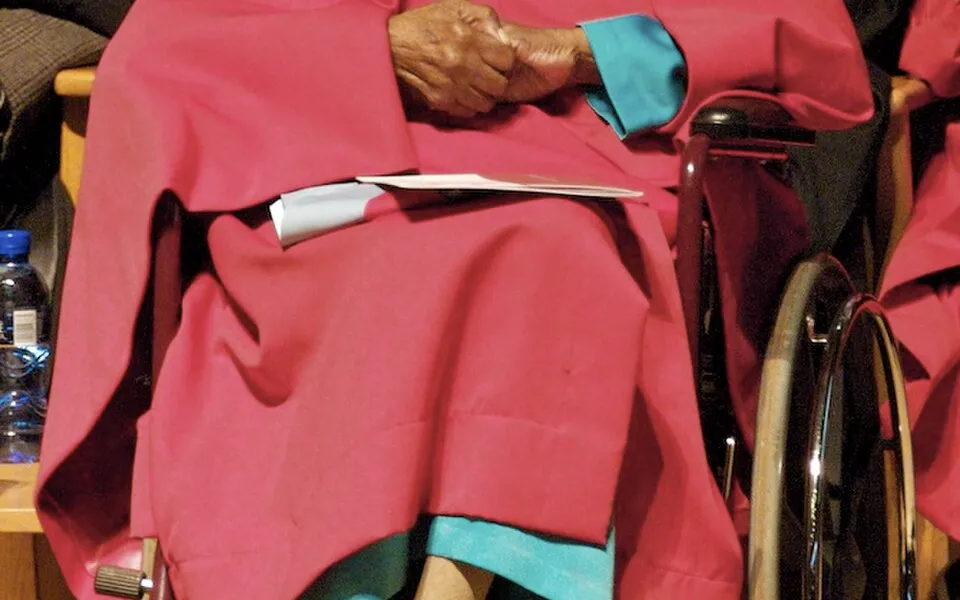
Albertina Sisulu receiving honorary doctorate, 2007 / Wikimedia Commons
You have probably heard the word "patriarchy" before. Maybe in a conversation, in a social media debate, or in a classroom. It can feel like a big, academic word that does not connect to real life. But patriarchy is not abstract. It is one of the most practical things you can learn to recognise because it shapes almost everything around you.
So what is it?
Patriarchy is a social system where men hold the primary power in political leadership, moral authority, social privilege, and control over property. In a patriarchal society, men are generally at the centre of power and women are expected to operate around them.
That does not mean every man has power or that every woman is powerless. It means the system is set up in a way that favours men as a group, often without anyone making a conscious decision to do so. It is built into laws, traditions, expectations, and habits that have been passed down for generations.
Think of it like a game where one team starts with more points. Individual players on either side can be talented or not, lucky or not. But the starting conditions are not equal, and that affects the outcome even when nobody is cheating on purpose.
Where does it come from?
Patriarchy is not a natural law. It is a human-made system, and it has looked different in different times and places.
In many precolonial African societies, women held significant power. Among the Igbo, women had their own political institutions and market systems. In the Ashanti kingdom, lineage was traced through the mother. Among the Lovedu people of southern Africa, the ruler was a Rain Queen. These were not perfect systems, but they were not strictly patriarchal either.
Colonialism played a huge role in deepening patriarchy across Africa. European colonial governments often dealt only with men, gave land titles only to men, and imposed legal systems that treated women as dependents. Many of the "traditional" gender roles that people defend today were actually shaped or hardened by colonial influence, not by African tradition alone.
How does patriarchy show up in everyday life?
This is where it gets real. Patriarchy is not just about presidents and parliaments. It is in the small things too.
At home. When girls are expected to cook, clean, and look after younger siblings while boys are free to play or study, that is patriarchy at work. When a father's word is automatically final in the household, regardless of what the mother thinks, that is a patriarchal norm.
At school. When teachers call on boys more often or expect girls to be quiet and well-behaved while tolerating noise from boys, that reflects patriarchal expectations. When girls are told to "dress properly" to avoid distracting boys rather than boys being told to focus regardless, that is the same pattern.
In relationships. When people assume the man should make all the decisions in a relationship, or when a woman is judged for being ambitious but a man is praised for the same ambition, patriarchy is shaping those judgments.
In the workplace. When women are paid less for the same work, or when leadership positions are overwhelmingly held by men, or when a woman in charge is called "bossy" while a man in the same role is called "a strong leader," those are patriarchal patterns.
In law and policy. In some African countries, women still cannot inherit property, open bank accounts without a male relative's consent, or pass citizenship to their children. These are not cultural preferences. They are legal expressions of patriarchy.
In language. Think about common phrases: "man up," "don't cry like a girl," "he wears the trousers." These phrases reinforce the idea that masculinity is strong and femininity is weak. They limit both men and women.
Patriarchy hurts men too
This might sound surprising, but patriarchy does not just harm women. It sets up expectations for men that are damaging in their own way.
Boys are taught from a young age to suppress emotions. "Boys don't cry." "Be a man." These messages push boys toward aggression, silence, and isolation. Men who struggle with mental health are less likely to seek help because they have been taught that vulnerability is weakness.
The pressure to be the provider, the protector, the strong one at all times is exhausting and unrealistic. When men are taught that their value depends on dominance, it damages their relationships, their health, and their sense of self.
Patriarchy tells men they must be in control. Feminism says they can just be human. That is not a loss. It is freedom.
How to recognise it
Once you start seeing patriarchy, you cannot unsee it. Here are questions that help.
Who gets to speak? In meetings, classrooms, or family discussions, whose voice carries weight? Whose gets ignored or interrupted?
Who does the unpaid work? In your household, who cooks, cleans, and cares for children or elderly relatives? Is that labour shared or assumed to belong to women?
Who gets judged differently? When a man and a woman do the exact same thing, do people react the same way? Think about ambition, anger, sexuality, parenting, or career choices.
What are the rules, and who made them? Many of the rules we live by, legal, cultural, or social, were created at a time when women had no say. Are those rules still fair?
What does "normal" look like? Patriarchy works best when it is invisible, when people accept it as "just the way things are." Questioning what is normal is the first step toward changing it.
What can young people do?
You do not need to overthrow a system overnight. Awareness is the first and most important step.
Notice the patterns. Pay attention to who does what at home, who speaks in class, what expectations are placed on boys versus girls. Just noticing is powerful.
Question what you have been taught. Not everything passed down as tradition is fair or worth keeping. You are allowed to ask "why" and to disagree with answers that do not make sense.
Speak up in small moments. When someone makes a sexist joke, when a girl is talked over, when a boy is shamed for crying, say something. These moments are where change actually happens.
Educate yourself. Read about women like Lilian Ngoyi who stood against unjust systems, or Albertina Sisulu who fought for equality while raising a family under constant threat. Their stories show you what challenging patriarchy looks like in practice.

What to take away
- Patriarchy is a social system where men hold most of the power. It is human-made, not natural.
- It shows up in homes, schools, workplaces, laws, relationships, and everyday language.
- Many "traditional" gender roles in Africa were reinforced or created by colonialism, not by African cultures alone.
- Patriarchy harms men too by forcing them into rigid roles that limit their emotional and personal freedom.
- Recognising patriarchy is the first step to challenging it. You do not need to be an expert. You just need to start asking better questions.
The point of understanding patriarchy is not to blame anyone. It is to see the system clearly so that you can choose to do things differently. Every generation has the power to reshape what "normal" looks like. That includes yours.
Cite this page
HerStory Africa. (2026). What Is Patriarchy and How Does It Show Up in Everyday Life?. HerStory Africa. Retrieved October 23, 2026, from https://herstoryafrica.com.ng/articles/what-is-patriarchy
"What Is Patriarchy and How Does It Show Up in Everyday Life?." HerStory Africa, 2026, https://herstoryafrica.com.ng/articles/what-is-patriarchy. Accessed 23 Oct 2026.
HerStory Africa. "What Is Patriarchy and How Does It Show Up in Everyday Life?." Accessed October 23, 2026. https://herstoryafrica.com.ng/articles/what-is-patriarchy.