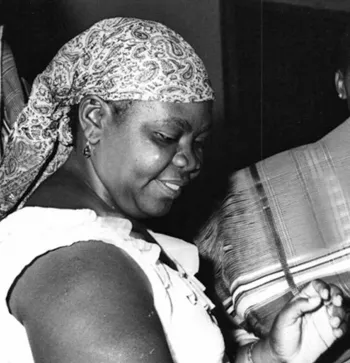
Bibi Titi Mohammed with Julius Nyerere / Wikimedia Commons / Public Domain
Bibi Titi Mohammed
Five thousand women enrolled in TANU in ninety days, then a 127-day treason trial.
The Dar es Salaam singer who talked thousands of women into joining Tanganyika's independence movement, helped found a nation, then was erased from its story after a treason trial, until historians restored her name.
Biography
Before she was a politician, Bibi Titi Mohammed was a voice. In the courtyards of Dar es Salaam she sang as the lead singer of ngoma groups, the dance and music societies where the city's Muslim women gathered, celebrated, and organized. She had only a few years of primary school. Her father, a businessman, had at first refused to educate her at all, fearing school would pull her from her faith; it was her mother, after his death, who insisted. Married off at 14, divorced young with a daughter named Halima, she seemed destined for an ordinary, invisible life. Then, in 1955, the independence movement came looking for a voice, and found hers.
Julius Nyerere had founded the Tanganyika African National Union (TANU) in 1954 to end British colonial rule, but the party was struggling to reach half the population: women. Bibi Titi, introduced to TANU circles through a family taxi driver's connection, took on the job of organizing them. She went straight to the networks she knew best, the ngoma groups. "I talked to Mama Swaleh Kubunju, leader of the Tongakusema," she later told historian Susan Geiger. "That's how I went to British Empire and to Ratu Sudan." Group by group, song by song, speech by speech, she recruited. Within three months she had enrolled more than 5,000 women in TANU. Soon she was crossing the whole territory addressing rallies, and by the late 1950s she was, by many accounts, as well known among ordinary Tanganyikans as Nyerere himself.
When independence came in December 1961, Bibi Titi stood at the center of the new nation. She led the founding of Umoja wa Wanawake wa Tanzania (UWT), the national women's organization, served as a junior minister, helped shape the 1964 constitution, and co-founded the All African Women's Conference. Then came the fall. In 1965 she lost her parliamentary seat. In 1967 she resigned from the party's central committee, objecting that the Arusha Declaration's ban on leaders renting out property stripped uneducated women like her of their only income. In October 1969 she was arrested with former minister Michael Kamaliza and four army officers, accused of plotting to overthrow the government. Tanzania's first treason trial ran for 127 days. She insisted on her innocence throughout. She was convicted and sentenced to life in prison. Her husband divorced her out of shame; her old comrades fell silent.
In 1972, President Nyerere commuted her sentence and she walked free, but into obscurity. She died on November 5, 2000, in a Johannesburg hospital, aged 74.
Historical Context
Tanganyika in the 1950s was a British-administered territory where colonial authority, and much of local custom, assumed politics was men's business. Most women had little or no formal schooling, and many, like Bibi Titi, had been secluded at puberty and married in their teens. Yet the same colonial city that shut women out of offices could not shut them out of each other's courtyards. The ngoma dance societies were a parallel world of female leadership, with their own stars, treasurers, and networks stretching across neighborhoods and ethnic lines.
Bibi Titi's genius was to see that this world was already a political machine waiting for a cause. When she plugged the ngoma networks into TANU, the independence movement suddenly had crowds, songs, fundraisers, and couriers. Historians credit women, mobilized largely by her, with giving TANU its mass character and helping carry Tanganyika to independence in 1961 without a war. The new nation she helped build, however, kept the old habit of writing history around one great man. That is the world in which her story could be misplaced for decades.
What She Fought For
Bibi Titi fought first for freedom, telling crowds across Tanganyika that colonial rule had to end, at a time when a Muslim woman with four years of schooling was not supposed to speak in public at all. But woven through everything she did was a second fight: the conviction that the women who won independence deserved a full share of it. She built UWT so that women's organizing would outlive the independence campaign, and she pushed for women's place in the party, the parliament, and the constitution.
Her turning point cuts both ways. The rise: 1955, when she accepted the task of mobilizing women and, in ninety days, delivered five thousand members and a movement's heartbeat. The fall: October 1969, when the state she helped create put her on trial for treason. For 127 days the woman who had sung a nation into being sat in a courtroom while former friends looked away. The life sentence, and the silence that followed, nearly deleted her from the story of Tanzania.
Even her final protest was about poor women. When the Arusha Declaration barred leaders from renting out rooms, the educated elite lost little, but for an unschooled woman whose house was her only asset, it meant ruin. Bibi Titi said so, out loud, and paid for her honesty with her political life. She never stopped insisting that she had been loyal, and she never apologized for defending women like herself.
Major Achievements
- Transformed Dar es Salaam's ngoma women's networks into the engine of the independence movement, enrolling more than 5,000 women in TANU within three months in 1955
- Became the leading female voice of Tanganyika's independence struggle, by many accounts as famous among ordinary people as Julius Nyerere
- Led the founding of Umoja wa Wanawake wa Tanzania (UWT), Tanzania's national women's organization
- Served as a junior minister after independence, helped shape the 1964 constitution, and co-founded the All African Women's Conference
- Survived Tanzania's first treason trial, 127 days long, and a life sentence, maintaining her innocence until her pardon in 1972
- Officially honored in 1991 as a Heroine of the Uhuru Struggle, with a major Dar es Salaam road later named after her
Her Impact Today
For years after her trial, Bibi Titi's name was spoken quietly, if at all. The rescue came from historians, above all Susan Geiger, whose interviews with Bibi Titi in the 1980s and 1997 book on TANU's women restored the record: Tanganyika's independence was won not just in meeting halls of educated men but in courtyards full of singing, organizing women. In 1991, on the thirtieth anniversary of independence, the state itself named her a Heroine of the Uhuru Struggle.
Today one of Dar es Salaam's major roads carries her name, and her face and story have returned to textbooks, documentaries, and animations made for young Africans. She has become a symbol of a larger truth about liberation movements across the continent: that women built them, and that memory can be a battlefield too. Bibi Titi lost her freedom, her marriage, and for a time her place in history. She got the last of these back, because the record, like the woman, refused to stay silent.
Wikipedia (Bibi Titi Mohammed); African Feminist Forum, "Bibi Titi Mohamed, Tanzania" (drawing on Susan Geiger's interviews); Qiraat Africa, "Tanzania's Bibi Titi Mohammed (1926-2000)"; Susan Geiger, "TANU Women" (1997).
Cite this page
HerStory Africa. (2000). Bibi Titi Mohammed. HerStory Africa. Retrieved September 15, 2026, from https://herstoryafrica.com.ng/women/bibi-titi-mohammed
"Bibi Titi Mohammed." HerStory Africa, 2000, https://herstoryafrica.com.ng/women/bibi-titi-mohammed. Accessed 15 Sept 2026.
HerStory Africa. "Bibi Titi Mohammed." Accessed September 15, 2026. https://herstoryafrica.com.ng/women/bibi-titi-mohammed.