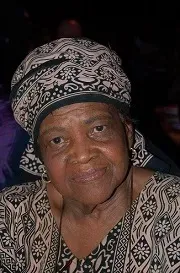
South African History Online (sahistory.org.za); rights unstated, permission recommended
Miriam Tlali
A bookkeeper's novel from a Johannesburg furniture store, banned by the censors in 1979.
The first Black South African woman to publish a novel inside South Africa, whose banned books about township life under apartheid opened the door for generations of Black women writers.
Biography
Miriam Masoli Tlali was born on 11 November 1933 in Doornfontein, Johannesburg, and grew up in Sophiatown, the vibrant Black cultural hub later demolished under apartheid. She attended St Cyprian's Anglican School and Madibane High School, and sought to study at the University of the Witwatersrand, only to be excluded when it closed to Black students under apartheid. She enrolled instead at Pius XII University in Roma, Lesotho, but had to abandon her studies for financial reasons, taking work as a bookkeeper at a Johannesburg furniture store. That office, with its daily racial humiliations, became the raw material of her first novel.
She completed the manuscript of "Muriel at Metropolitan" in 1969, but it sat unpublished for six years until Ravan Press issued it, with cuts, in 1975, making her the first Black South African woman to publish a novel in English inside South Africa. The apartheid government banned the book in 1979; that same year it was published internationally by Longman as "Between Two Worlds." Her second novel, "Amandla" (1980), based on the 1976 Soweto Uprising, was banned within weeks of release. The bans on her books were lifted only in 1986. Undeterred, she was a founding contributor to Staffrider magazine, where her "Soweto Speaking" column preserved the voices of ordinary township residents, and in 1984 she co-founded Skotaville, a pioneering Black-owned publishing house.
She took part in the International Writing Program in Iowa in 1978, published the collections "Mihloti" (1984) and "Footprints in the Quag" (1989, published internationally as "Soweto Stories"), and was a visiting scholar at Yale University's Southern African Research Program from 1989 to 1990. She died on 24 February 2017 in Johannesburg, aged 83. A selected-writings volume, "Miriam Tlali: Writing Freedom," appeared in 2021.
Historical Context
Tlali wrote under high apartheid, when censorship boards banned Black protest literature, Black students were barred from white universities, and the 1976 Soweto Uprising radicalised township writing. Publishing at all, as a Black woman, in South Africa, about apartheid's daily humiliations, was itself an act of defiance. Bessie Head had published earlier, but from exile; Tlali did it from inside the machine.
What She Fought For
The right of Black South Africans, and Black women in particular, to tell their own stories on their own terms. She rejected conforming to white and Western aesthetic standards, insisting that writers had a duty "to write for our people and about them," and she fought censorship for her entire career, including by building Black-owned publishing infrastructure so the gatekeepers could be bypassed altogether.
Major Achievements
- Published "Muriel at Metropolitan" (1975), the first novel published in South Africa by a Black South African woman.
- Published "Amandla" (1980), one of the first novels about the Soweto Uprising; both books were banned until 1986.
- Co-founded Skotaville, the pioneering Black-owned publishing house (1984).
- International Writing Program, Iowa (1978); visiting scholar at Yale University (1989–1990).
- Literary Lifetime Achievement Award from South Africa's Department of Arts and Culture (1995).
- Order of Ikhamanga (Silver), South Africa's national honour for the arts (2008).
Her Impact Today
Tlali opened the door for generations of Black South African women writers, and "Muriel at Metropolitan" is a set text in African literature courses worldwide. Her Staffrider interviews preserved ordinary Soweto voices as historical record, and Skotaville proved that Black South Africans could own the means of literary production. The censors who banned her are footnotes now; her books are the curriculum.
South African History Online, Wikipedia (Miriam Tlali), The Citizen, Ravan Press and Skotaville publishing histories.
Cite this page
HerStory Africa. (2017). Miriam Tlali. HerStory Africa. Retrieved October 1, 2026, from https://herstoryafrica.com.ng/women/miriam-tlali
"Miriam Tlali." HerStory Africa, 2017, https://herstoryafrica.com.ng/women/miriam-tlali. Accessed 1 Oct 2026.
HerStory Africa. "Miriam Tlali." Accessed October 1, 2026. https://herstoryafrica.com.ng/women/miriam-tlali.