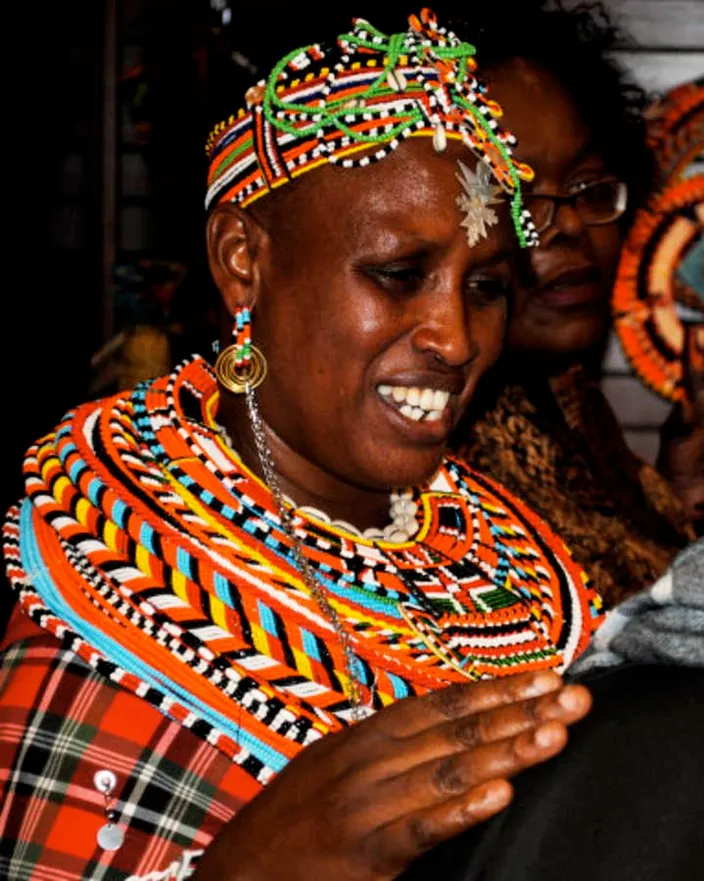
ThSNbTL / CC BY-SA 4.0 via Wikimedia Commons
Rebecca Lolosoli
Founded Umoja around 1990 with fifteen other survivors, a village where no man may live.
Samburu matriarch who founded Umoja, believed to be Africa's first all-women village: a self-governing refuge for survivors of violence that has defied threats, armed attacks and tradition for over three decades.
Biography
Rebecca Samaria Lolosoli was born in 1962 in Wamba, Samburu District, in northern Kenya. She entered Wamba girls' primary school in 1971 but could not complete formal education, and later trained at a Catholic nursing centre before financial hardship forced her out months before finishing. Raised in the strongly patriarchal Samburu pastoralist culture, she underwent female genital cutting at about fifteen and at eighteen was married for a dowry of seventeen cows. When she began speaking publicly about women's rights, men in her community beat her while her husband declined to defend her. That rupture pushed her to leave, and to build something no one had built before.
Around 1990, Lolosoli and roughly fifteen other women, survivors of rape (including women who reported rape by British soldiers training in the region), domestic violence, FGM and forced marriage, founded Umoja Uaso village near Archers Post in Samburu County. "Umoja" means "unity" in Kiswahili. The village bans men from residing there and became a refuge for women, girls, widows and orphans with nowhere else to go. The women built a livelihood on traditional Samburu beadwork, a campsite and cultural tourism, and established a school and cultural centre serving the surrounding villages. Lolosoli chaired the local branch of Maendeleo Ya Wanawake, Kenya's national women's development organisation, from roughly 1995 to 2005, and serves as Umoja's democratically chosen matriarch.
Her defiance drew violent backlash: the village was harassed for years, and in 2009 her former husband attacked Umoja armed with a gun. International recognition followed instead of retreat. She addressed a United Nations conference in New York in 2005, received the Vital Voices Global Leadership Award in 2010, appeared with Hillary Clinton at the Women in the World Summit in 2011, and received the GR8! Women Award in Dubai in 2012. She finally secured her divorce around 2010. By 2015 the village counted 47 women and about 200 children, and sister villages have appeared across the region.
Historical Context
Samburu society is semi-nomadic and pastoralist, with entrenched practices of FGM, child and forced marriage, and the exclusion of women from property ownership. In the 1980s and 1990s, reports emerged of Samburu women raped by British soldiers on training exercises; survivors were often blamed and abandoned by their husbands. Kenya criminalised FGM only in 2011, meaning Umoja predated national legal protection by two decades. Lolosoli did not wait for the law; she built the refuge first.
What She Fought For
A world where Samburu women can own property, refuse FGM and forced marriage, live free from violence, earn their own income and educate their daughters. Umoja is her proof of concept: a functioning, self-governing all-women community that has sustained itself for more than thirty years.
Major Achievements
- Co-founded Umoja around 1990, believed to be Africa's first all-women village, as a refuge for survivors of violence.
- Chaired the local Maendeleo Ya Wanawake women's development organisation (1995–2005).
- Addressed a United Nations conference in New York on women's rights (2005).
- Vital Voices Global Leadership Award (2010).
- Featured at the Women in the World Summit alongside Hillary Clinton (2011) and profiled in the book "Vital Voices" (2012).
- GR8! Women Award, Dubai (2012).
Her Impact Today
Umoja still operates, sustained by jewellery sales and tourism, and has become a global symbol of grassroots feminist resistance. It inspired other women-led villages in Samburu, features in documentaries such as "Umoja: The Village Where Men Are Forbidden," and appears in curricula and journalism on FGM and gender-based violence worldwide. Lolosoli's premise was radical in its simplicity: if the society will not protect its women, the women will build their own.
Vital Voices, Wikipedia (Rebecca Lolosoli; Umoja, Kenya), The Guardian, NBC News, Wikimedia Commons.
Cite this page
HerStory Africa. (1962). Rebecca Lolosoli. HerStory Africa. Retrieved October 1, 2026, from https://herstoryafrica.com.ng/women/rebecca-lolosoli
"Rebecca Lolosoli." HerStory Africa, 1962, https://herstoryafrica.com.ng/women/rebecca-lolosoli. Accessed 1 Oct 2026.
HerStory Africa. "Rebecca Lolosoli." Accessed October 1, 2026. https://herstoryafrica.com.ng/women/rebecca-lolosoli.