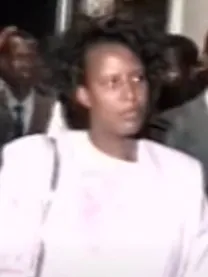
RTNB (Burundi National Radio and Television) / CC BY 3.0 via Wikimedia Commons
Sylvie Kinigi
Prime Minister for 103 days, then head of state from inside the French embassy.
Economist who became Burundi's first female Prime Minister in 1993, survived the coup that killed the president three months later, and as acting head of state held a shattered government together long enough to hand power back to an elected successor.
Biography
Sylvie Kinigi was born Sylvie Ntigashira on 24 November 1953 into a Tutsi family in Burundi. Numbers were her first language. She earned a degree in banking from the University of Burundi in 1979, added a diploma from the Centre de Formation de la Profession Bancaire in Paris, and built a career most Burundian politicians could not match: by 1990 she was directing research and statistics at the Bank of the Republic of Burundi, and the following year she was put in charge of the country's structural adjustment programme. Along the way she served on the central committee of the Union of Burundian Women, lobbying for laws and budgets that actually reached women.
In June 1993 Burundi did something it had never done before. It held a free election, and Melchior Ndadaye, a Hutu, won the presidency from the Tutsi-dominated establishment. Ndadaye then did something even more unusual. He reached across the divide and asked Kinigi, a Tutsi associated with the rival UPRONA party, to be his Prime Minister. She took office on 10 July 1993, the first woman ever to hold the post, and announced that her top priority was not the economy she knew so well but ethnic reconciliation, because without it there would be no economy to manage.
She got 103 days. On 21 October 1993, Tutsi soldiers stormed the palace and murdered President Ndadaye along with several of the country's highest officials. Kinigi survived because the plotters could not find her. She took refuge in the French embassy with the ministers still alive, and from there, by telephone, she did an extraordinary thing: she refused to let the government die. The coup collapsed in the face of internal division and international condemnation, and Kinigi emerged as the highest-ranking official left standing, de facto head of state of a country sliding into massacre.
Through the following months, as reprisal killings took tens of thousands of lives, she worked to broker a political settlement. It produced the election of Cyprien Ntaryamira as president in January 1994, and she resigned when he took office that February, having delivered the one thing the coup had tried to destroy: a constitutional handover. She returned to banking, took senior roles with international institutions including United Nations agencies, and came home in 2008 to work as an independent economic consultant.
Historical Context
Burundi in 1993 carried the same combustible inheritance as its twin, Rwanda: a Hutu majority and a Tutsi minority set against each other by colonial rule and post-independence violence, including the 1972 massacres that killed perhaps two hundred thousand people. The 1993 election was a fragile experiment in sharing power. The coup of 21 October blew it apart and set off a civil war that would last more than a decade. Kinigi's months in office sit in the narrow space between the experiment and the explosion, when one exhausted, grieving government was all that stood between Burundi and total collapse. Two months after she left office, the plane carrying President Ntaryamira was shot down over Kigali alongside Rwanda's president, the event that triggered the genocide next door.
What She Fought For
Reconciliation before everything, because she understood that in Burundi ethnicity was the fault line under every policy. An economy run on competence rather than patronage. The survival of constitutional government itself: after the coup she insisted that legitimacy lay with the elected institutions, not with whoever held the guns, and she made that claim stick.
Major Achievements
- Rose from bank economist to head of Burundi's structural adjustment programme by 1991.
- Became Burundi's first and so far only female Prime Minister on 10 July 1993, in a deliberate act of cross-ethnic power sharing.
- Survived the October 1993 coup and, as acting head of state, held the government together from inside a foreign embassy.
- Brokered the compromise that produced an elected successor, then handed over power and stepped down, a rarity in the region's politics.
- Became the second woman in African history to serve as a head of state.
Her Impact Today
Burundi has not had another woman as Prime Minister or President. Kinigi's example is studied less for what she built, since war swallowed most of it, than for how she behaved when everything fell apart: the civil servant who kept the state alive by refusing to concede that it was dead. In a decade remembered for leaders who inflamed the Great Lakes, she belongs to the small company of those who tried to hold it together, alongside her Rwandan counterpart Agathe Uwilingiyimana, who faced the same forces and did not survive them.
Wikipedia (Sylvie Kinigi), Encyclopædia Britannica, UN and academic accounts of the 1993 Burundi coup and civil war.
Cite this page
HerStory Africa. (1953). Sylvie Kinigi. HerStory Africa. Retrieved October 1, 2026, from https://herstoryafrica.com.ng/women/sylvie-kinigi
"Sylvie Kinigi." HerStory Africa, 1953, https://herstoryafrica.com.ng/women/sylvie-kinigi. Accessed 1 Oct 2026.
HerStory Africa. "Sylvie Kinigi." Accessed October 1, 2026. https://herstoryafrica.com.ng/women/sylvie-kinigi.