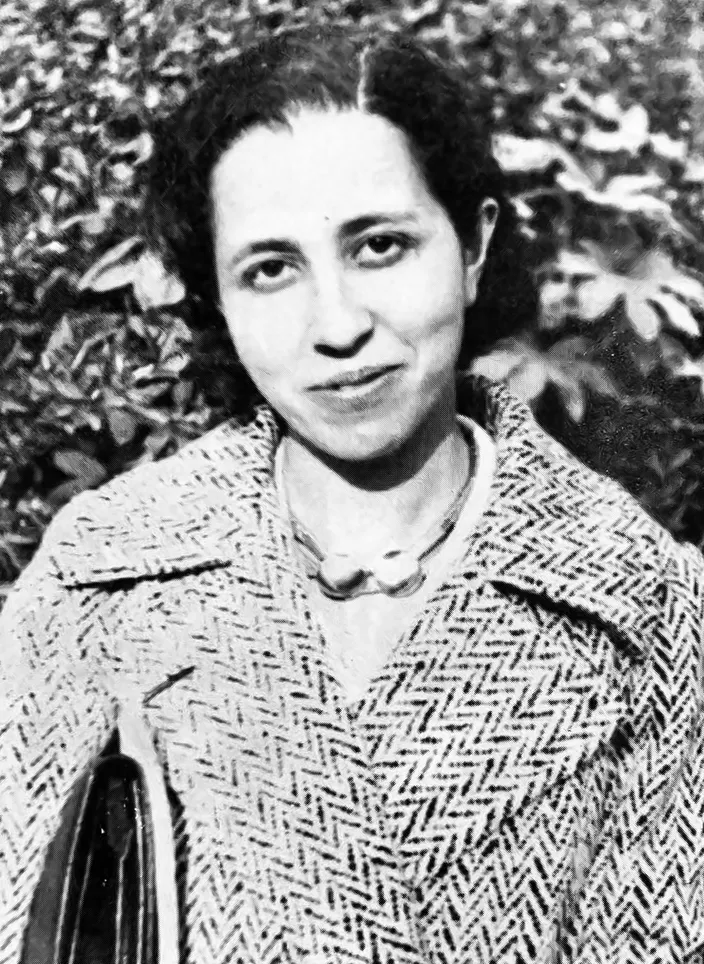
Portrait, 1936, photographer unknown / Wikimedia Commons / Public Domain
Tawhida Ben Cheikh
The face on Tunisia's 10-dinar note, a doctor when no Tunisian woman had been one.
The first modern female doctor of Tunisia and North Africa, who graduated in Paris in 1936 and spent a century of life opening medicine, family planning, and freedom of choice to Tunisian women.
Biography
Pull a 10-dinar note from your pocket in Tunis today and a woman in a doctor's calm gaze looks back at you. Her name is Tawhida Ben Cheikh, and when she was a schoolgirl, the thing she became did not exist: there was no such person as a Tunisian woman doctor. She had to invent her.
Born on January 2, 1909, in Tunis, into a conservative elite family with roots in the coastal town of Ras Jebel, Tawhida lost her father young and was raised by her widowed mother. She attended Tunisia's first public school for Muslim girls, on the Rue de Russie, and became one of the first Tunisian Muslim girls to earn the French baccalaureate. Then came the wall. Studying medicine meant Paris, and an unmarried young woman from a respectable Tunis family simply did not travel alone to France. The turning point arrived in the form of Dr. Etienne Burnet, a scientist at the Pasteur Institute of Tunis, who saw her school results and, with his wife, sat down with Tawhida's mother and persuaded her that this daughter's promise was too great to waste. The Burnets even helped arrange her lodging in Paris. Her mother said yes, and that yes changed North Africa.
In 1936 she graduated from the Faculty of Medicine in Paris, becoming the first modern female doctor of Tunisia and the wider Arab North African world. She sailed home to a hero's welcome; the doctors of Tunis threw a dinner in her honor. But under the colonial system the public hospitals had no place for her, so she opened her own private practice in Tunis, specializing in gynecology and obstetrics, and treated poor women free of charge. She also took up the pen, leading Leila, the first French-language women's magazine in Tunisia, a journal dedicated, in its own words, to the evolution and emancipation of North African Muslim women.
From 1955 she directed the maternity ward at the Charles Nicolle Hospital in Tunis, where she created Tunisia's first family planning service and helped train a new generation of midwives. She served as vice president of the Tunisian Red Crescent and founded charities for orphans, mothers, and poor families. She died on December 6, 2010, at the age of 101.
Historical Context
Tawhida grew up in a Tunisia ruled as a French protectorate, where power, hospitals, and universities belonged to the colonizers, and where most Tunisian girls were expected to marry early and stay home. Girls' education was a battlefield of its own: her school on the Rue de Russie was a rare experiment, and each diploma a Muslim girl earned was a small revolution. For a Tunisian woman to stand in a Paris lecture hall dissecting anatomy in 1930 was almost unimaginable.
She returned with her medical degree into a society on the eve of great change. Her own uncle, Tahar Ben Ammar, would later lead the negotiations for Tunisia's independence, ratified in 1956. Independent Tunisia became a regional pioneer in women's rights, and medicine was one of the front lines. The question of whether a woman could decide when and whether to have children was, in mid-century North Africa, radical. Tawhida had spent decades quietly preparing the answer.
What She Fought For
Everything in Tawhida Ben Cheikh's career flows from one conviction: a woman's body and future belong to her. As a young doctor shut out of the colonial public hospitals, she did not wait for permission. She opened her clinic to women who could pay nothing, and in the pages of Leila she argued for the education and emancipation of Muslim women at a time when such arguments could scandalize.
Her greatest battle was for family planning. Long before it was accepted, she championed access to contraception, and later to safe, legal abortion, believing that no woman should die or be broken by pregnancies she did not choose. When independent Tunisia began building modern health services, she was ready: at Charles Nicolle Hospital she set up the country's first family planning service and trained the midwives who would carry it into villages and back streets. Tunisia went on to become one of the most progressive countries in Africa and the Arab world on reproductive health, and her fingerprints are on that achievement.
The scene that best captures her is the one that started it all: a widowed mother in colonial Tunis, listening to a French scientist explain that her daughter could become a doctor if only she were allowed to try. So much hung on that conversation. Tawhida spent the rest of her hundred years making sure the next girl would not need such a miracle.
Major Achievements
- Became the first modern female doctor of Tunisia and the Arab North African world, graduating from the Faculty of Medicine in Paris in 1936
- One of the first Tunisian Muslim girls to earn the baccalaureate, blazing the trail for girls' education
- Opened a private gynecology and obstetrics practice in Tunis in 1936, treating poor women free of charge
- Led Leila, Tunisia's first French-language women's magazine, a platform for women's emancipation
- Directed the maternity ward of the Charles Nicolle Hospital in Tunis from 1955, founding Tunisia's first family planning service and helping train midwives
- Honored on Tunisia's 10-dinar banknote in March 2020, the first woman on Tunisian currency, and celebrated with a Google Doodle in 2021
Her Impact Today
Tawhida Ben Cheikh lived to be 101, long enough to see Tunisian women become doctors, professors, and ministers in the thousands. Today women make up a large share of Tunisia's medical profession, an outcome that traces directly back to the door she pushed open in 1936. The family planning system she pioneered helped make Tunisia a reference point for reproductive health in Africa and the Arab world.
Her afterlife has been remarkable. A health center in Montreuil, France, bears her name. Tunisia put her on a postage stamp in 2012, unveiled a bust in Ras Jebel in 2022, and in March 2020 placed her portrait on the new 10-dinar banknote, the first Tunisian note ever to carry a woman's face. Every day, millions of Tunisians pass her image from hand to hand, a quiet reminder that a girl once told there was no path simply built one.
Wikipedia (Tewhida Ben Sheikh); The National, "Who is Tawhida Ben Cheikh? Google Doodle pays tribute to celebrated Tunisian doctor"; Ville de Paris, "Tawhida Ben Cheikh"; New Africa Daily, "Tawhida Ben Cheikh, Pioneering Feminist and Doctor, Honored as Face of New Banknote".
Cite this page
HerStory Africa. (2010). Tawhida Ben Cheikh. HerStory Africa. Retrieved October 1, 2026, from https://herstoryafrica.com.ng/women/tawhida-ben-cheikh
"Tawhida Ben Cheikh." HerStory Africa, 2010, https://herstoryafrica.com.ng/women/tawhida-ben-cheikh. Accessed 1 Oct 2026.
HerStory Africa. "Tawhida Ben Cheikh." Accessed October 1, 2026. https://herstoryafrica.com.ng/women/tawhida-ben-cheikh.